Social Media Research: The Insight Goldmine Most Brands Still Underuse


When's the last time your company ran a proper focus group? If it's been a while, you're not alone. Traditional market research still has its place, but it moves too slowly for how fast consumer opinion shifts today. Social media research fills that gap, in real time.
You don't need convincing that social media matters. More than 5.7 billion people now use it, close to 70% of the world's population, and that number keeps climbing every quarter. What's less obvious is how much of that conversation your brand is actually capturing — and how much you're leaving on the table by relying only on surveys and structured interviews.
That's where social media market research comes in. It's not a replacement for everything that came before it. It's a faster, cheaper, and often more honest lens on what people actually think.
If you're new to the term, social media market research (sometimes shortened to social media research) is simply market research conducted through social media platforms and social media channels instead of, or alongside, surveys and interviews. If the vocabulary is unfamiliar, the social listening glossary is a quick way to get the terms straight before you go further.
What is social media market research?
Social media market research is the process of collecting and analyzing what people say, share, and post across social platforms to understand your audience, your category, and your competitors — then feeding that back into your marketing strategies. Think of it as eavesdropping on millions of unprompted conversations at once, minus the awkwardness.
Nobody's being asked a leading question here. People post about brands because they're annoyed, delighted, or just bored and scrolling. That unfiltered quality is what makes social media data valuable for market research — it captures opinion as it happens, not as it's recalled three weeks later in a research session.
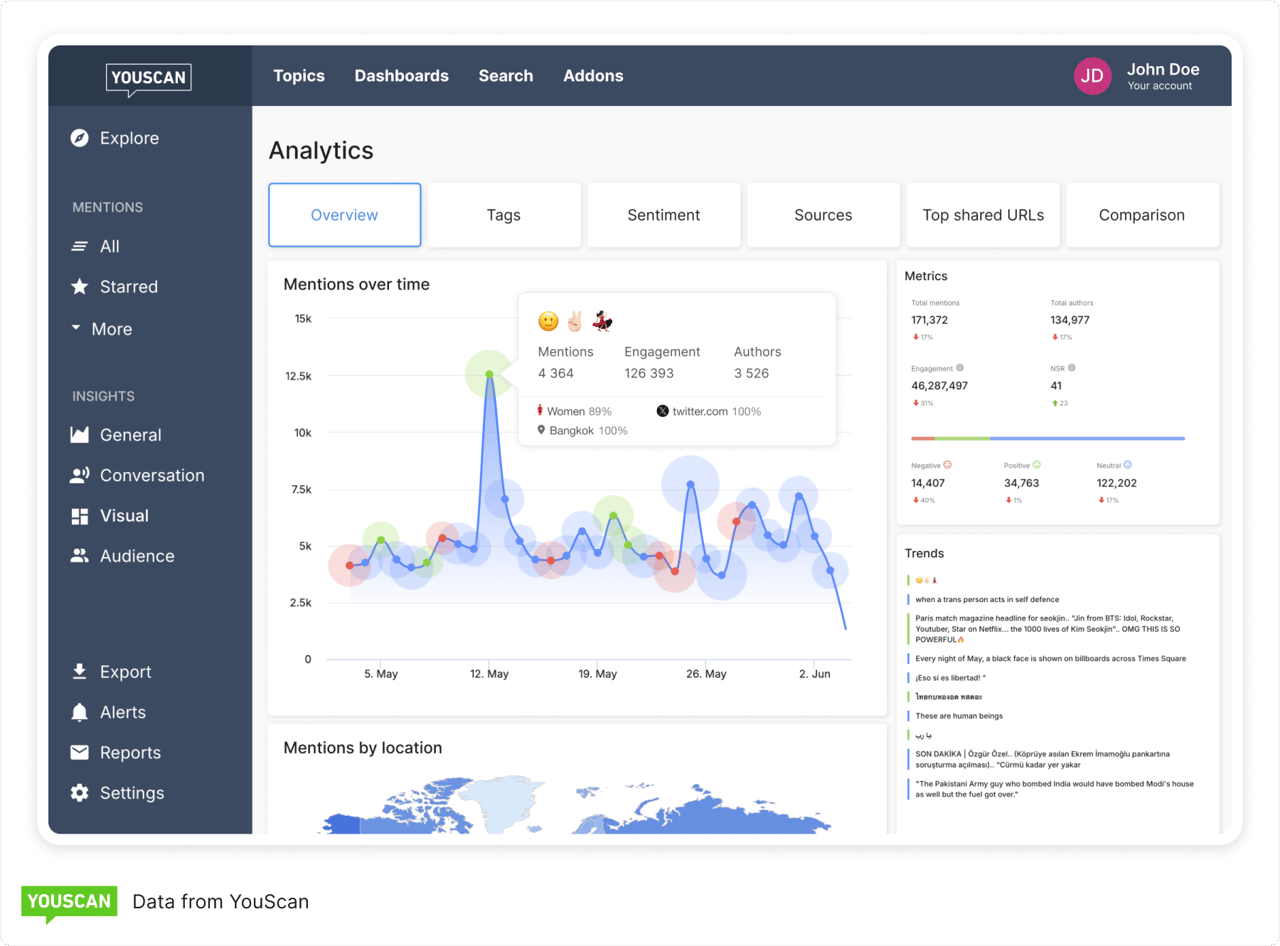
Social media platforms generate an enormous, constant stream of data: text posts, comments, images, video, reactions. A social media research tool pulls that firehose into something usable — sentiment scores, volume trends, audience breakdowns — so a human being can actually make sense of it. If you're starting from zero, it's worth understanding what social media listening covers before you start comparing vendors.
Social media research vs. traditional market research
Let's be fair to the old guard. Traditional market research — surveys, interviews, focus groups — still does things social can't: controlled conditions, a sample you designed on purpose, and answers to questions nobody posts about spontaneously (pricing sensitivity rarely shows up in a tweet).
But traditional methods are slow. By the time a survey is fielded, analyzed, and reported on, the market has often moved. And they're expensive — recruiting focus groups and processing structured data isn't cheap, especially if you need to repeat it often.
Social media research doesn't replace focus groups or surveys. It runs alongside them, catching what social platforms surface and surveys don't: the emerging complaint before it becomes a support ticket avalanche, the meme your product accidentally became part of, the competitor stumble everyone's already talking about. Used together, traditional market research and social listening give you both depth and speed.
The types of insights social media research actually delivers
Once you get past "you can see what people are saying," the real question is what kinds of decisions that data can inform. Here's where it gets useful.
A real read on your category
Social conversations reveal how people actually talk about your category — not the language your brand deck uses, but the words, complaints, and comparisons real customers reach for. That gap between your positioning and their vocabulary is often where the best marketing messages come from. This is the raw material behind most genuinely useful consumer insights.
Who's actually driving the conversation
Social media profiling lets you identify the accounts and creators shaping opinion in your niche — not just follower count, but who people actually listen to. A brand advocate with 4,000 engaged followers can matter more than a celebrity with four million disengaged ones — and you gain valuable insights from the former that the latter will never give you. Spotting that difference is one of the more underrated uses of social media analytics, and it's exactly what audience insights are built for.
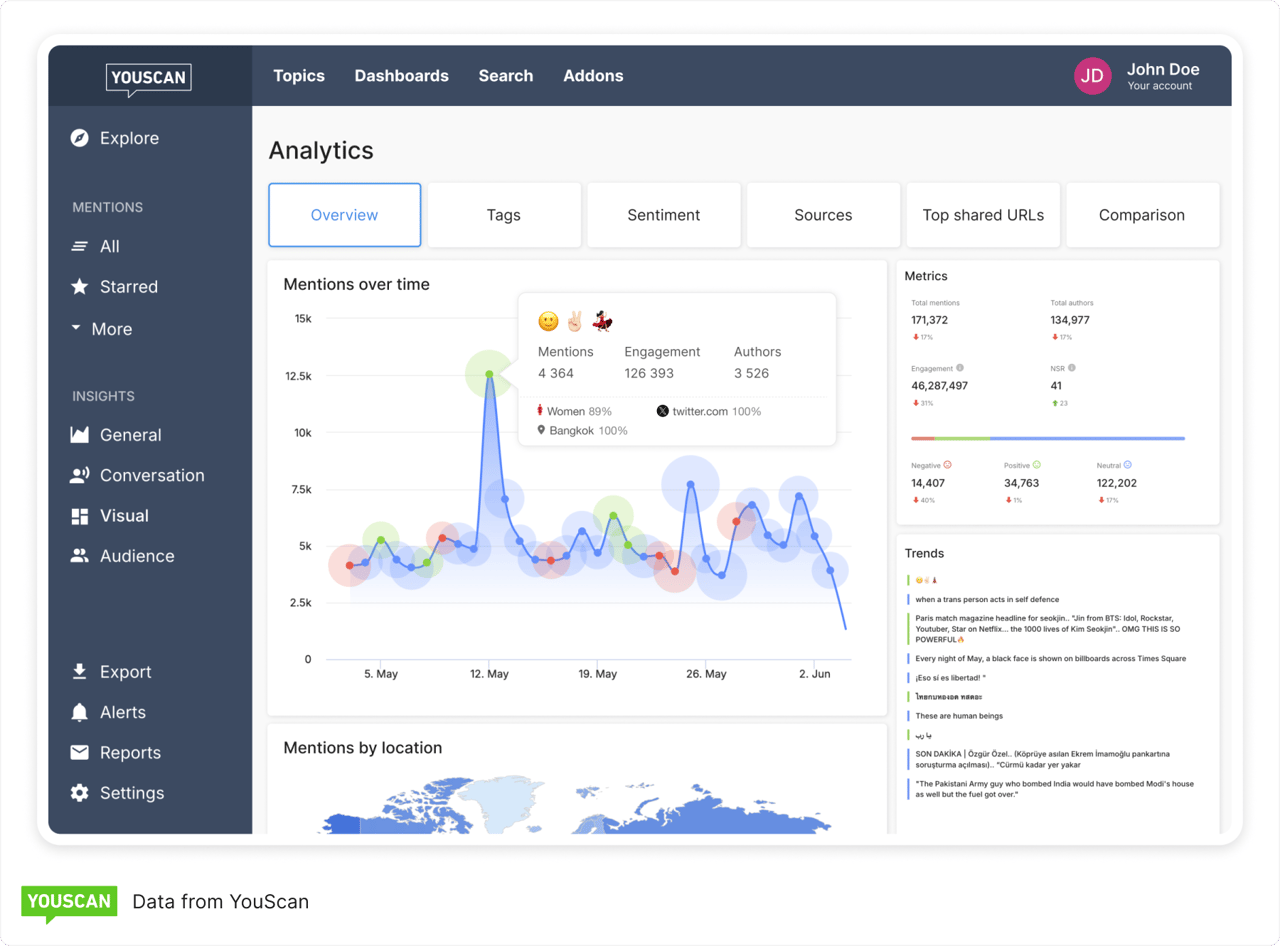
Whether your campaigns actually landed
Reach numbers tell you who saw an ad. Social media data tells you what they thought of it. Comparing mention volume, sentiment, and user-generated content before and after a campaign is a far more honest measure of whether it worked than impressions ever will be.
What your customers really think, unprompted
Reviews and social posts surface both praise and complaints your support team may never hear directly, because most unhappy customers vent on X or in a Facebook group before they ever open a ticket. AI-assisted sentiment analysis can classify that volume of chatter as positive, negative, or neutral far faster than a person reading every post one at a time — and if you're weighing options, this rundown of sentiment analysis tools covers what separates accurate ones from the rest.
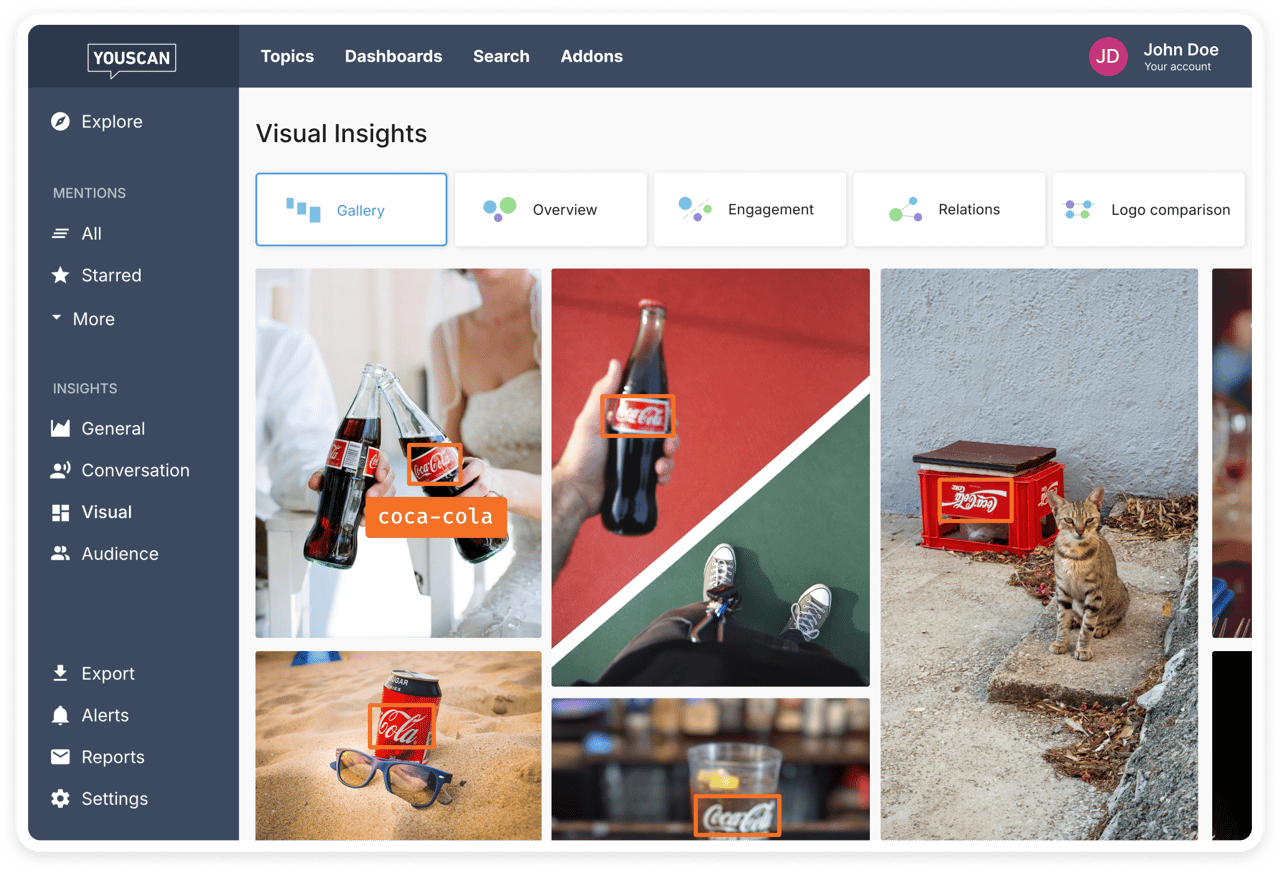
Modern tools go a step further, scanning images and video for logos and products your customers mention without ever typing your brand name. That's visual listening, and it's the single biggest blind spot in most text-only setups.
The one-off questions nobody planned for
Sometimes you just need an answer fast — how a competitor's price hike is landing, whether a feature request is a fluke or a trend. Ad hoc social media market research covers exactly this: narrow, fast, and often more useful than a three-month study.
The key benefits of social media market research
Beyond the insight types above, here's the broader case for why social media market research earns a permanent seat in your marketing strategies.
It sharpens your target audience. Social conversations reveal audience demographics, audience preferences, consumer preferences, and the actual language your target audience uses — not the language you assumed they'd use when you wrote the brief. Picking from the available audience analysis tools is usually the fastest way to turn that into something structured.
It protects brand perception in real time. Reputation management used to mean waiting for a press mention or a review roundup. Now, public opinion about your brand forms and shifts on social media daily, and continuous brand health tracking works best when you catch a shift in brand perception before it hardens into a narrative.
It feeds your content strategy. Most consumers now expect brands to keep up with online culture, and trending topics, engagement metrics, and social insights from actual conversations tell you which content creation ideas will land, instead of guessing. A content strategy built on trending topics you verified beats one built on a hunch. If a topic is already generating engagement patterns among your audience, that's a far safer bet for your next campaign than a topic your team simply likes.
It supports better, faster decisions. Data-driven decisions require data. Social media data — layered with sentiment analysis, audience segments, and social network analysis — gives your team informed decisions to work from instead of hunches, especially when market shifts happen faster than your next scheduled research cycle.
It builds brand loyalty over time. Brands that visibly respond to what they hear on social media, rather than just broadcasting marketing messages, tend to earn more brand loyalty. People notice when a company is actually listening to online communities instead of just posting into them.
How to conduct social media market research, step by step
Knowing the value isn't the hard part. Doing it well is. Here's a practical sequence.
Start with a specific question. "What do people think of us" is too broad to act on. "Why did sentiment around our new pricing tier drop last month" is something you can investigate.
Set up listening around the right keywords. Track your brand name, common misspellings, competitor names, and category terms — not just direct mentions. A lot of the most useful social media conversations never tag the brand at all.
Separate quantitative data from qualitative data. Volume, reach, and engagement metrics tell you scale. Sentiment, tone, and what people actually say tell you why. You need both, and treating them the same is a common mistake.
Segment your audience. Not everyone talking about your category is the same customer. Audience segmentation by demographics, interests, or behavior turns a pile of mentions into distinct groups you can actually target with different messaging.
Watch for emerging trends before they peak. Emerging trends are easiest to catch early, and trend analysis works best when you're tracking direction, not just volume — a small but fast-growing conversation often matters more than a large, flat one. A dedicated trend analysis tool will surface the ones you'd otherwise only notice after a competitor did.
Benchmark against competitors. Your numbers mean very little in isolation. Competitive benchmarking puts your share of voice and sentiment next to the people you're actually losing deals to.
Turn it into something your team can act on. A dashboard nobody opens isn't insight, it's decoration. Build reporting around the decisions your marketing, product, and comms teams are actually making — actionable insights they can use to adjust marketing strategies this week, not next quarter.
Where the conversations actually live
Not every platform deserves equal attention; the right mix depends on your category.
Reddit is where people say what they actually think, especially in considered-purchase categories — Reddit social listening surfaces buying intent earlier than most places. Video is harder, since the signal is spoken or shown rather than typed;
YouTube social listening only works if your tool handles audio and on-screen content. And for food, fashion, beauty, or home, images carry more than captions — which is what makes consumer insights on Pinterest worth a look.
There's also a genuinely new one worth knowing about. Bots on AI-only networks now discuss brands among themselves, and those conversations get screenshotted onto human platforms. Moltbook monitoring exists because of exactly that risk — YouScan's own breakdown of the Moltbook conversation is a decent primer on why it matters.
Choosing a social media analytics platform
Not every social listening tool does all of this equally well. Some are built for scheduling and light monitoring; others for social media market research at scale, with real audience segmentation, sentiment accuracy, and visual recognition. At the shortlist stage, this comparison of social listening tools and the guide on how to choose the right social listening tool beat any vendor's feature page.
That last capability matters more than most brands assume. A huge share of product mentions on social media are visual — a photo, a screenshot, a video — with no branded keyword anywhere in the caption. Text-only tools miss all of it. YouScan's
visual insights exist for this reason, catching up to 80% more brand mentions through logo detection than text alone would.
Worth noting: lightweight social media monitoring tools are fine if all you need is a mention count. The moment you care about why sentiment moved, you've outgrown them. The social listening dashboards library is a good way to see what real output looks like before committing to anything.
The metrics and tools worth paying attention to
The key metrics that matter once you're set up: engagement metrics, sentiment split, share of voice against competitors, and volume trends. Beyond raw counts, look for relevant patterns — a spike that correlates with a launch tells you more than one with no obvious cause. A structured brand health tracker keeps these in one place instead of five reports.
Most analytics platform options can hand you these numbers. Fewer help you identify trends before they peak, or extract meaningful insights from a wall of customer data the same day. Analyzing social media data at volume is where cheap tools quietly fall over. And reviews, unboxing videos, and product photos are often more revealing than branded hashtags — it's where feature requests show up before support logs them, and where real-time data about a launch surfaces first.
A quick, realistic example
Sometimes the clearest way to show the value of social data is a scenario. Say a mid-size skincare brand wants to conduct market research on a new serum before a relaunch, and needs a deeper understanding of customer behavior than its last survey gave it. Instead of only commissioning surveys, the team sets up listening across the social media platforms and social platforms their audience actually uses — TikTok, Instagram, a couple of niche forums.
Within two weeks, they have enough social data to see three things: competitive intelligence on how a rival's product is landing, an emerging trend around an ingredient nobody flagged in the brief, and brand mentions tied to a packaging complaint that never reached support.
None of that came from a survey. The team didn't gather insights by commissioning anything — they watched social channels people already use, ran sentiment analysis on the mentions, and used a few simple analysis tools to separate signal from noise. Three weeks, no recruitment fee, genuinely valuable insights. That's the unglamorous value here — not one dramatic insight, but a steady stream of smaller, actionable insights you can react to before a competitor does.
You don't need a huge program for this. Even a lightweight setup, checked weekly, can uncover insights you'd otherwise only get by deciding to create surveys and waiting a month. Tailor messaging to what you're actually hearing, and the gain from even a modest, effective research habit compounds fast.
Common mistakes that quietly ruin good research
A few things trip up teams that are otherwise doing this right.
Treating every mention as equally important is one. A bot account and a genuine brand advocate should not carry the same weight in your analysis, but plenty of dashboards count them identically unless you filter for it.
Ignoring data privacy is another. Public posts are public, but how you store, tag, and act on that data still matters across regions with different rules. Build data privacy in from day one rather than retrofitting it.
And treating social as the whole picture, rather than one input among several, is probably the most common mistake of all. Social media users skew younger and more vocal than your average customer. Pairing social insights with traditional market research and your own first-party data gives you a far more balanced view than social data alone ever will.
Conduct social media research with YouScan
Seeing this in real data beats reading about it. You'll gain insights faster from one session on your own category than from another explainer. YouScan analyzes text, images, and audience data across social media platforms, forums, review sites, and news — sentiment analysis, audience segmentation, and logo detection in one place instead of four tools.
Wrapping up
Social media research won't replace the rest of your market research toolkit, and it shouldn't try to. What it does is fill the gap traditional methods leave — the real-time, unprompted, occasionally messy signal of what your target audience actually thinks right now. Combine it with the structured depth of traditional research, respect data privacy along the way, pick a social media tool that captures both text and visual mentions, and you've got a genuinely complete picture of your market. The brands that gain deeper insights aren't the ones with the biggest social media budgets — they're the ones who keep looking for more insights after the first report lands.
Whether you're running full marketing campaigns off the back of it or quietly analyzing data between bigger projects, the goal is the same: not more data, just more valuable insights, gathered faster and acted on sooner. Deeper insights and better audience behavior data are there for any brand willing to go looking — you don't need a massive budget, just a habit of paying attention.
Book a demo for a walkthrough on your own brand and category, plus a straight answer on whether it fits what you're trying to do.
FAQs
Is social media research a replacement for traditional market research?
No. It's a complement. Traditional methods still offer controlled conditions and answers to questions people won't post about spontaneously. Social media research adds speed and an unfiltered, real-time layer on top.
What's the difference between social listening and social media monitoring?
Monitoring tracks direct mentions and basic metrics. Listening goes further, analyzing sentiment, trends, and context across a broader set of conversations — including ones that never tag your brand directly.
How much data do you need before insights become reliable?
It depends on your category's conversation volume, but a good rule of thumb is enough mentions to see a pattern hold across at least a few weeks, not just a single viral spike.
Can small brands use social media market research, or is it only for big companies with big budgets?
Smaller brands can use it too — the entry point is lower than most traditional research methods, since you're not paying for recruitment or a research facility. The main investment is picking the right listening tool and being disciplined about what you track.