Visual Listening: What It Is and Why Brands Need It


Here's a thought experiment. Right now, a student is posting pictures from their morning setup — laptop open, your product sitting right there on the desk, phone camera catching it all. Someone else is uploading videos from a music festival where your logo appears on a t-shirt in the crowd. A group of friends shared dinner images with your bottle clearly in frame. A student photographer posted a portfolio shot where your product happened to be in the frame. Nobody typed your brand name in any caption. None of them used a hashtag. Those posts are out there, getting engagement, being watched by their networks — and your monitoring setup never sees any of it.
That's not a hypothetical. Study shows that 85% of visuals containing a brand's logo include no written mention of the brand at all. If your social media listening is still keyword-based, you're working with four-fifths of the picture absent from your data.
Visual listening is what fills that gap.
What is visual listening?
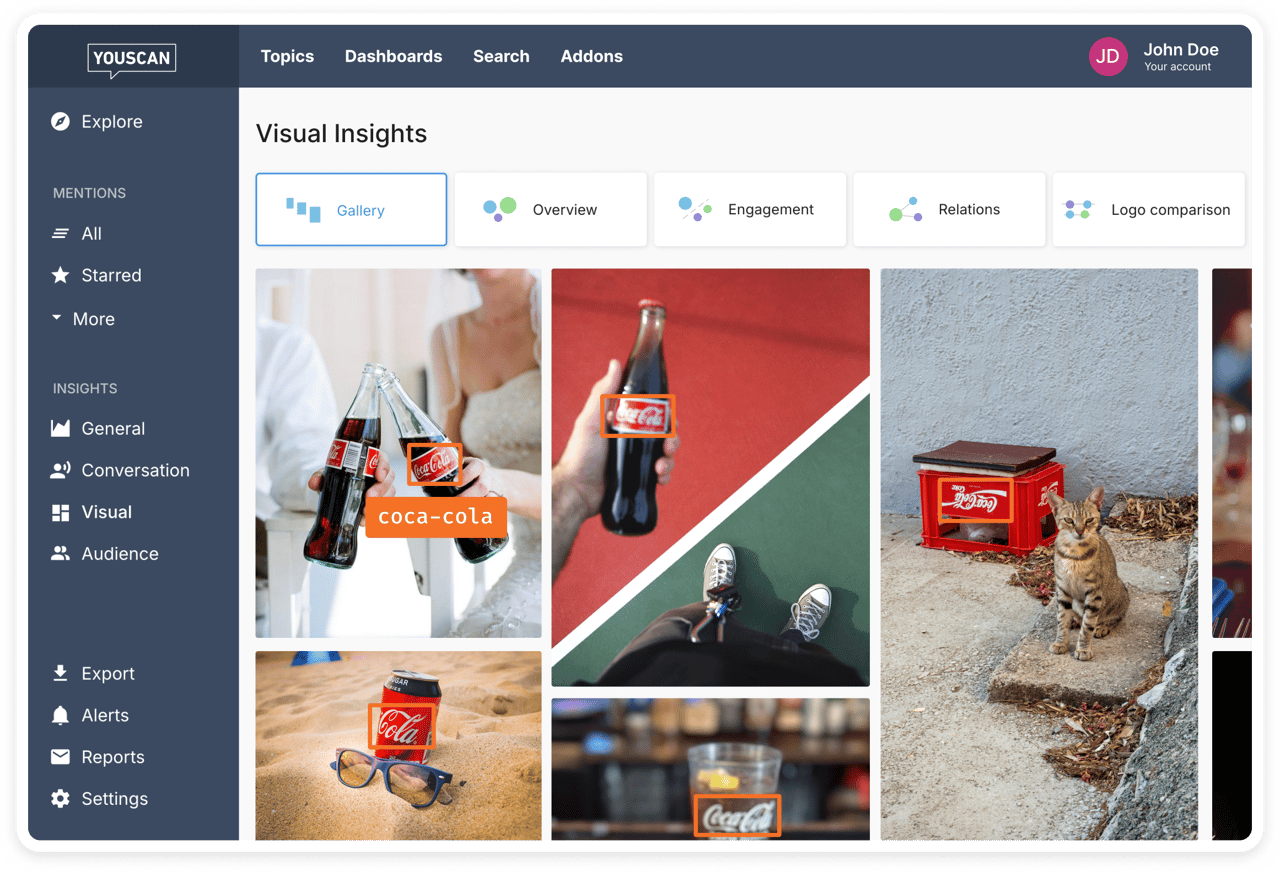
Short answer: it's social listening vs. social monitoring — but for visuals. Instead of catching a post when a caption matches a keyword, visual listening catches a post when a logo is detected in an image. Same underlying goal. Very different data.
Here's what makes this important: captions and visuals don't carry the same information. Text tells you what people say. The images and visuals customers post show you what they actually do. Those can be completely different things. Students and young professionals who'd never write a written mention of your brand might post visuals of your product at music events, in their kitchen, at late-night venues — logo clearly visible, zero written context — dozens of times a year. You hear about your brand in the words people write. You see it in the visuals they share.
Most social listening tools were built to read keyword captions. They're good at what they do. They just weren't designed to read visuals, which is increasingly where the most authentic brand moments live. YouScan's social listening glossary covers the relevant listening terminology if you want a clear reference before diving in.
What your listening strategy is missing
DOMO's Data Never Sleeps report puts Instagram alone at roughly 66,000 visuals posted every minute. Scale that across TikTok, Facebook, Reddit, Pinterest, and X, and you're in billions of daily posts — a meaningful share of which contain brand logos, incidentally, in pictures and clips that have nothing to do with your brand in the caption.
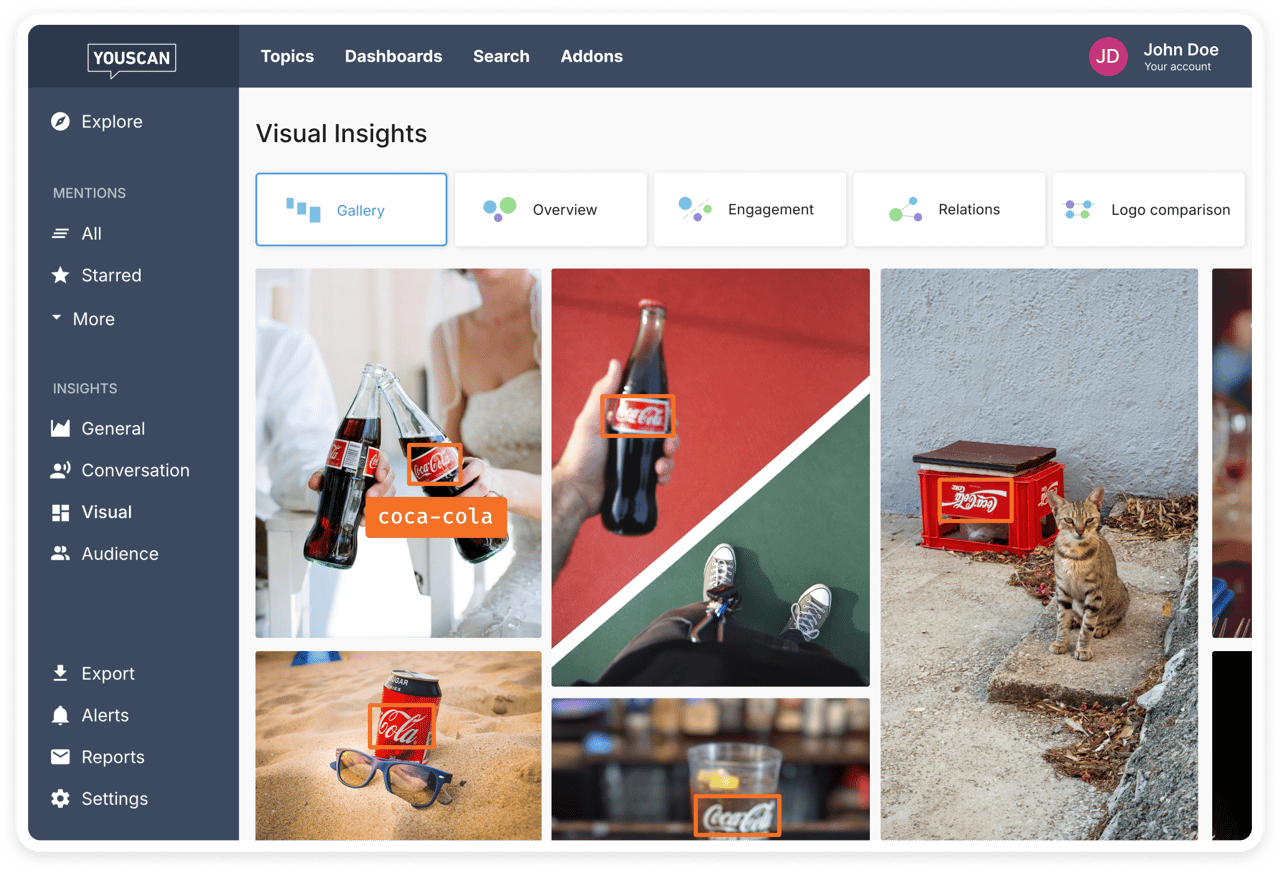
AI social listening has pushed NLP further than most brands fully use. But even the most sophisticated language processing hits the same wall: it doesn't see visuals. YouScan's Visual Insights is built specifically for the visual layer — logo detection, scene recognition, activity identification — and surfaces up to 80% more brand mentions than keyword listening alone. For many brands, the visuals are the bigger dataset. A listening strategy that ignores them is leaving most of the behavioral picture on the table.
What visual listening actually reveals
More mentions isn't the main point. The point is different mentions — visuals that carry behavioral context that text could never provide.
How people actually use your product
Oreo earns its place as the most cited example in visual listening discussions. Monitoring the visuals created by fans surfaces consistent patterns: people using the cookies in baking, decorating cakes, building cheesecake bases, in dessert recipes where the cream and cookie play separate roles. Very few of those posts include any brand mention in the caption. Nobody's writing about their mug cake ingredients; they're just posting visuals of the finished result.
This consumption behavior is nearly impossible to discover any other way. Focus groups produce answers shaped by what people think they should say. Surveys have the same problem. Their user-generated content — the visuals created without direction from the brand — shows what they actually do. The gap between what consumers say and what the visuals reveal is frequently where the most interesting marketing opportunities are sitting, waiting to be found.
Starbucks saw a version of this when baristas started posting visuals of personal drink combinations on TikTok — recipes the brand hadn't created or promoted. Discovered by watching the content their audience was sharing. Ways UGC can improve your marketing performance gets into the playbook, but none of those strategies work without first being able to read the visuals your audience is creating.
Brand logos in images and what they tell you
The settings where your brand logos appear in visuals are their own kind of intelligence. Are they showing up in pictures from music festivals, student events, late-night venues? Do the visuals show your brand in domestic settings, professional contexts, outdoor activities? What other brand logos appear in the same visuals? What do the images tell you, in aggregate, about the lifestyle associations your brand has built — and does that match your positioning?
These visual maps feed directly into brand analysis in ways surveys can't replicate. The details in those visuals — the scenes, the consumption situations, the lifestyle signals — tell you who's actually engaging with your brand versus who your media budget targets. Brands that examine this gap internally often develop a better understanding of their actual audience versus their assumed one — and that understanding is more valuable than most survey data. It's the kind of insight you simply can't discover by listening only to written content.
Brand health tracker programs that only measure written sentiment miss this entirely. You can have strong positive text mentions while your logos are accumulating visual associations that directly contradict your positioning. No keyword alert catches that. Consistent monitoring of visuals does. And for brands where the visual language matters most — fashion, sportswear, beverages, music-adjacent categories — this is arguably the most important listening task available.
There's a competitive angle here too. Visual listening tracks competitors' logos alongside your own. If a competing brand appears in visuals speaking to audiences you're trying to reach, in lifestyle contexts where you're not showing up — that's strategic intelligence. Your ears pick up the written brand conversations. Your eyes on the visual data catch everything else.
Campaign ideas hiding in plain sight
McDonald's logo appears on non-licensed fan-created merchandise constantly — clothing, accessories, custom print items — because individuals created it themselves, without any prompt. Tracking those UGC content examples doesn't just tell you what merchandise to produce. It tells you what the brand means culturally to the people creating and sharing it — something no research session reliably surfaces.
The Korean iced coffee trend — McDonald's coffee combined with a vanilla ice cream cone — spread almost entirely through images and videos with no brand mention in the caption. Visual listening discovers that when it's emerging. By the time it shows up in keyword searches, the trend is weeks old. The visuals told the story first.
So why isn't everyone doing this?
Honestly, a few reasons.
Most listening programs were set up when visual monitoring wasn't a mainstream capability, and nobody's gone back to revisit the setup. There's a genuine resourcing reality: the resources required to add visual monitoring to an existing stack — new tools, adjusted workflows, training — aren't trivial. Adding visual monitoring strategies, and dedicating ongoing resources to reviewing the visuals, takes budget and organizational buy-in. And visual monitoring tends to get treated as a premium add-on — accessible to enterprise teams, not a standard task for everyone else.
That last framing is where brands go wrong. Students posting dorm room photos, fans wearing branded gear, anyone photographing your product in everyday life — they're all generating brand data that only visual listening captures. For any brand with recognizable logos, packaging, or products that appear in lifestyle contexts — which is most consumer brands brand monitoring without the visual layer isn't comprehensive. It's monitoring with most of the behavioral data absent. Simple as that.
How to build active listening for images into your strategy
The active listening framing matters here. Most teams that add visual monitoring engage with it passively — checking dashboards occasionally, noting the volume of visuals went up this week. That's not active listening. That's data sitting in a tab.
Active listening for visuals means asking real questions: what contexts are our logos appearing in? Do those visuals match our positioning? What product combinations keep surfacing in the visuals customers post? What do those images teach us about who's actually engaging with the brand? It means treating the visual stream as a genuine intelligence resource — something you learn from, not just collect.
This is where effective visual listening strategies separate from poor ones. Teams that use filters to isolate specific visual contexts, that engage seriously with what the visuals show in planning sessions, that bring visual data into audience strategy the same way they bring written mention trends — get significantly more value than teams that simply wait for something obvious to surface. There's real interest in this approach among brand teams that have seen how much the visuals reveal that text-only listening misses.
Choosing the right social listening tool matters more than most expect. Logo detection accuracy varies significantly across platforms. Ask vendors to demonstrate it on a real, untagged post during a demo. If they won't do that live, it's a telling signal.
Once the tool is sorted, the question is about bringing visual and written data together rather than managing separate streams. YouScan's social listening dashboards put both in one view — brand logos detected in visuals alongside written mentions, with filters for visual context, audio and sound in video posts (including background sound and music), and sentiment. Teams doing detailed evaluations will find the best image recognition software comparison useful before committing to a platform.
And if you want to see what brand mentions actually look like when you layer visual data on top of written analysis, there's a
free demo you can run on your actual brand. The difference tends to be more striking than people expect.


Frequently asked questions about visual listening
What's the difference between visual listening and social monitoring?
Social monitoring and written listening track text — brand mentions, hashtags, captions — and analyze sentiment across conversations. Visual listening extends that to the visuals and images being shared: detecting brand logos and products in visuals whether or not any text appears in the post. Neither replaces the other. Written content tells you what people say; visuals tell you what they do. Run only keyword-based approaches and you're working without most of your brand's actual social presence in view.
How does logo recognition actually work?
The AI is trained on large datasets of brand assets and learns to identify logos across different sizes, angles, lighting conditions, and levels of obstruction — including logos on clothing, merchandise, print packaging, or partially visible in a background. The best implementations also identify context: what the visuals show around the logo, what objects appear in the images, what activities are happening. Logo detection without context is useful for counting; with context, it's what you learn from.
Why do brand logos appear in so many visuals without any written text mention?
Because people are posting visuals of moments, not writing product reviews. Your logo is in the images because it was there — on the table, in the gym bag, in the background. A student posting their morning setup doesn't think to add a caption mentioning every brand in frame. Friends sharing festival visuals aren't narrating the logos they can see.
Which brands benefit most from visual listening?
Consumer brands with recognizable logos, distinctive print packaging, or products that appear in lifestyle contexts get the most out of it — food and beverage, sportswear, fashion, automotive, music-adjacent brands. But it applies broadly: if people interact with your product visually, you're leaving data on the table without it.