Top 12 Social Listening Tools to Consider in 2026


Picking the right social listening tool is one of those decisions that sounds simple until you actually sit down to do it. There are dozens of platforms, most of them good at something, a few of them genuinely great, and almost all of them designed to look identical on a comparison page. 39% of companies now spend over $100K a year on social listening — so the stakes are real, and so is the noise.
The category has also gotten more complex. Modern social media listening software doesn’t just track brand mentions anymore. Sentiment analysis, audience insights, image recognition, competitive benchmarking, crisis alerts, trending topics — the feature lists are long, and the marketing copy is relentlessly similar. If you’re new to all of this, the social listening glossary is a decent starting point before you get into vendor comparisons.
Quick note on free tools: Google Alerts can get you started tracking online conversations at no cost, but the moment you care about sentiment, volume trends, or any meaningful data collection beyond “someone mentioned your brand name,” you’ve outgrown it. For a fuller picture of what the category covers, the social listening 101 guide for marketers is worth a read. This list focuses on the top social listening tools for digital marketing teams that need to keep up with the latest social media trends and run an actual social listening strategy.
Ten tools. Honest takes. Here’s how they stack up.
Best social listening tools for 2026: compared
1. YouScan
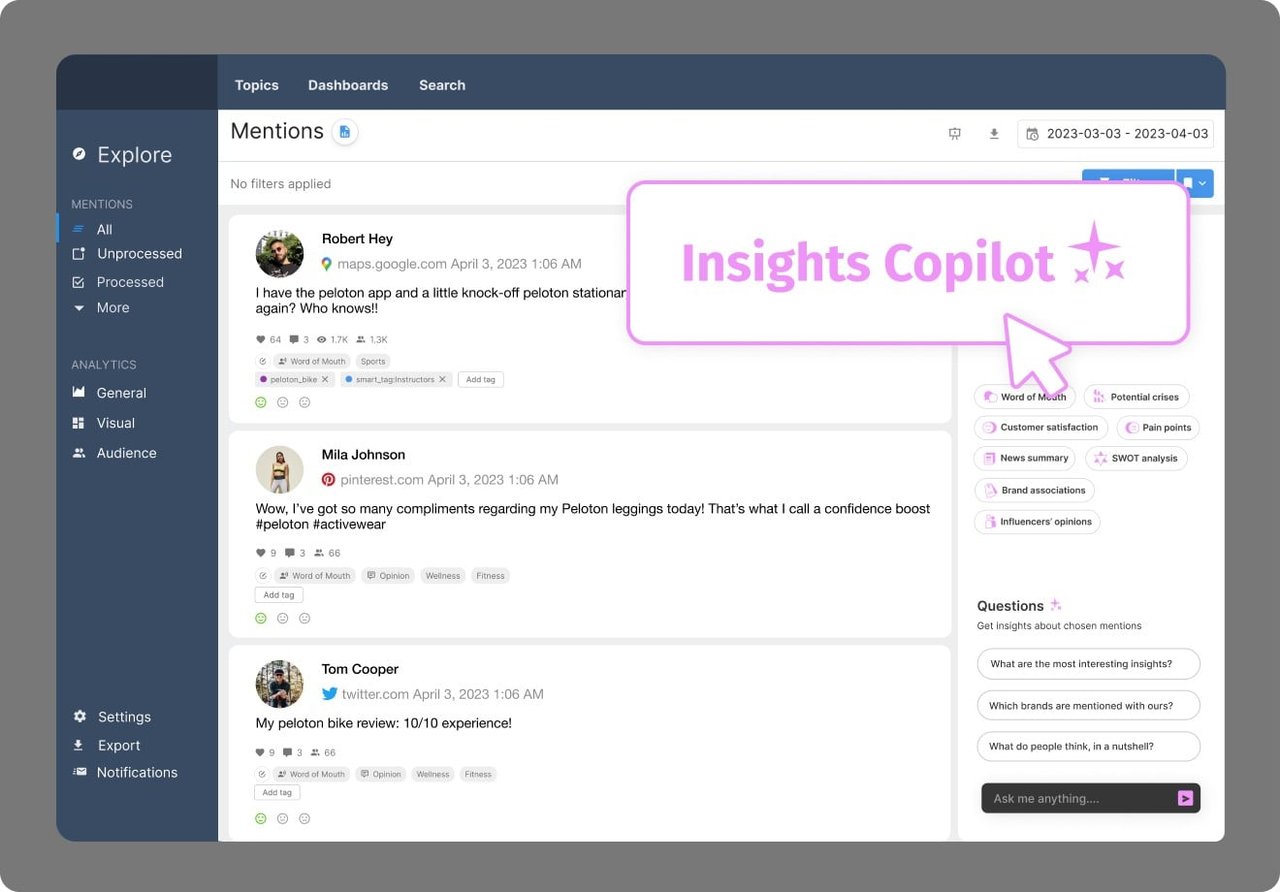
YouScan is the tool on this list that’s hardest to compare to anything else, because its core differentiator — visual analytics — is genuinely in a different category from what most social media monitoring tools offer. Where other platforms analyze text, YouScan analyzes images. It detects brand logos, real-life product usage, objects, scenes, activities — stuff that never shows up in a caption.
That matters more than it sounds. A significant chunk of the most valuable social conversations happening around any brand are visual — someone photographing your product at a concert, a logo in the background of a TikTok, a competitor’s packaging showing up in a haul video. Text-only tools miss all of it. YouScan’s AI social listening engine catches it, turning raw data into real time insights and social media analytics you can actually act on.
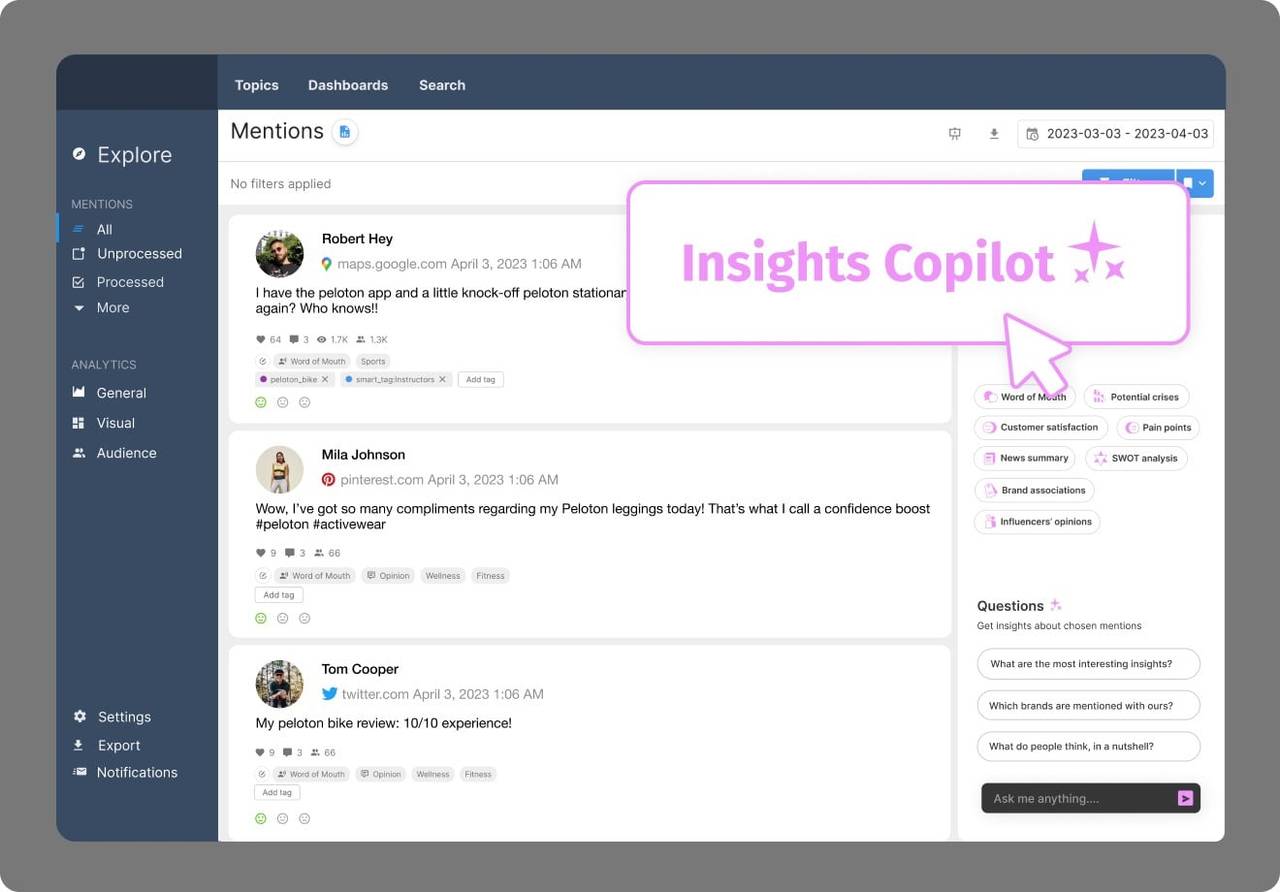
Beyond the visual layer, the platform does everything you’d expect: sentiment analysis, brand mention tracking, audience segmentation, trend detection. The AI is solid — it sorts and categorizes mentions automatically rather than dumping everything into a feed you have to manually clean up. The AI-powered Insights Copilot lets you ask questions about your data and get meaningful, actionable insights back in plain language, which is useful when you need to brief stakeholders or adjust your social media strategy without waiting on a custom report.
Worth calling out: YouScan recently added Moltbook monitoring as a supported source, which is a useful addition for brands. The social listening dashboards are also among the more flexible on the market — you can build views for different teams (brand performance for one, audience insights for another) without it getting messy. Sales teams especially seem to appreciate having their own filtered view rather than wading through a full listening feed.
What it’s good at
Image recognition: Detects logos, products, and visual brand interactions in user photos. This is the main reason people choose YouScan over tools with a similar feature set.
Insights Copilot: Conversational AI interface for querying your data — faster than building a custom report every time.
WOM filtering: Separates genuine user opinions from promotional content, which is a specific pain point most listening tools don’t address well.
Pricing
Starter plan at $499/month covers the essentials. Unlimited plans with full image recognition are custom-priced — request a demo.
Best for
Brands where visual brand monitoring matters — consumer goods, fashion, food and beverage, anything with a strong product or logo presence on social platforms. See why brands choose YouScan over others.
2. Dash Social
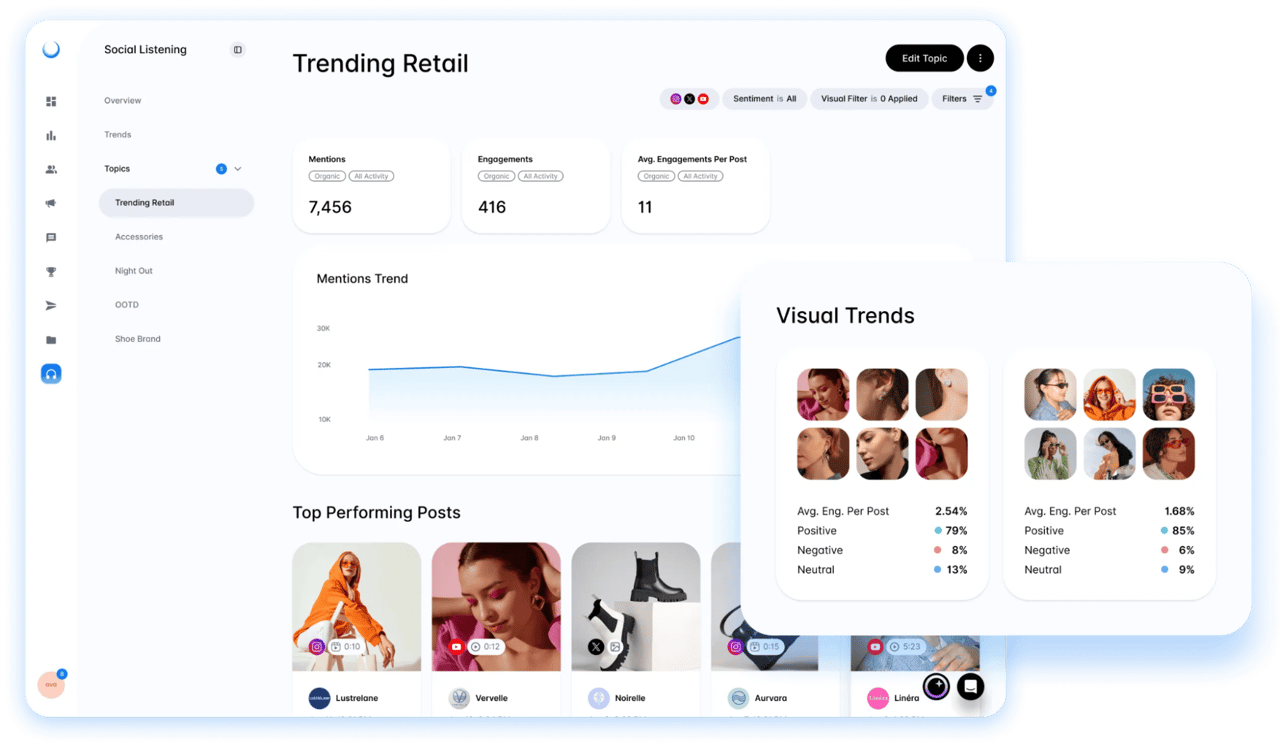
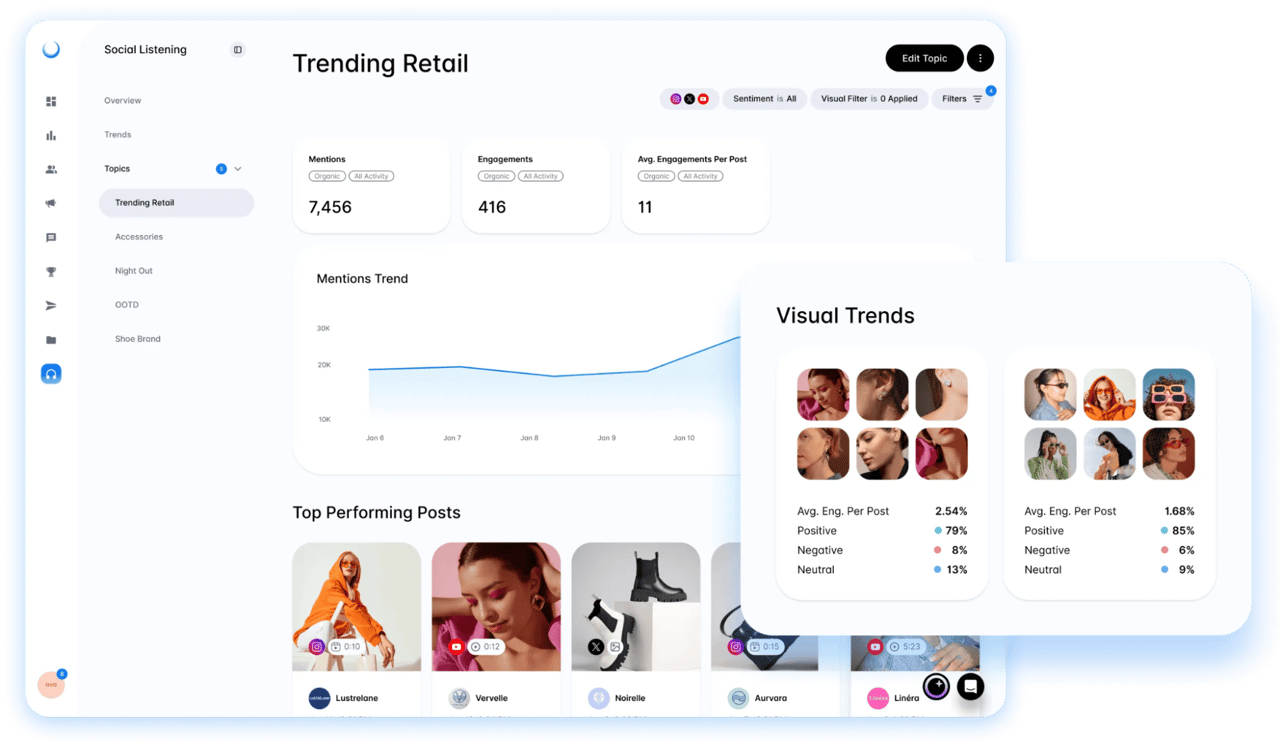
Dash Social is an AI-powered social media management platform that combines advanced social listening with analytics, publishing, creator management, and reporting in a single workspace. Unlike traditional listening tools that focus primarily on text, Dash Social uses its proprietary Vision AI technology to analyze both visual and text-based conversations across social media, helping brands understand how their products, campaigns, and competitors are being discussed and represented online.
Teams can monitor brand mentions, keywords, hashtags, sentiment, competitors, and emerging trends while uncovering actionable insights that inform content strategy, campaign planning, influencer partnerships, and executive reporting. By connecting social listening directly to performance data, Dash Social makes it easier to move from insight to action without switching between multiple tools.
One thing to keep in mind is that social listening is available only as an add-on and is not included in Dash Social’s pre-existing plans.
Pricing
Custom pricing. Social Listening is available as an add-on for Dash Social’s Advanced and Enterprise plans.
Best for
Mid-market and enterprise brands that want to combine social listening with competitive intelligence, AI-powered reporting, and social media management.
3. Brandwatch
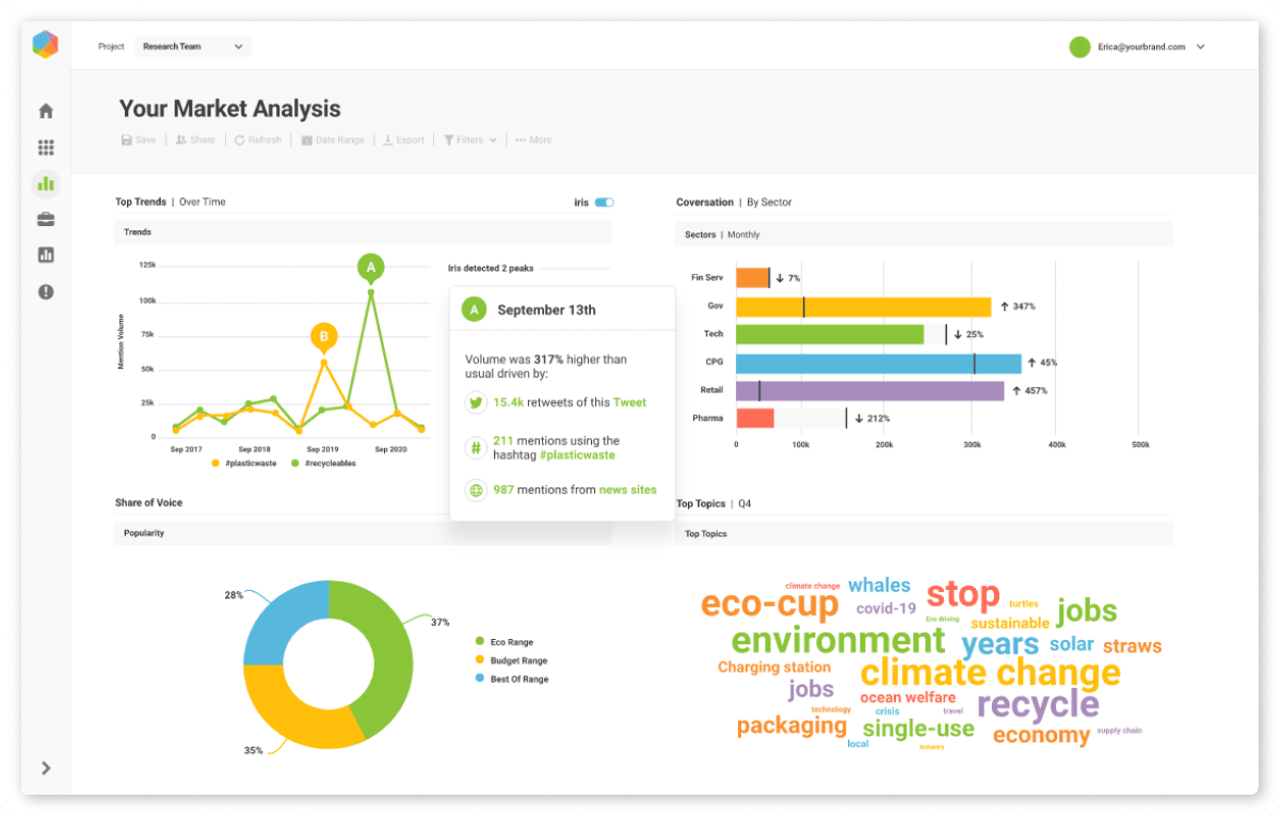
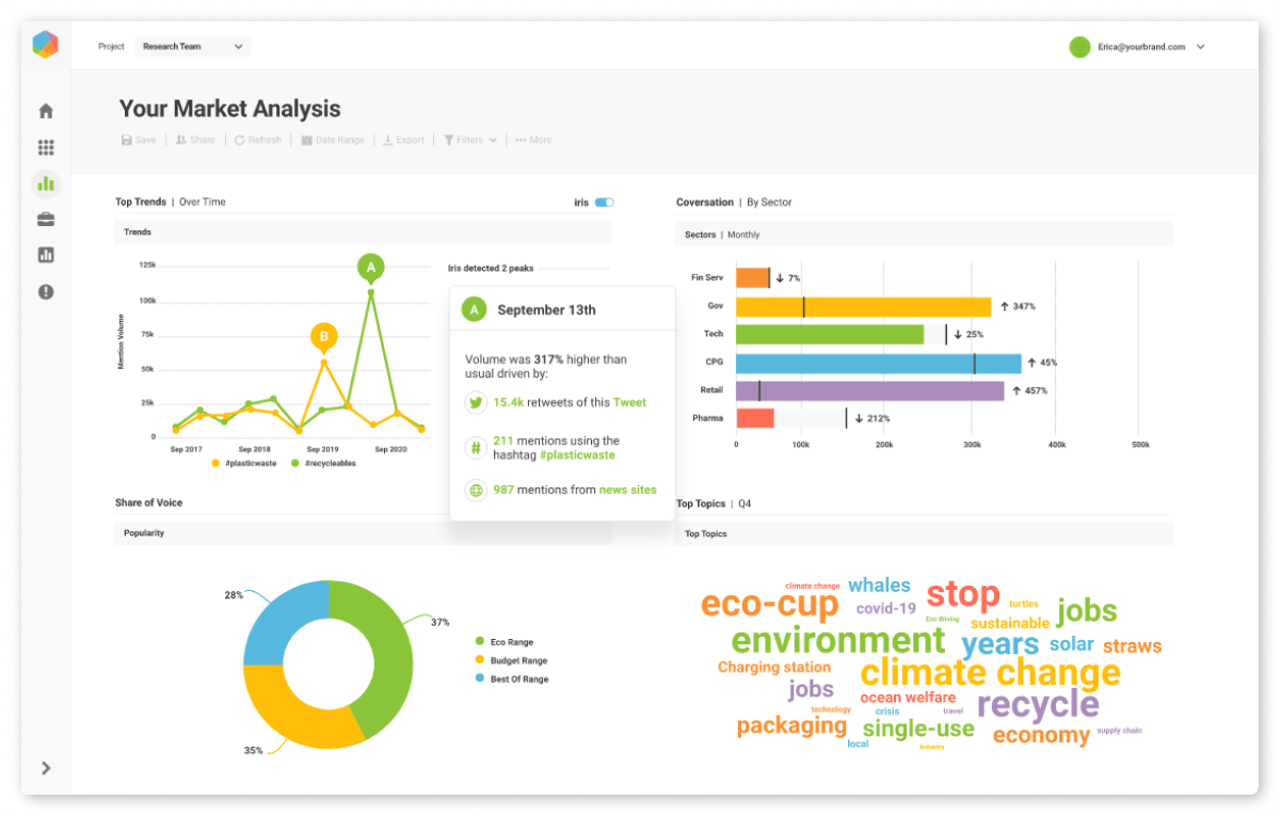
Brandwatch is the expensive option. That’s not a complaint — it’s just the reality. If you’re at an enterprise and budget isn’t the constraint, it’s one of the most capable social media listening tools available, with genuinely deep consumer intelligence, strong historical data access, and an influencer database that covers over 30 million creators for influencer marketing campaigns. It’s also one of the enterprise tools that takes tracking conversations at volume seriously — the data pipeline is built for scale in a way most mid-market platforms aren’t.
The AI is the main event here. It analyzes massive datasets automatically, surfaces the reasons behind trend spikes, and helps teams respond to shifts in brand sentiment analysis before they become PR problems. The social media management layer — publishing, engagement, content calendar — is also baked in, so it can replace multiple third party tools for teams that want everything in one place.
The caveats are real though. Pricing is opaque (you won’t find a number on the website), many of the most useful features are paid add-ons, and there’s a learning curve. Teams who haven’t used an enterprise listening platform before sometimes find it overwhelming at first. If you’re evaluating it, our Brandwatch alternatives breakdown covers what else is out there at a lower price point.
Pricing
Custom. Request a demo. Don’t expect a quick answer on cost.
Best for
Enterprises that need deep consumer insights, multi-channel social media management, and an influencer marketing layer — and have the budget to match.
4. Brand24
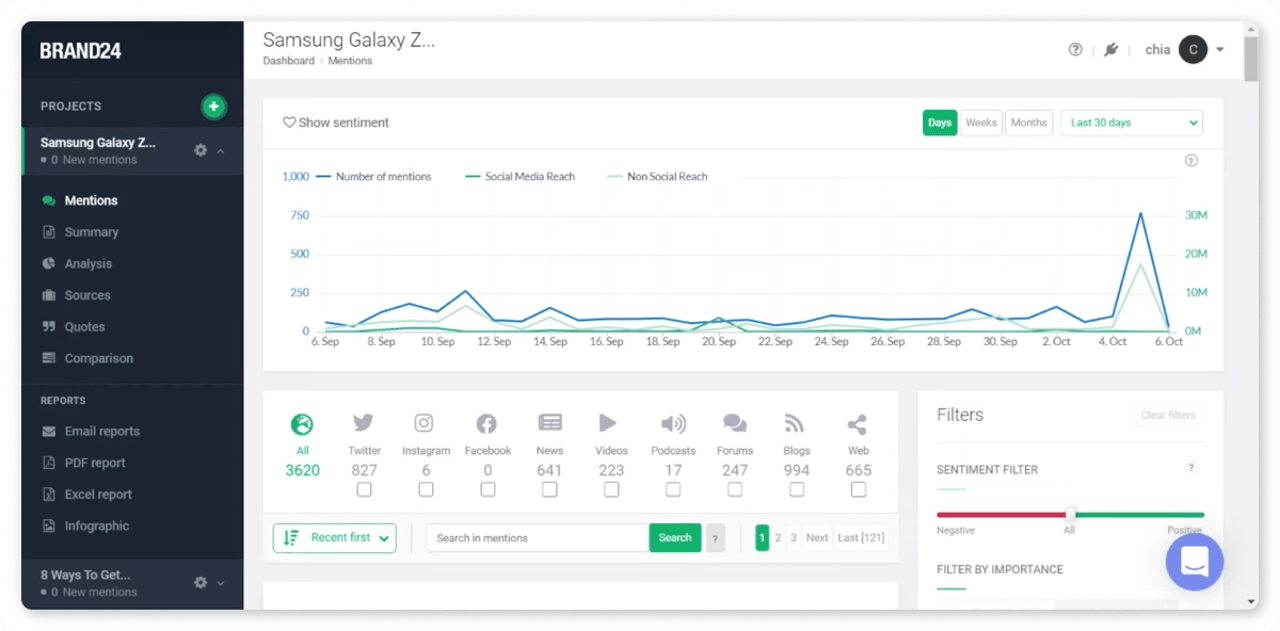
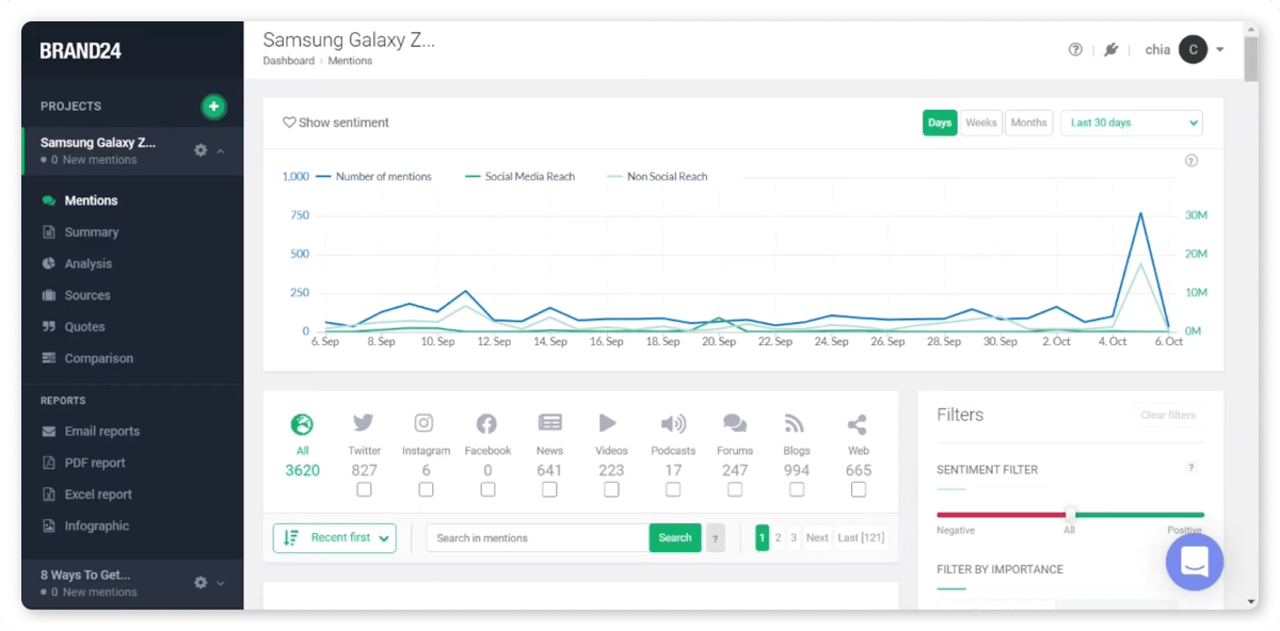
Brand24 is probably the most underrated tool on this list. It’s often written off as a “small business option,” which is underselling it. Yes, the entry price is lower than most ($119/month), and yes, it works for small teams. But the AI capabilities are legitimately good — anomaly detection that flags unusual spikes in brand mentions, an AI brand assistant that gives you tailored recommendations, and presence scoring that tells you how impactful a given source actually is.
For teams doing active brand monitoring and reputation management, the real-time alerts work well. You can track brand mentions across social media, news sites, blogs, forums, and review sites, jump into those conversations directly from the platform, and track sentiment as it shifts. The competition social listening features are solid too — you can set up side-by-side tracking of your brand vs. competitors and see who’s winning the conversation.
If there’s a limitation, it’s that it doesn’t do visual recognition. So if image-based social conversations are a meaningful part of what you need to track, you’ll hit a ceiling quickly.
Pricing
Individual: $119/month — 3 keywords, 2K mentions
Team: $299/month — 7 keywords, 10K mentions
Pro: $399/month — 12 keywords, 40K mentions
Enterprise: $1499/month — custom limits
Best for
Small to mid-sized businesses, agencies, and PR teams. Among the top social listening tools that actually work for non-enterprise budgets, it punches well above its price. Most social media listening tools at this tier don’t deliver the AI depth Brand24 does.
5. Konnect Insights


Konnect Insights is a unified customer experience management platform that brings social listening and customer engagement into a single workspace. Most teams monitor brand conversations in one tool and manage customer responses in another.
Konnect Insights removes that split. Social mentions, comments, reviews, and direct messages are captured across channels and connected directly to the workflows your support and CX teams already use. Nothing gets lost between listening and acting. The platform tracks brand mentions, sentiment trends, and audience conversations across social media, review sites, forums, and news.
AI-powered analytics surface what matters, so teams spend less time sorting through noise and more time making decisions. Custom dashboards give marketing, support, and leadership a shared view of what customers are saying and how the team is responding. Ticket routing, SLA tracking, and response management sit alongside listening data in the same platform.
A customer complaint picked up through social monitoring can be converted into a ticket, assigned to the right agent, and resolved without switching tools. Konnect Insights suits mid-to-large brands that need social listening connected to real customer engagement operations, not just reporting.
Best For
Brands looking to unify customer interactions and engagement in one platform.
Pricing
Starts from $39/user/month | $79/user/month | $119/user/month
6. Digimind
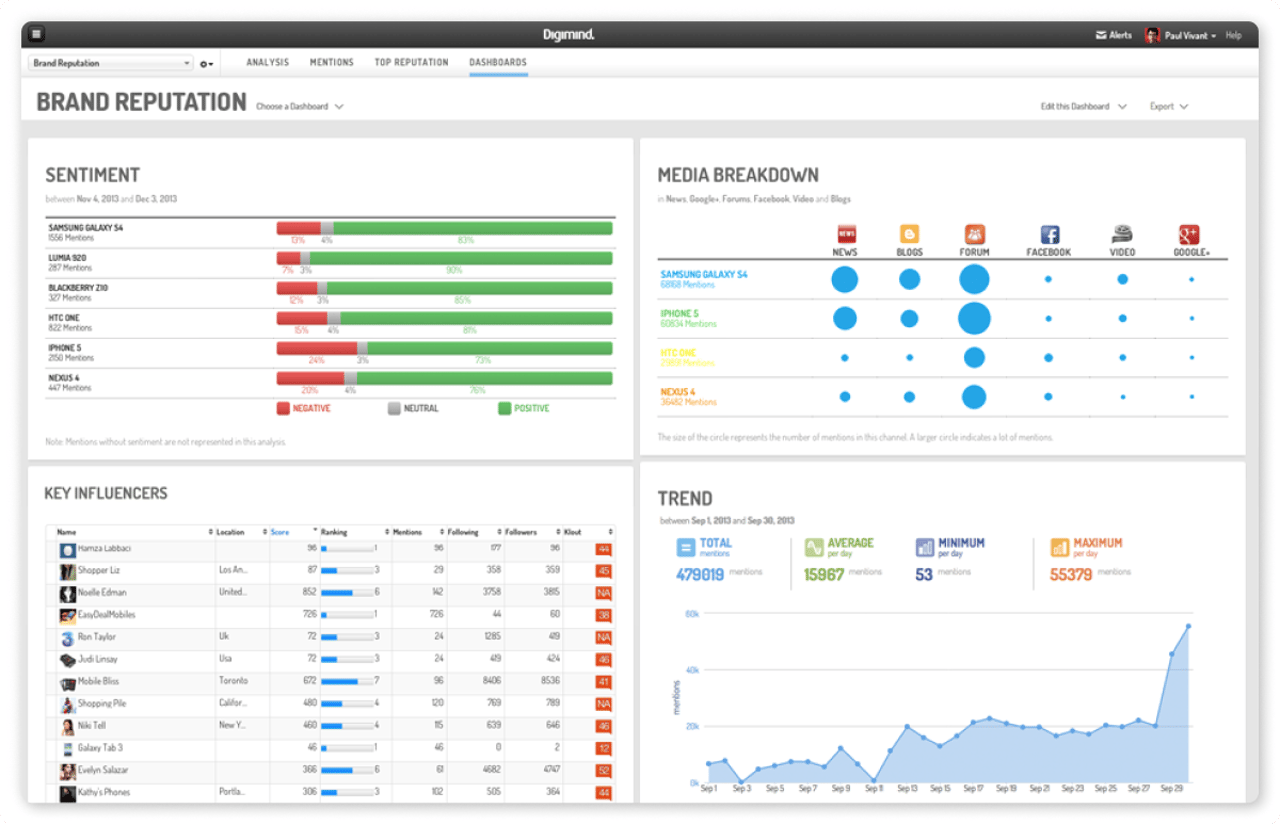
Digimind sits in an interesting middle position — it’s more powerful than a basic social media monitoring tool, but not trying to be the full-suite enterprise platform that Brandwatch or Talkwalker are. Its focus is social media intelligence: social listening across social media platforms, competitive benchmarking, and trend tracking, all feeding into actionable insights you can take straight to a client deck.
The reporting is where it stands out. Digimind’s reports are genuinely presentation-ready in a way that most tools’ exports aren’t — useful if you’re regularly briefing executives or clients who don’t want to stare at a dashboard. The brand reputation and crisis detection features are also solid, and it covers 10+ social media channels including some you won’t find on every platform.
Visual recognition is available but basic. If that’s a priority for you, it probably won’t be enough. If it’s not, Digimind is a well-built tool for its niche.
Pricing
Custom. Demo required.
Best for
Agencies and mid-to-large enterprises that need competitive intelligence, industry trends analysis, and brand reputation management baked into their marketing strategy. Especially strong for teams that track brand performance over time and regularly produce reports for stakeholders who don’t want raw dashboards.
7. Sprout Social
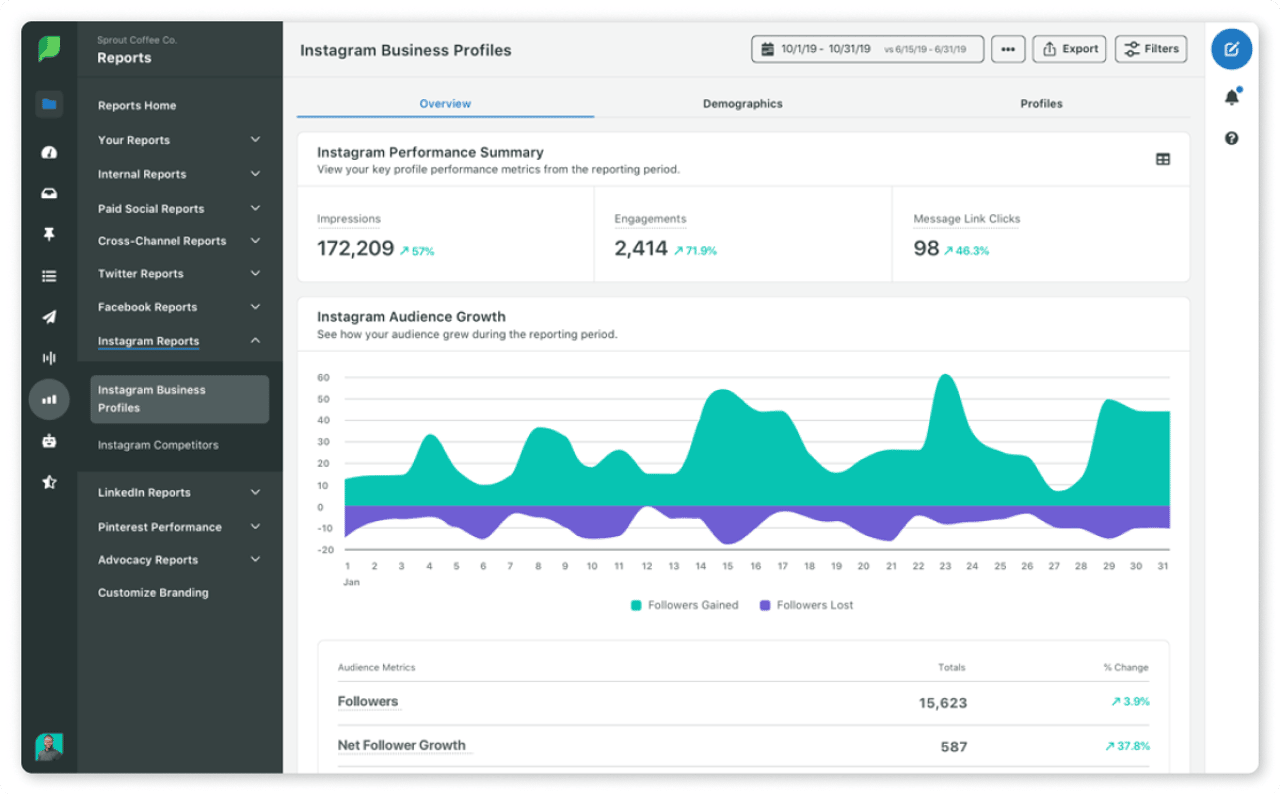
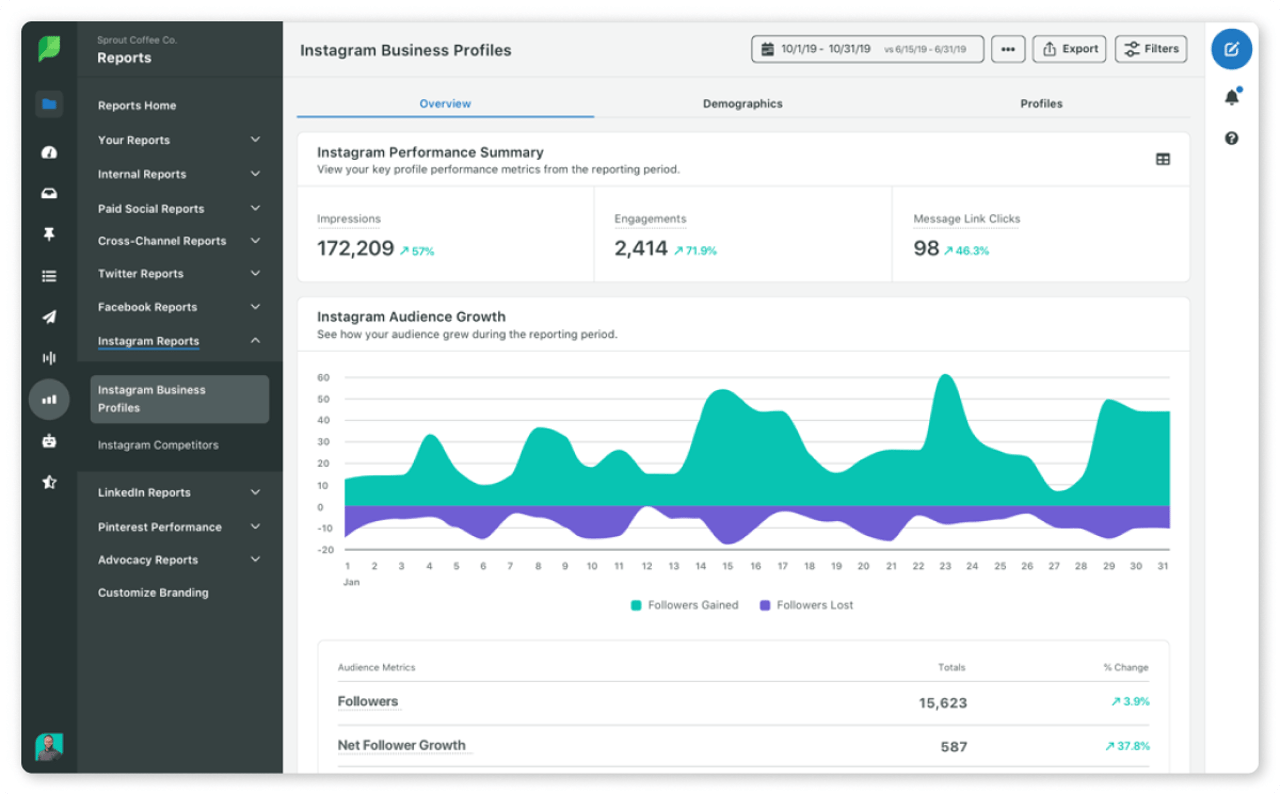
Sprout Social is a social media management platform that happens to have very good social listening built in — which is a different starting point than a dedicated listening tool. If your team needs to publish, schedule, engage, and listen all from one place, Sprout is probably the strongest all-rounder on this list. For a detailed comparison of how the listening features actually hold up, the Sprout Social vs Hootsuite breakdown is worth a look.
The social media analytics are thorough and the AI-driven sentiment analysis is solid. The unified inbox is genuinely useful for customer-facing teams — it classifies and prioritizes messages so you’re not drowning in noise. And the
analyzing customer feedback use case is something Sprout does particularly well: their reporting is designed to surface business growth signals, not just engagement metrics.
The trade-off is that it’s not a dedicated social listening tool. If deep consumer insights, visual monitoring, or competitive intelligence at scale are what you need, you’ll probably want something more specialized. But if your social media strategy and your social media analytics need to live in the same place — and your team is also managing direct audience response — Sprout handles that well. Pricing is on the higher side past the base plan, though the valuable insights on business growth in the reporting do justify it for the right team.
Pricing
Standard $199/month — Professional $299/month — Advanced $399/month — Enterprise: custom.
Best for
Marketing and social media teams that want publishing, engagement, and listening under one roof. Particularly strong when the team also manages a lot of direct customer interaction across social platforms.
8. Talkwalker
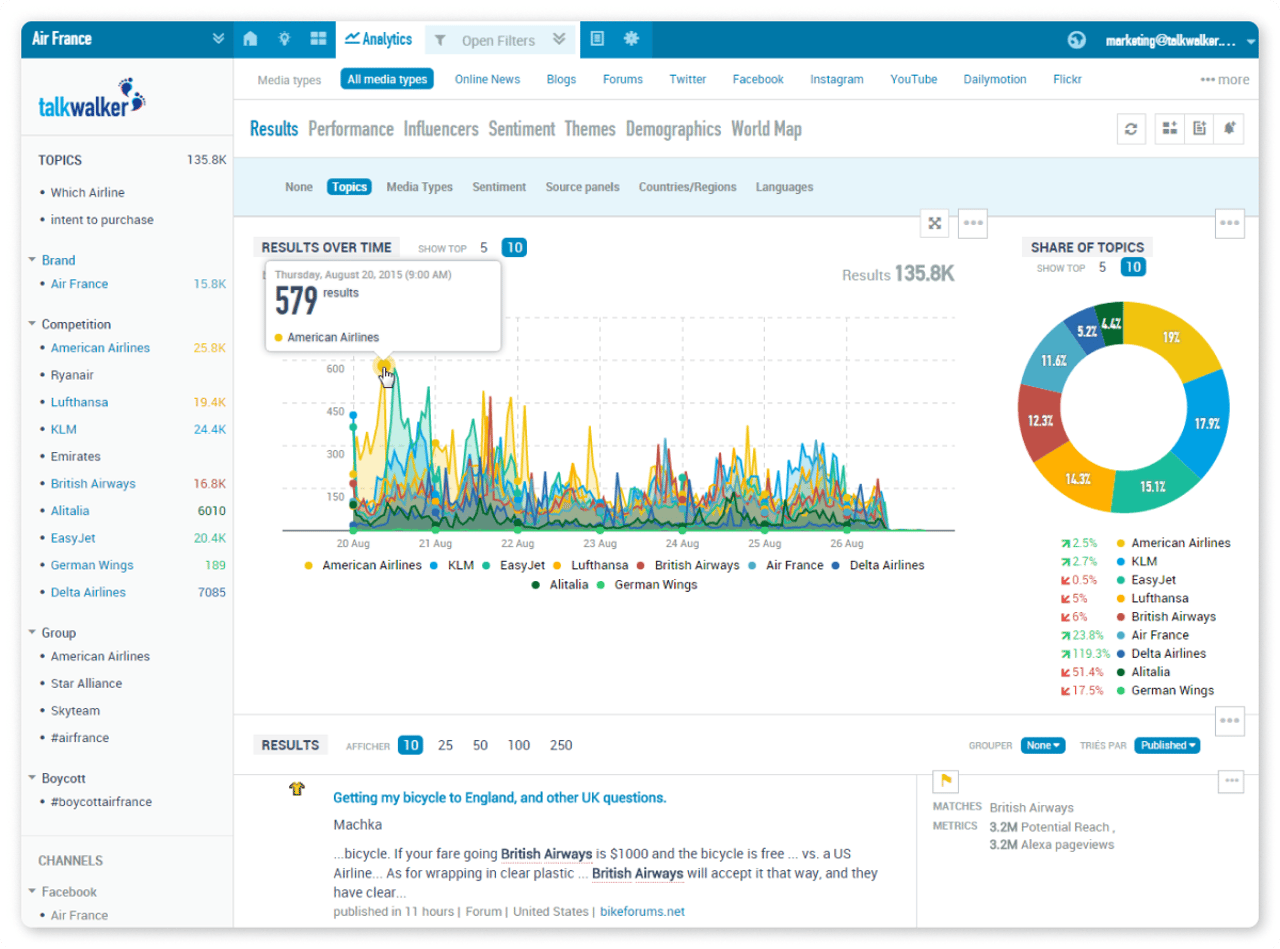
Image source: G2
Talkwalker is one of the most powerful social listening platforms on the market, and also one of the more complex ones to get comfortable with — that steep learning curve at the start is a real thing, not just a complaint from people who didn’t read the docs. Once you’re in, though, the coverage is exceptional: 150M+ websites, 187 languages, and the ability to analyze not just text and images but video and speech content from TV and radio broadcasts.
That last part matters more for certain industries than others — if your brand runs broadcast campaigns or shows up in traditional media, most other tools miss those social media conversations entirely. Talkwalker doesn’t. The conversation clusters feature is also genuinely useful for making sense of large volumes of brand mentions: it groups related topics so you can see structural patterns in the data rather than just a firehose of individual posts.
Worth noting: it doesn’t cover marketplace channels, which is a real gap depending on your category. And if you’re considering it, our Talkwalker alternatives page covers the options for teams who want similar depth at a different price point or with a shorter onboarding curve.
Pricing
Four tiers (Listen, Analyze, Business, Premium) — all require a demo for pricing.
Best for
Enterprises that need multi-region coverage, cross-channel analysis including traditional media, and have the internal resources to get the most out of a complex platform.
9. Meltwater
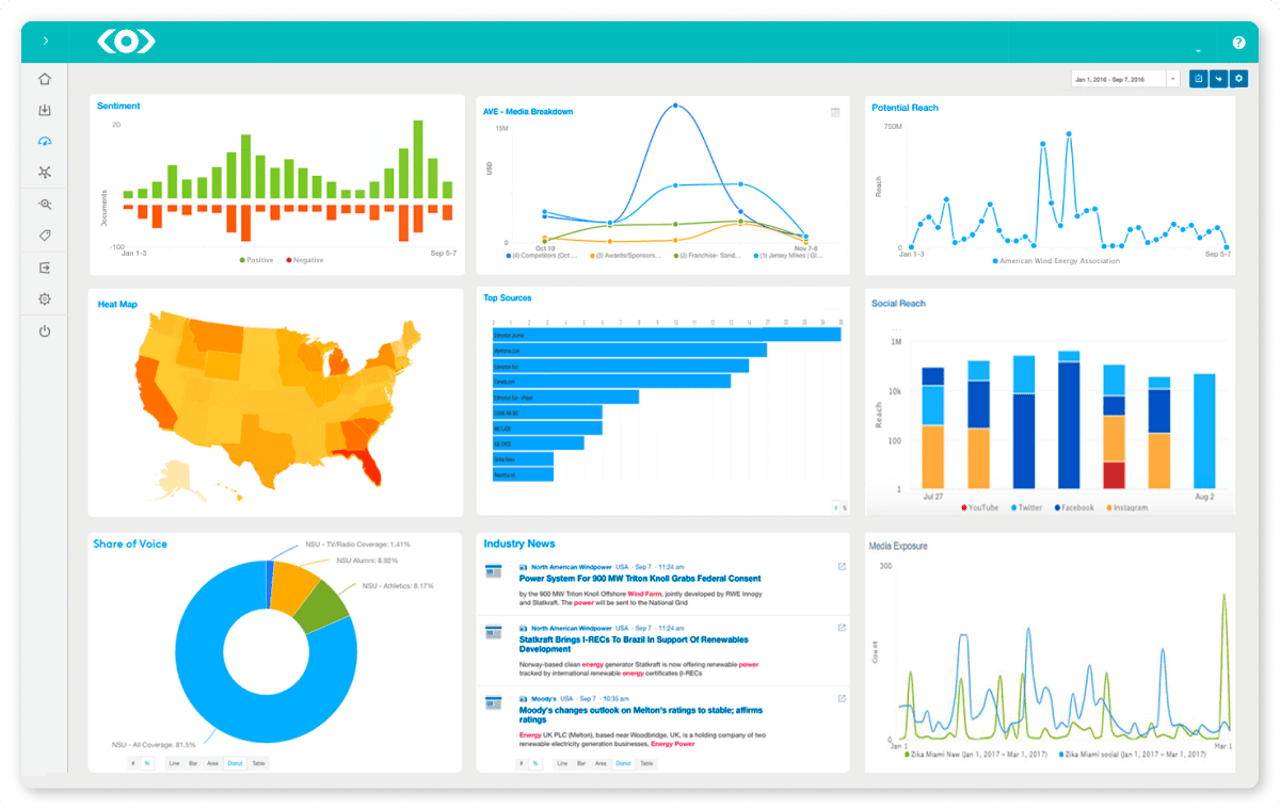
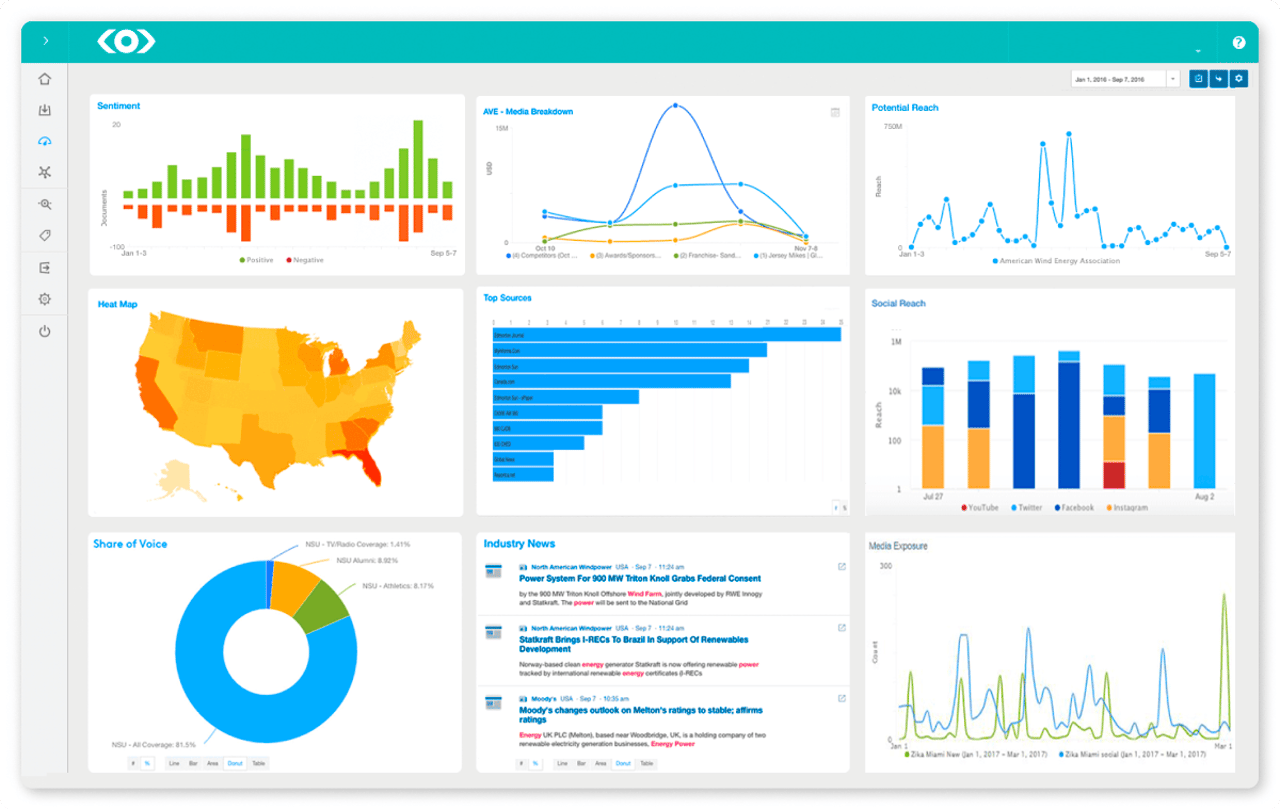
Image source: G2
Meltwater is what you reach for when your social monitoring needs to connect to the broader media picture. It pulls together social, news, broadcast, and industry news data in one place, which makes it unusually useful for PR and communications teams who need to track brand reputation across both social and traditional channels simultaneously. Our Meltwater competitors roundup compares it to eight alternatives if you’re still deciding.
The influencer and sales intelligence layer is worth mentioning — it identifies key influencers and market positioning signals, which extends its usefulness beyond just a social listening platform into something closer to a full intelligence tool. The social monitoring covers industry news alongside social channels, and the cross-department accessibility means marketing, PR, comms, and sales teams can all get value from it without needing separate third party tools for each function. If that unified view is what leads to smarter marketing decisions at your org, Meltwater is probably worth the conversation.
It’s not the most intuitive platform in the world, and like most enterprise tools in this category, pricing is opaque until you talk to sales. But for organizations that need a unified view of media and social data, it’s hard to beat.
Pricing
Essentials, Suite, and Enterprise packages — all on request.
Best for
PR, comms, and marketing teams that need social listening and traditional media monitoring to talk to each other. Strong for global brands and organizations with cross-functional intelligence needs.
10. NetBase Quid
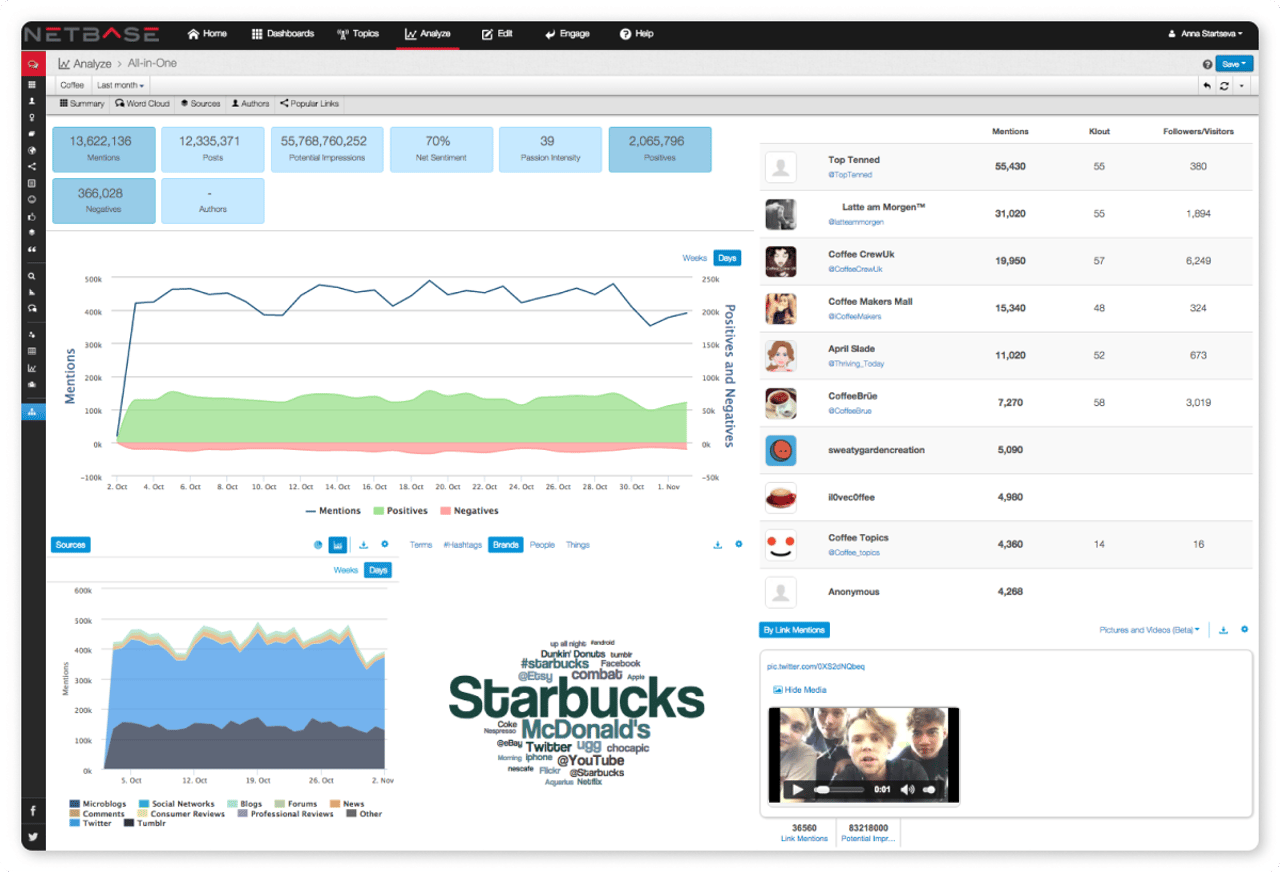
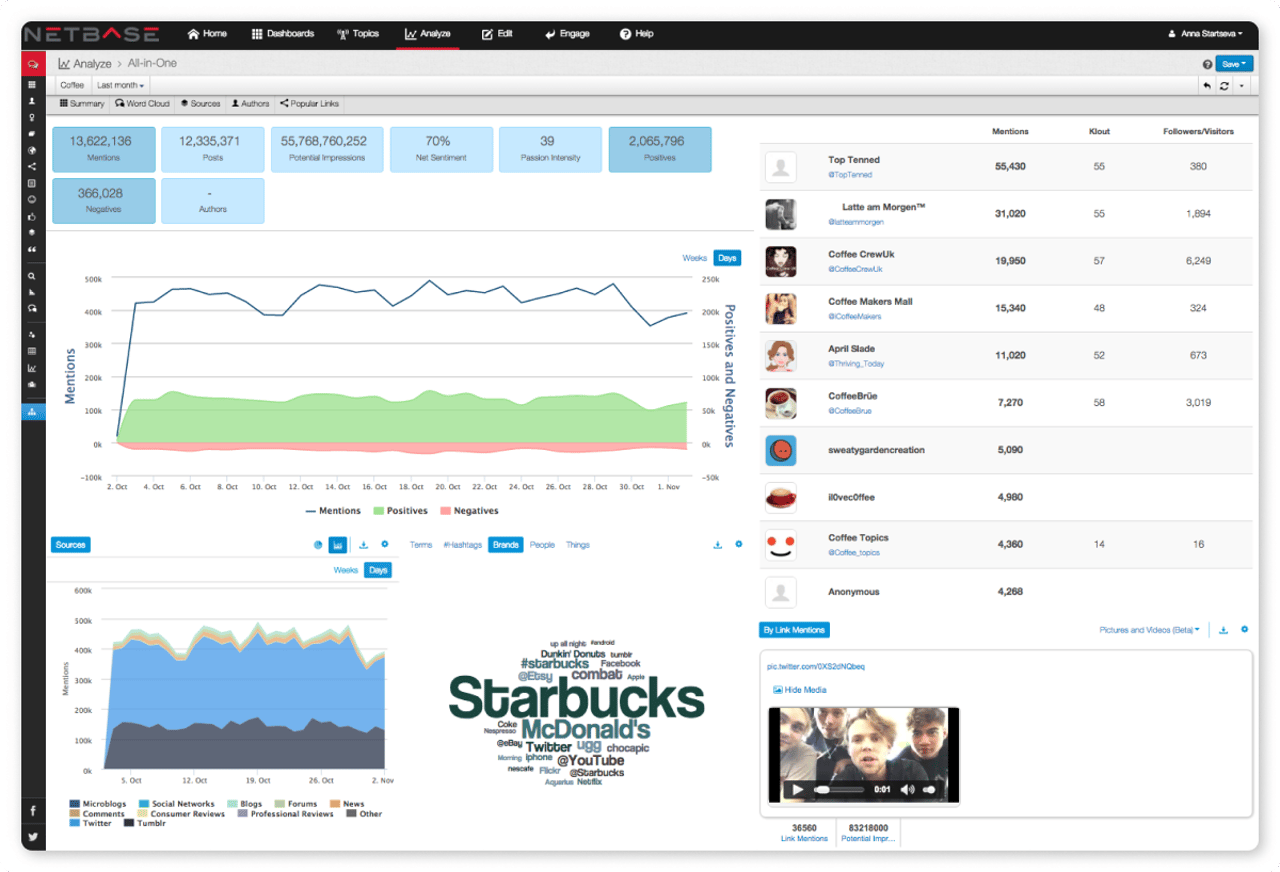
NetBase Quid is the most research-oriented tool on this list. It’s less about monitoring your brand’s day-to-day social conversations and more about using natural language processing and generative AI to answer harder strategic questions — where is the market going, what’s an emerging trend before it becomes obvious, what weak signals in the data should we be paying attention to? The Quid Predict module specifically is built to spot emerging themes before they surface in mainstream conversations.
Visual analytics are available too, so you can track brand appearances in images across social platforms like Instagram, which matters for user-generated content and influencer performance. And the NLP-powered data collection is thorough enough that social media posts, reviews, news, and forums all feed into the same analysis.
The honest caveat: it’s complex, the pricing is custom and tends to be high, and if your primary need is day-to-day brand monitoring rather than strategic consumer research, it’s probably more tool than you need.
Pricing
Custom — request a demo.
Best for
Market research teams and enterprise strategy functions that need deep consumer insights, predictive analytics, and the ability to integrate findings into existing business intelligence systems.
11. BuzzSumo
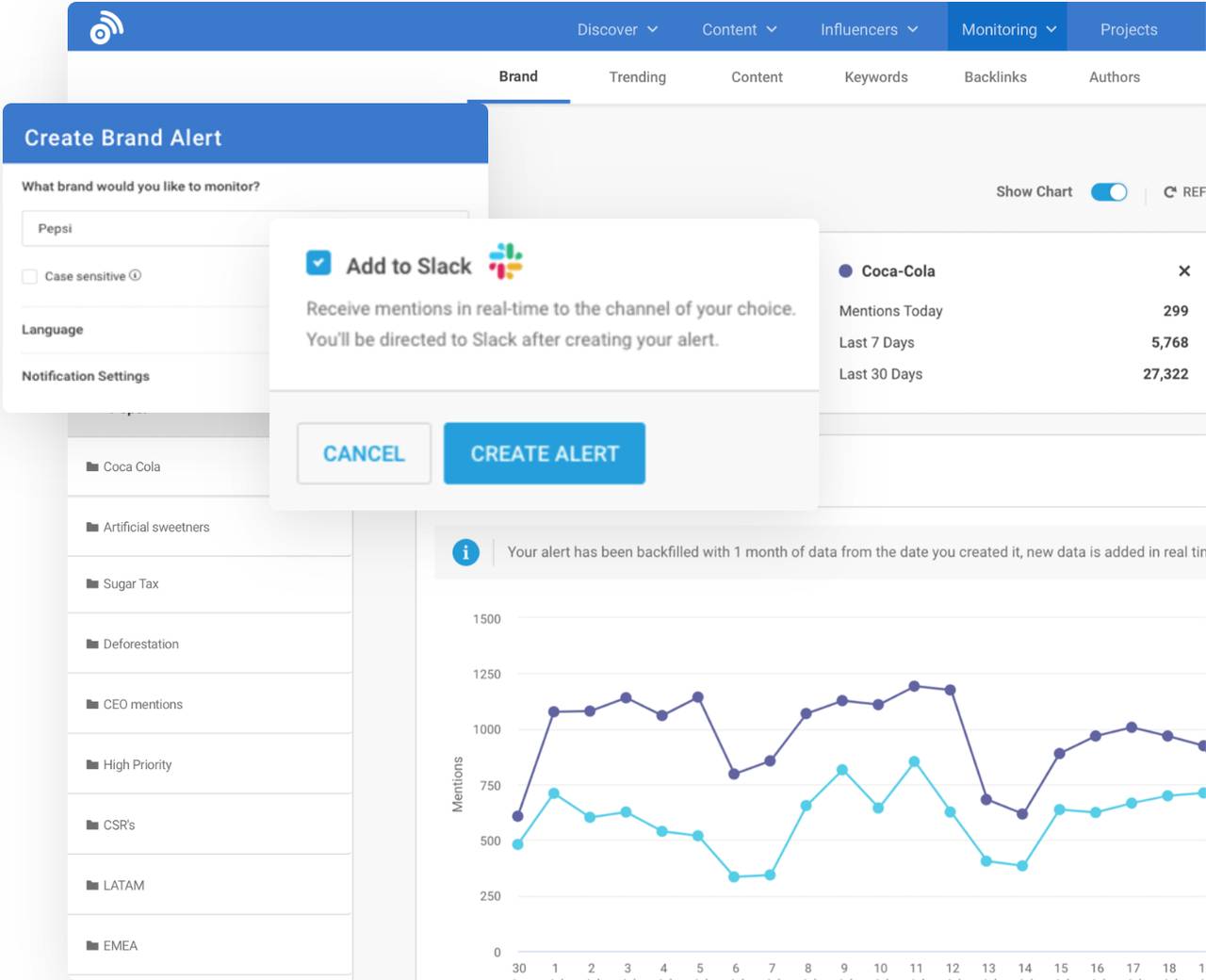
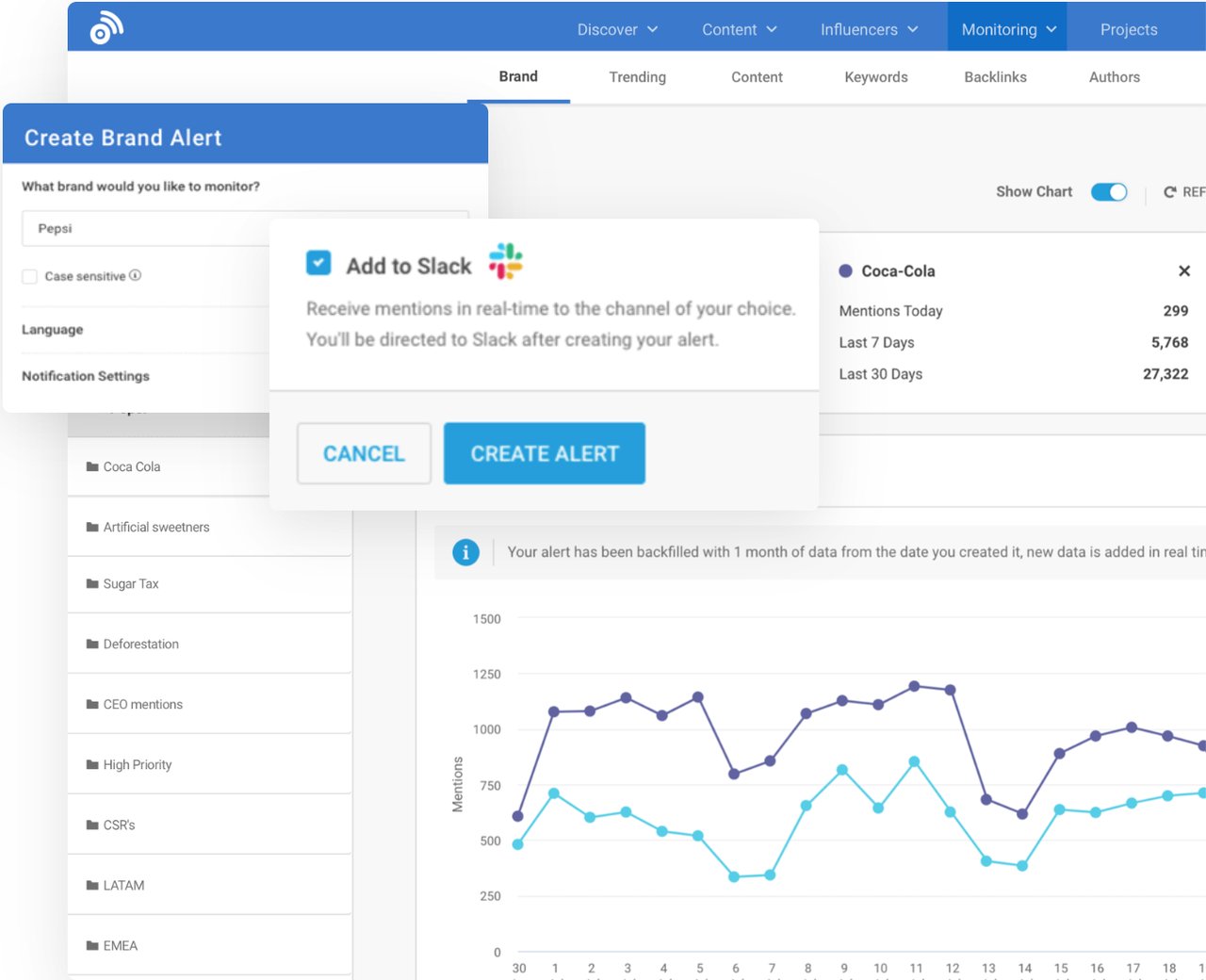
BuzzSumo is the odd one out on this list, and that’s worth being upfront about. It’s primarily a content intelligence tool, not a social listening platform in the traditional sense. It doesn’t do sentiment analysis on your brand mentions, and it won’t track brand health over time the way other tools here will. What it does is tell you what content is actually working — trending topics, high-engagement formats, which influencers and journalists have real reach, and what your competitors’ best-performing content looks like.
For content teams and digital marketing practitioners, that’s genuinely valuable. The relevant keywords and relevant conversations you find in BuzzSumo are the ones already generating engagement — which takes a lot of guesswork out of content planning and makes your social listening efforts more targeted. The meaningful insights aren’t about brand sentiment or audience demographics here; they’re about what content is worth making. And the free trial makes it easy to test before committing.
Just don’t buy it expecting it to replace a proper social listening tool. It won’t. Think of it as a complement to one.
Pricing
From $199/month. Free trial available.
Best for
Content marketers and PR teams who care more about what’s resonating on social platforms than about monitoring their brand specifically.
12. Keyhole
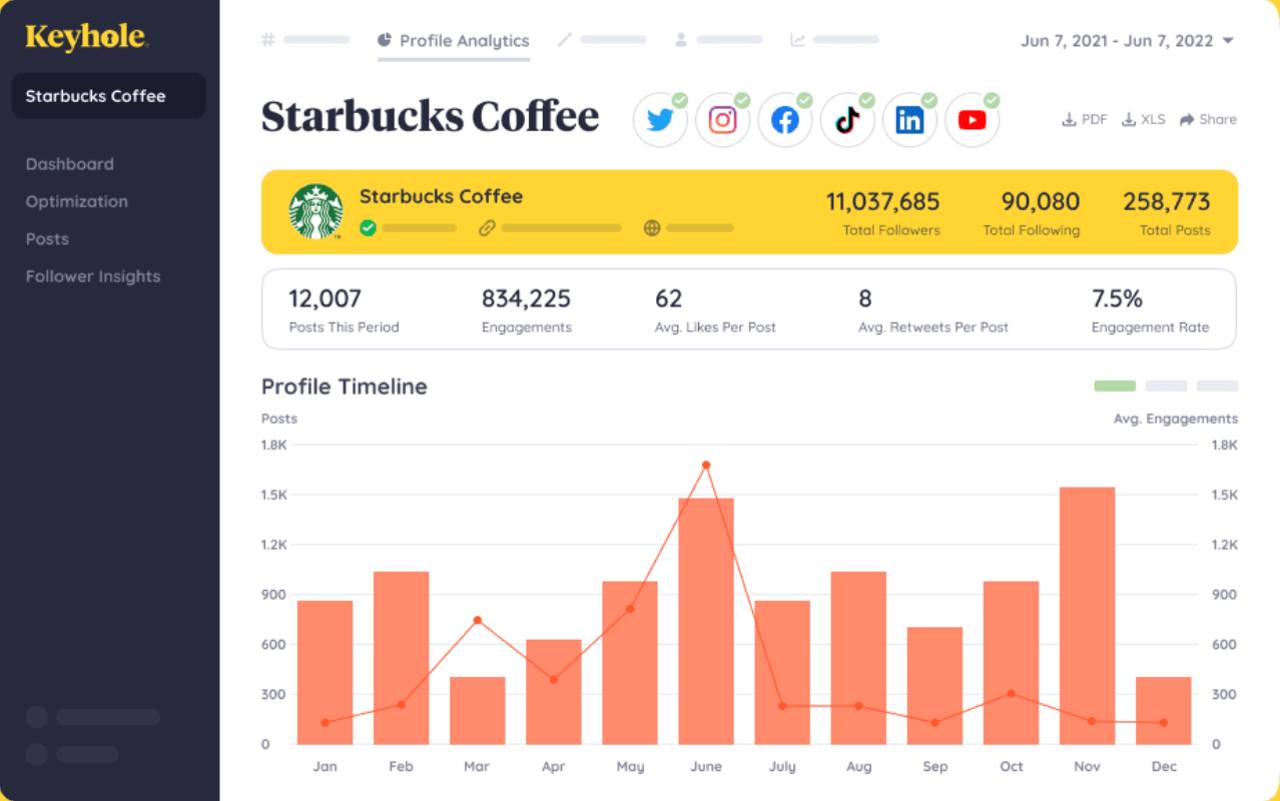
Keyhole is built for campaign-level social listening more than ongoing brand monitoring — and that’s a useful distinction. If your social media team runs a lot of hashtag campaigns, event activations, or influencer partnerships, Keyhole’s tracking is precise in a way most platforms aren’t. Volume predictions that tell you when social media posts are likely to spike, live dashboards you can show in a war room during an event, granular audience response metrics — it’s the kind of tool that makes campaign reporting much less painful.
The audience insights are solid and the social media campaigns analytics are particularly strong. That said, there’s a real steep learning curve for users who haven’t used a data-heavy platform before — tracking conversations at volume means a lot of raw data to configure, and getting the relevant keywords and hashtag setup right takes time. It also doesn’t do visual recognition. But once you’re set up, the meaningful insights on campaign reach and influencer impact are hard to match at this level of detail.
Pricing
Custom — demo required.
Best for
Marketing teams and agencies running active social media campaigns, events, or influencer marketing programs where campaign-level analytics matter more than always-on brand monitoring.What should I consider when choosing the best social listening tool?
Here are the most important factors to consider when choosing from the top social listening tools.
Comparison table of the best social listening software 2026
Tool | Starting price | Best for | Sentiment analysis | Visual recognition | Free trial | Standout feature |
YouScan | $499/mo | Visual + text brand monitoring | ✅ | ✅ Advanced | ✅ 3-day free trial, demo available | Image recognition & AI visual insights |
Dash Social | Custom add-on | Combining social listening with brand intelligence, reporting, and social media management | ✅ | ✅ | ✅ | Proprietary AI that analyzes both visual and text-based social content. |
Brandwatch | Custom | Enterprise consumer intelligence | ✅ | ✅ | ❌ (demo) | Historical data depth & influencer reach |
Brand24 | $119/mo | SMBs & agencies, real-time monitoring | ✅ | ❌ | ✅ | Anomaly detection & presence scoring |
Konnect Insights | $39/user/month | Brands looking to unify customer interactions and engagement in one platform | ✅ | ❌ | ❌ | AI-powered analytics, custom dashboards |
Digimind | Custom | Competitive intelligence & brand reputation | ✅ | ✅ Basic | ❌ (demo) | Presentation-ready custom reports |
Sprout Social | $199/mo | Multi-platform social media management | ✅ | ❌ | ✅ | Unified inbox + Salesforce integration |
Talkwalker | Custom | Enterprises needing multi-region coverage | ✅ | ✅ | ❌ (demo) | Video & speech analytics (TV/radio) |
Meltwater | Custom | PR, comms & cross-dept media intelligence | ✅ | ❌ | ❌ (demo) | Broadcast + social data in one place |
NetBase Quid | Custom | Predictive consumer & market intelligence | ✅ | ✅ | ❌ (demo) | NLP-powered predictive analytics |
BuzzSumo | $199/mo | Content marketers & PR outreach teams | ❌ | ❌ | ✅ | Trending content discovery & influencer DB |
Keyhole | Custom (demo) | Campaign tracking & influencer analytics | ✅ | ❌ | ❌ (demo) | Volume predictions & live event dashboards |
What to consider when choosing the best social listening tool in 2026
Before getting into specific social listening features, it’s worth being honest about what actually makes these decisions hard: most vendors claim the same things. “Real-time insights. AI-powered. Customizable dashboards.” It’s table stakes language.
The questions that actually help you decide are more specific than that. Here’s how to think through the main ones. And if you want to see what strong social listening efforts look like in practice, the social listening examples page covers how real brands have used these tools to drive actual outcomes.
One thing worth saying upfront: if you’re still asking whether you need dedicated social listening software at all, the social listening data you get from a proper tool is qualitatively different from what any free tool gives you — the valuable insights from tracking online conversations at scale simply don’t show up in a basic alert feed.
1. Platform coverage — and what “coverage” actually means
Most tools claim broad platform coverage. What they usually mean is the major social media platforms: Instagram, Facebook, X/Twitter, LinkedIn, maybe TikTok. What they often don’t mention: marketplace conversations, niche forums, news sites, review sites, the specific communities where your target audience actually lives. There’s also an important distinction between social listening vs social monitoring — monitoring tells you what’s being said, listening tells you what it means in context.
The relevant conversations you’re missing aren’t always happening on the obvious channels. Some of the most useful social listening data comes from the forums, review sites, and niche communities where your target audience talks openly — the conversations happening there rarely show up in a mainstream feed. For brands operating in certain markets, it’s also worth asking about newer platforms like YouScan’s Moltbook monitoring support — the kind of source-specific coverage that can matter for some teams but never shows up in a standard comparison.
2. Sentiment analysis — and whether it’s actually accurate
Every tool does sentiment analysis. Not every tool does it well. The difference between a good implementation and a mediocre one is whether it can handle sarcasm, slang, context, and mixed sentiment within a single post. A tool that classifies “Great, another price hike” as positive sentiment is worse than useless for brand health tracking — it actively misleads you.
When evaluating, ask for accuracy figures, ask to see how it handles edge cases, and consider whether you need
aspect-based sentiment analysis — the ability to break down sentiment by specific product features or topics rather than just brand-level positive/negative. The difference in quality between basic and advanced sentiment analysis tools is significant.
3. Real-time monitoring — because timing matters more than people think
There’s a meaningful difference between a tool that surfaces mentions in real time and one that batches them every few hours. For routine brand monitoring, hourly updates are usually fine. But when something starts moving fast — a negative story, a PR crisis, a competitor announcement — you want real time insights, not a summary from the next batch cycle.
Tools that let you track sentiment and audience response as it shifts — not after the fact — are the ones that let you get in front of a situation rather than behind it. Having a solid PR crisis management workflow starts with not being the last to know.
4. Dashboards and reporting — who actually needs to see the data
This is the feature most people underestimate during evaluation and regret later. The question isn’t just “can I build a custom dashboard?” — it’s “can I build different dashboards for different stakeholders without it becoming a maintenance nightmare?” A social media team, a sales team, a PR function, and a C-suite exec all want different views of the same social listening data. The tools that handle this well, like YouScan’s social listening dashboards, let you build distinct views without the whole thing falling apart every time you tweak a filter.
5. Competitor monitoring — not an add-on, a core use case
Competition social listening should be part of any serious marketing strategy, but the depth of what’s actually available varies a lot. Some tools give you basic share-of-voice metrics. Others let you do a full target audience analysis across your competitive set — who’s talking about your competitors, what they’re saying, where the gaps in competitor positioning are. Industry trends tend to surface in competitor conversations before they show up in market reports, so the quality of this feature has direct strategic value.
6. Pricing and whether it scales
The wide range here is real: you can spend under $150/month or over $100K/year depending on what you need. Cost-per-mention pricing can also bite you fast if you’re in a high-volume category, or if the latest social media trends suddenly put your brand in the middle of a big conversation. Before signing anything, get clarity on what happens to your bill if mention volume doubles.
The best social listening tool for your own social listening strategy is the one that doesn’t become unaffordable the moment it starts working. And if you’re choosing social listening software for the first time, test at realistic volume — not a slow news week.
Wrapping up
There’s no universally best tool here — that’s the honest answer. Among the top social listening tools in digital marketing right now, these ten represent the clearest range of use cases. YouScan is the strongest if visual brand monitoring, brand performance tracking, and deep consumer insights matter to you.
Brandwatch is the enterprise default, especially for teams running large influencer marketing campaigns. Brand24 is genuinely underrated for what it costs. Sprout makes sense if you also need to manage your social media publishing from the same platform. And BuzzSumo is only on this list because it’s useful — just not for traditional brand listening.
The best way to build your own social listening strategy and see if social listening will help you launch new products of yours is to start with your actual use cases — not the feature checklists — and work backwards from there. What questions are you trying to answer? Who needs the data? How fast do you need to know when something changes? Starting there leads to smarter marketing decisions than any comparison grid will.
If you want to see what YouScan looks like in practice — the visual insights, the AI layer, the social listening dashboards — the best way is to request a demo and have your actual use cases in mind when you do it.
FAQs
What is a social listening tool?
A social listening tool tracks online mentions of your brand, competitors, or industry keywords across platforms, providing insights into audience sentiment, trending topics, and brand reputation. The short version: it tells you what people are actually saying about you, and what it means.
Which social listening tool is best?
Depends entirely on what you need. YouScan is the strongest for visual analytics and sentiment analysis. Sprout Social makes sense if social media management is also part of the picture. Brand24 is the best value at the lower end of the market. Check the comparison table above or the social listening glossary if you’re still building out your criteria.
What are social listening strategies?
Social listening strategies are how you turn ongoing social media monitoring into decisions. At a minimum: tracking brand mentions, measuring sentiment shifts, watching competitors, and flagging emerging trends before they become mainstream. In practice, the best social listening strategies feed into product development, customer service, campaign planning, and crisis response — not just the marketing team’s weekly report.
What is an example of social listening?
A product team notices a spike in negative mentions around a specific feature. Instead of waiting for a formal survey, they use the social listening data to understand the complaint pattern, prioritize a fix, and then track whether sentiment improves after the update ships. That’s social listening feeding directly into customer feedback loops and product decisions — not just brand monitoring.