What Is Social Media Listening? Definition, Benefits & How to Do It

Social media listening is the practice of tracking and analyzing online conversations about your brand, competitors, and industry, then turning what you find into decisions you can act on. Social listening covers social media platforms, forums, review sites, news sites, and every other place people talk without tagging you.
Think of social listening as a hearing aid for the parts of the internet that never @ you. You are not counting brand mentions, you are working out why they happened.
Here is what a social listening habit gives you:
Early warning on a crisis before it reaches your reputation management budget
Real customer feedback through sentiment analysis, including the negative sentiment nobody emails you about
Product ideas buried in relevant conversations you were never copied on
Sharper marketing campaigns, because you know what your target audience actually cares about
Honestly, the last one matters more than most teams admit. Most bad marketing campaigns are not creative failures. They are social listening failures.
So what is social listening, exactly?
Social media listening has two halves. First, data collection: you gather social media posts, comments, reviews, and articles that match your queries. Second, social listening analysis: you look for patterns in that pile and pull out relevant insights.
The second half is where social listening earns its keep. Anyone can collect mentions. Fewer teams sit with their social listening data long enough to notice that complaints about “slow delivery” spike every third week of the month, right after payday. Good social listening turns that pile into actionable insights that someone owns by Friday.
Mordor Intelligence values social media listening at $10.91 billion in 2026, heading for $20.51 billion by 2031, a shift it credits to demand for predictive intelligence over vanity metrics.
Social listening vs social media monitoring
People use these terms interchangeably. They are not the same, and the difference between social listening and social monitoring shapes how you staff the work.
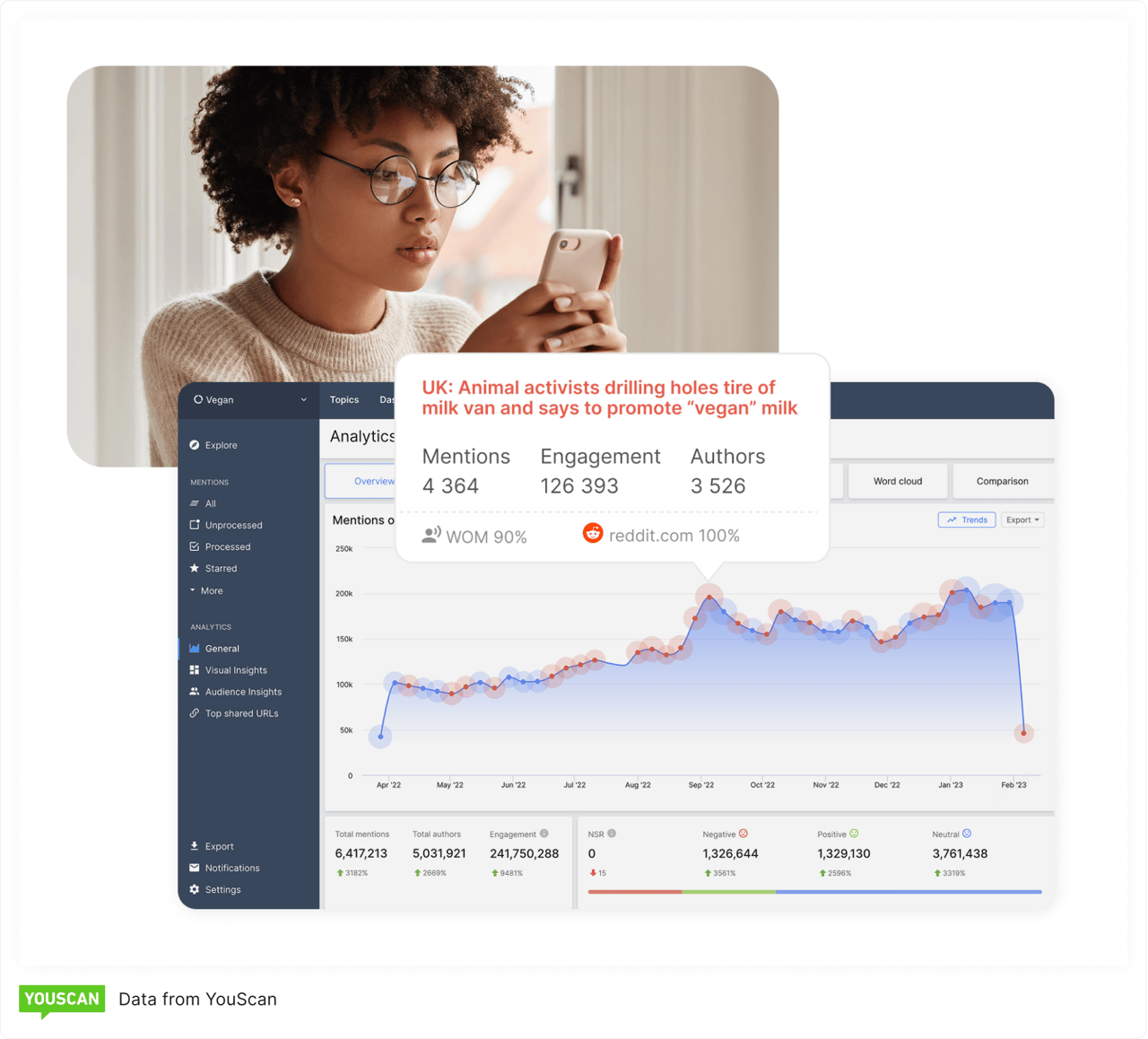
Social media monitoring | Social listening |
Reactive and immediate | Proactive and strategic |
Tracks direct mentions and tags | Finds broader social conversations |
Answers “what are people saying right now?” | Answers “why, and what should we do?” |
Feeds customer service | Feeds brand strategy |
Micro: individual messages | Macro: patterns and industry trends |
Social monitoring is putting out fires. Someone posts a complaint, you reply, done. Social media monitoring is necessary work, and it keeps your social media accounts from looking abandoned.
Social listening is asking why the fires keep starting in the same corner of the building. Your social media monitoring tool catches one shipping complaint. Your social listening platform shows you four hundred people discussing delivery delays across social media channels without tagging you once.
You need both. A social listening strategy includes monitoring as a component, not a rival. Skip monitoring, and you look rude. Skip social listening, and you stay busy without getting smarter.
What to listen for (and where)
Most social listening setups fail at the query stage, not the tool stage. Here is the shortlist worth building before you touch a dashboard.
Your brand and your campaigns
Start with brand names, product names, and official hashtags. Then add the misspellings, because half your audience is typing your name from memory at speed.
Give each launch its own query. If campaign mentions live in the same bucket as everyday chatter, you will never see which marketing campaigns actually moved anything.
Your competitors
Track rival names, their launches, and the social conversations around their complaint threads. Their unhappy customers are describing your opportunity in their own words, and those are the potential customers worth writing for.
Your category and its culture
Widen out to the category, the adjacent categories, and the jokes people tell about both. A category-level social media tracker is how you spot emerging trends while they are still a niche in-joke rather than a headline.
The places most teams forget
Your audience does not stay on the big platforms. Reddit threads often carry the most honest product talk you will find anywhere, and review sites, Discord servers, Twitch streams, and podcasts all matter depending on your category.
LinkedIn deserves its own mention for B2B. The LinkedIn post quality analyzer is a quick way to see how your own posts land before you worry about anyone else’s.
Brand reputation, brand health, and crisis management
Brand reputation moves faster than any approval chain, which is why social listening stopped being optional for comms teams. Sprout Social’s Q2 2026 Pulse Survey found that social media is the first place consumers hear about a brand controversy, and 84% say response speed directly shapes how they judge it.
Crisis management and crisis response
Set alerts on negative sentiment spikes, not just volume spikes. A quiet week with a sharp mood swing is more dangerous than a loud week of neutral chatter, and this is where social listening plays its most obvious role. Your social listening setup should push that alert to a phone, not an inbox.
Your crisis response plan should name who reads the alert, who drafts the reply, and who approves it. Sixty-four percent of those consumers want the crisis response on social, not a press release. Crisis management that runs through legal for three days is not crisis management.
Brand reputation management in practice
Brand reputation management is the slow version of the same work. Track share of voice, sentiment shifts, and negative mentions month over month, and your social listening efforts produce a brand health score that means something.
Watch audience perception by segment. Brand perception among long-time customers and among people who found you through political and social issues coverage can differ wildly, and averaging them hides the story.
Consumer insights, audience insights, and customer experience
Social listening data is the cheapest market research you will ever run. Nobody performs for a moderator, so the consumer insights are blunter than anything a focus group produces.
Product teams find valuable insights and feature requests in customer feedback nobody filed as a ticket. Customer experience teams spot customer pain points in real time across social media channels, usually a week or two before the same complaint reaches the support queue.
PR gets the earliest warning of a story forming. Sales gets language it can borrow, since the phrases people use to describe a problem convert better than anything written in a positioning workshop. Market researchers use social listening to identify trends and emerging trends before they show up in a quarterly report. Even sales gets something: understanding competitor strategies from people who just left them.
That said, this only works if the audience insights leave the marketing team. When social listening stays in one inbox, the entire organization keeps making decisions on instinct. Route findings to product, support, and leadership on a schedule, or your social listening strategy quietly becomes a reporting exercise. Done properly, social listening gives leadership a way to make informed decisions without waiting for a survey cycle.
There is room to move. HubSpot’s 2026 Social Media Marketing Report, based on more than 1,100 marketers, found only 13.54% currently use AI for social listening and trend monitoring, which the researchers call the biggest underused AI opportunity in social media marketing.
Competitive analysis and brand strategy
Track competitor brand mentions, launches, and campaign hashtags. Share of voice tells you where you stand. What people complain about tells you where to aim, and that is the kind of competitive analysis social listening hands you free.
Pay closest attention to praise you cannot match, and pain points you already solve. The second list is your messaging brief, written by potential customers who do not know you exist yet.
Feed what you find into brand strategy, and into the marketing strategies underneath it, rather than a slide nobody opens. Social listening findings should shape your content strategy calendar as much as your pricing page, and a content strategy built on real complaints beats one built on a brainstorm. The same goes for your wider social media strategy.
How to do social media listening, step by step
1. Set goals before you set queries
Decide what you want from social listening first. Reputation tracking, market research, campaign measurement, and lead discovery all need different setups, and each implies a different target audience.
Then pick metrics: sentiment score, share of voice, reply time, priority accounts. An effective social listening strategy starts with a number you are trying to move, because vague goals produce dashboards nobody reads.
2. Choose the right social listening platform
Not all social listening tools cover the same ground. Judge social listening tools on four things:
Data coverage. Does it reach the social media platforms your audience uses, plus forums, online platforms, review sites, and news sites? Newer sources matter, which is why YouScan added Moltbook monitoring in English and Ukrainian.
Sentiment accuracy. Sarcasm breaks most social listening tools. Test sentiment analysis on your own messy mentions before you buy.
Visual analysis. Can it see your logo in a photo with no text mention?
AI depth. Modern AI social listening tools should answer questions in plain language, not just chart volume.
Gartner published its first Magic Quadrant for social media management and listening in 2026, a sign the market has
consolidated into enterprise platforms.
3. Build queries that do not drown you
Start with your brand, products, and campaign hashtags, then add misspellings. If you are “TechCo,” someone is typing “Tekco” today.
Layer in industry-relevant keywords and the pain points people describe in their own words, not yours. A working query usually looks like your product category AND a frustration word, minus the noise terms that keep dragging in unrelated results. Boolean search operators keep the noise out, and broad topic monitoring catches online conversations that never name you at all. Track industry trends the same way you track your own name, and keep social listening queries boring and specific.
4. Analyze rather than admire
Set a rhythm: daily scan for crises, weekly review for tracking conversations, monthly deep dive for strategy. Your social listening dashboards should make that ten minutes, not an afternoon. Social listening rewards routine more than intensity.
Read the comments themselves at least once a week, not only the charts. Aggregate numbers tell you something changed; the raw posts tell you why, and that is usually the part you can act on.
Look for the odd stuff. A drop in mentions after a launch is a distribution problem, not a creative one. Those are the deeper insights a volume chart will never hand you.
5. Turn insights into action and increase customer advocacy
Actionable insights that stop at a social media report are trivia. Social listening that never changes a decision is a subscription, not a strategy.
The fastest way social listening can increase customer advocacy is to close the loop publicly. Ship the fix, then tell the people who asked. They tend to tell everyone else.
Visual listening and AI sentiment analysis
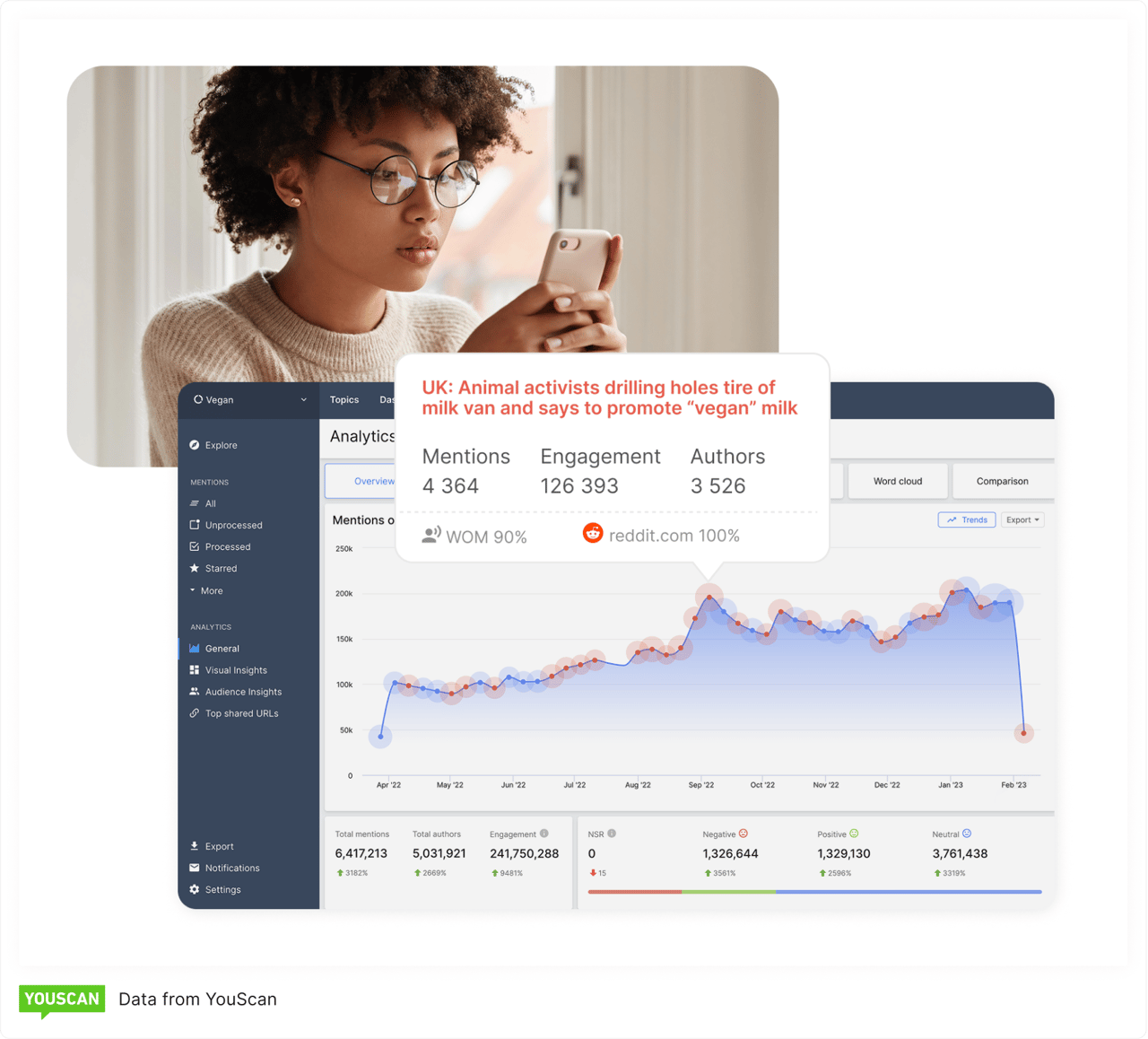
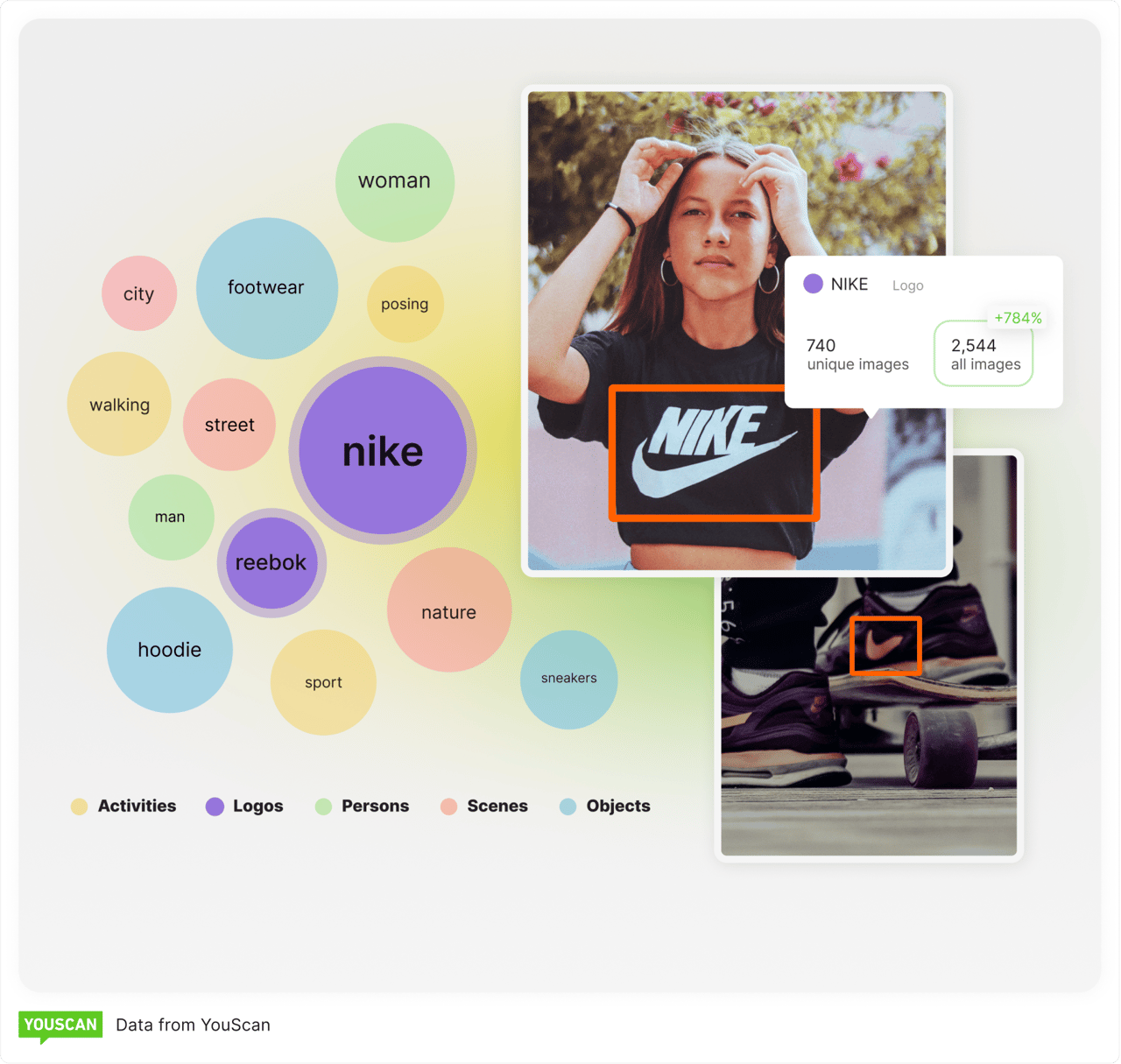
Here is where most brands lose data. The majority of social media posts now carry an image or video, and most logos in them come with no text mention at all, which text-only social listening never sees. Visual social listening is where that gap is widest.
Image recognition closes it. It finds your logo on a shelf, in a gym bag, in someone’s kitchen video, and tells you the context. As industry insights go, that is hard to beat.
AI changes the analysis too. Instead of filtering by hand, you ask Insights Copilot what changed this week and get the mentions behind the answer. Good ai sentiment analysis reads tone and emotion, not just positive or negative buckets, which makes it a powerful tool for teams without a data analyst.
None of it replaces judgment. Your analyst just spends the afternoon thinking instead of tagging.
Metrics, campaign optimization, and digital marketing impact
Track a small set of social listening metrics consistently:
Share of voice against named competitors
Sentiment ratio and how it moves after launches
Conversation velocity, your early signal for something going viral or going wrong
For campaign optimization, set a baseline two weeks before launch. Digital marketing decisions get easier when you can see which message travelled and which died in the feed, and your marketing strategies stop being an argument about taste.
The metrics worth adding later
Once the basics are running, two more earn their place. Emotion detection separates frustration from confusion, which matters because the fixes are different. Influencer impact shows which accounts actually move a conversation, so you stop treating a 200-reply thread and a 200,000-view video as the same event.
Then tie those valuable insights to business outcomes. Did faster crisis response protect revenue? Did sentiment recovery track with retention? That is the version of social analytics your CFO will sit through, and it is where social listening plays best in a digital marketing budget review.
Social listening examples from real brands
Theory is fine. Here is what social listening looks like in the wild, using recent cases rather than the case studies everyone has been recycling since 2019.
Neuro validated an audience it had only guessed at. The functional gum brand suspected gamers were a natural fit, but a hunch is not a media plan. Sizing the category conversation by audience, relevance, and opportunity confirmed it, so the brand went in with an esports partnership instead of a broad awareness push.
The campaign generated 4.6 million impressions across 30 social media posts and a 406% year-over-year sales lift,
according to CO— by the U.S. Chamber of Commerce. Neuro’s marketing lead, Jennifer Chang, has said the team wanted hard data behind the theory before committing budget to it.
Vaseline built a campaign on a hashtag it did not own. Unilever kept seeing people post homemade uses for the product under #VaselineHacks. Rather than politely ignoring content it had not commissioned, the brand answered with an official #VaselineVerified stamp on the hacks that actually worked, and the campaign took a Titanium award at Cannes. Not bad for a product launched in the 1870s.
Crayola started replying in the voice of a crayon. In 2025, the brand brought back eight retired colors, gave each one a personality, and had the social team respond to mentions in character. It only works if you catch the mention while the conversation is still warm.
That was the actual problem they solved. Brittany Mehalick, Crayola’s Social Media Engagement and Trends Manager, described the old setup plainly: “Our old workflow meant it could take days to process what was going viral.” After rebuilding around real-time listening, the team reported spotting and responding to emerging trends roughly 90% faster.
For more social listening examples, the pattern repeats: somebody tested an assumption against real social data instead of repeating it.
Your quick-start checklist
Pick one goal. Reputation, market research, or campaigns, not all three.
Write your social listening strategy on one page, then test tools on your messiest mentions.
Build social listening queries covering brand, products, competitors, and misspellings.
Give each insight an owner. No owner, no action.
From listening to acting
Social listening is not a dashboard you buy. Social listening is a habit of checking what you believe against what people say, and analyzing conversations you were never invited into.
Visual data and AI widened what you can hear, from social media conversations you were tagged in to ones happening three platforms away inside a photo. Brands that gain insights worth having act on them within the week, not the quarter. Social listening only pays at the speed you use it.
If you take one thing from this: start smaller than you think you should. One goal, one set of queries, one person who owns the follow-up. Programs that fail usually fail from ambition, not from lack of data.
Ready to hear what your target audience says when you are not in the room? Book a YouScan demo and look at your own social data, in words and in images.
FAQs
What is meant by social media listening?
Social media listening means monitoring and analyzing online conversations across social media platforms, forums, blogs, and review sites to understand what people say about your brand, competitors, and category. It goes past direct mentions to surface trends, sentiment, and meaningful insights you can use in planning. Social listening tools automate the collection so your team can spend its time on the analysis.
What is an example of social listening?
A coffee brand notices through visual social listening that customers keep photographing its cups next to pastries from one bakery chain, so it builds a co-branded promotion with them. Nobody wrote that idea in a survey.
What is the difference between social media listening vs social media monitoring?
Social media monitoring is reactive and handles direct mentions for customer service and day-to-day social media management. Social listening is proactive, analyzing conversation patterns and sentiment to guide longer-term marketing strategies. Most teams need both running side by side, since customer experience suffers when either one is missing.
What is visual social listening?
Visual social listening uses image recognition to spot your logo, products, and packaging in photos and videos even when the post never names you. It captures a large share of brand mentions that text-only social listening tools miss, and shows how people use your product rather than how they describe it.