Best AI Tools for Public Relations in 2027: 12 Tools and Tool Groups Compared

Most PR teams already use AI. Muck Rack’s State of AI in PR 2026 puts generative AI use at 76% among PR professionals, and Cision’s Inside PR 2026 says 91%. So whether to use AI tools for public relations is settled. The open question is which ones deserve budget, and where they fit in your week.
Most lists of AI tools for public relations throw chatbots, media databases, and monitoring platforms into one pile, as if a grammar checker and a journalist database were rivals. They aren’t. One fixes your pitch; the other tells you who should get it.
We used to see the same pattern every quarter. A comms team signs up for four AI tools in a burst of excitement, uses one, and pays for all of them until someone in finance asks awkward questions. The tools were fine. Nobody had asked which job each one was supposed to do.
So this guide sorts AI tools by the job they do. You’ll get pricing, honest trade-offs (ours included), a fit-by-need table, and a responsible-use checklist.
What are AI tools for public relations?
They’re software that uses artificial intelligence (machine learning, natural language processing, or generative AI) to speed up PR work: drafting, media list building, transcription, tracking media coverage, and reporting. They help PR professionals move faster. They don’t replace human judgment or the media relationships you spent years building.
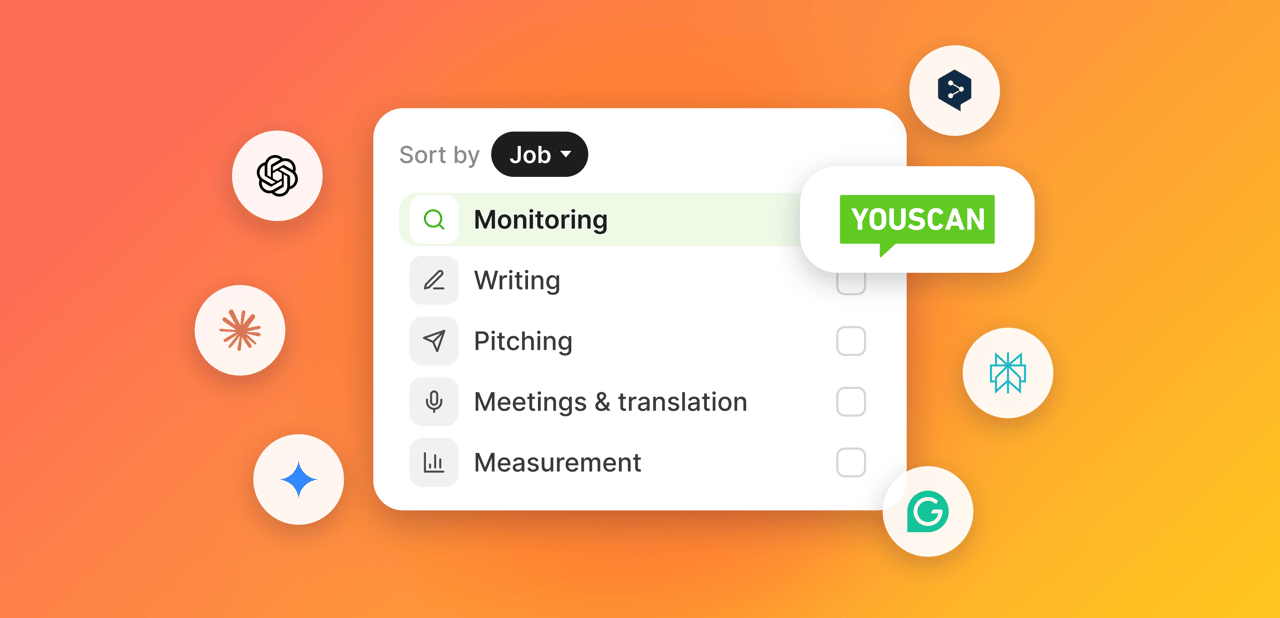
The tools below cover five PR activities:
Monitoring: real-time media monitoring, social listening, and sentiment analysis
Writing and research: drafts, edits, summaries
Media relations: finding reporters, pitching, follow-ups
Meetings and translation: interview transcripts, localized statements
Measurement: coverage reports, plus how AI engines describe your brand
General-purpose assistants are flexible but know nothing about your media list. PR-specific platforms come with media databases and workflows built in. Most teams need both. (Jargon overload? Try our social listening glossary.)
How to pick the best AI tool for your PR team
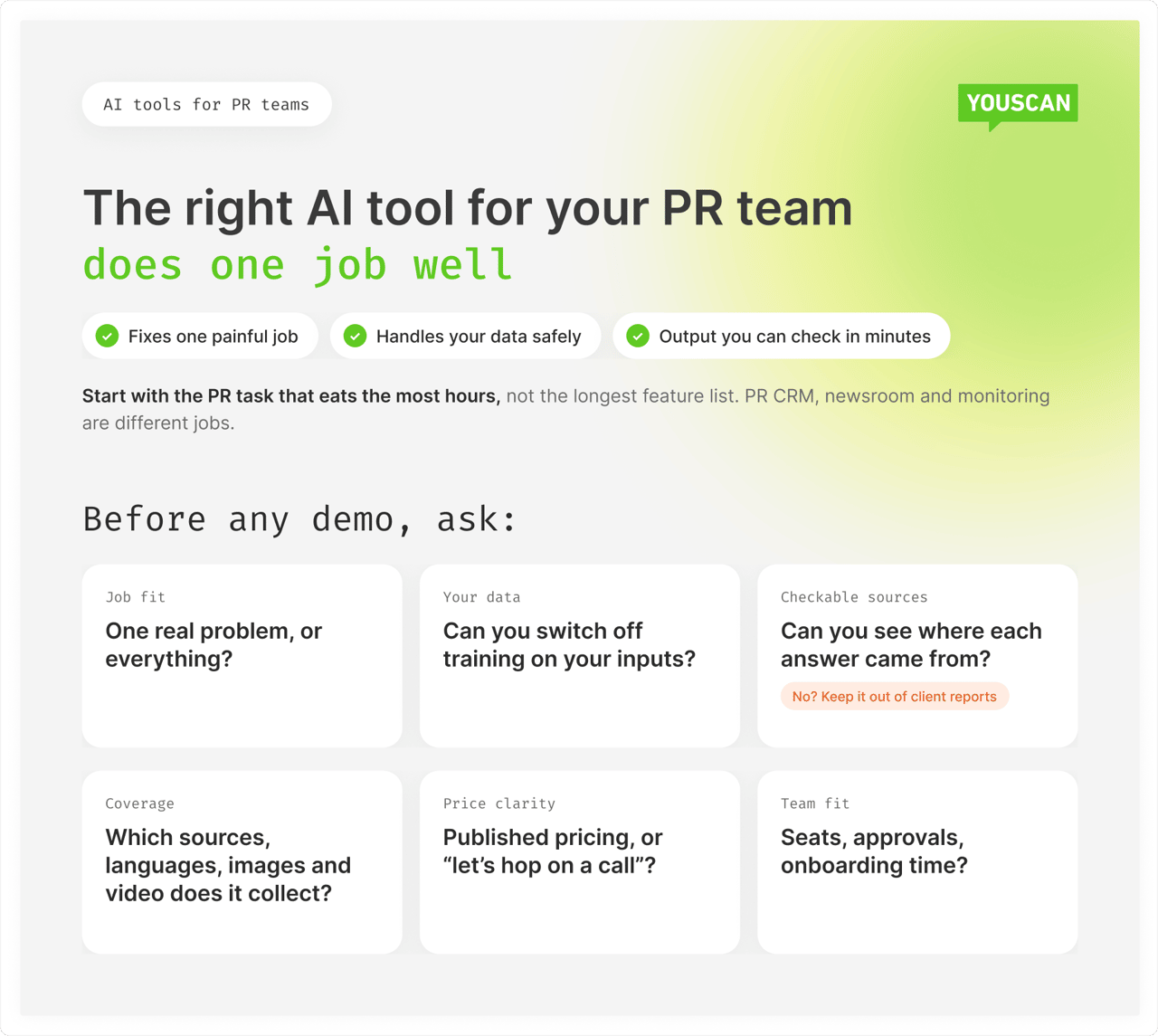
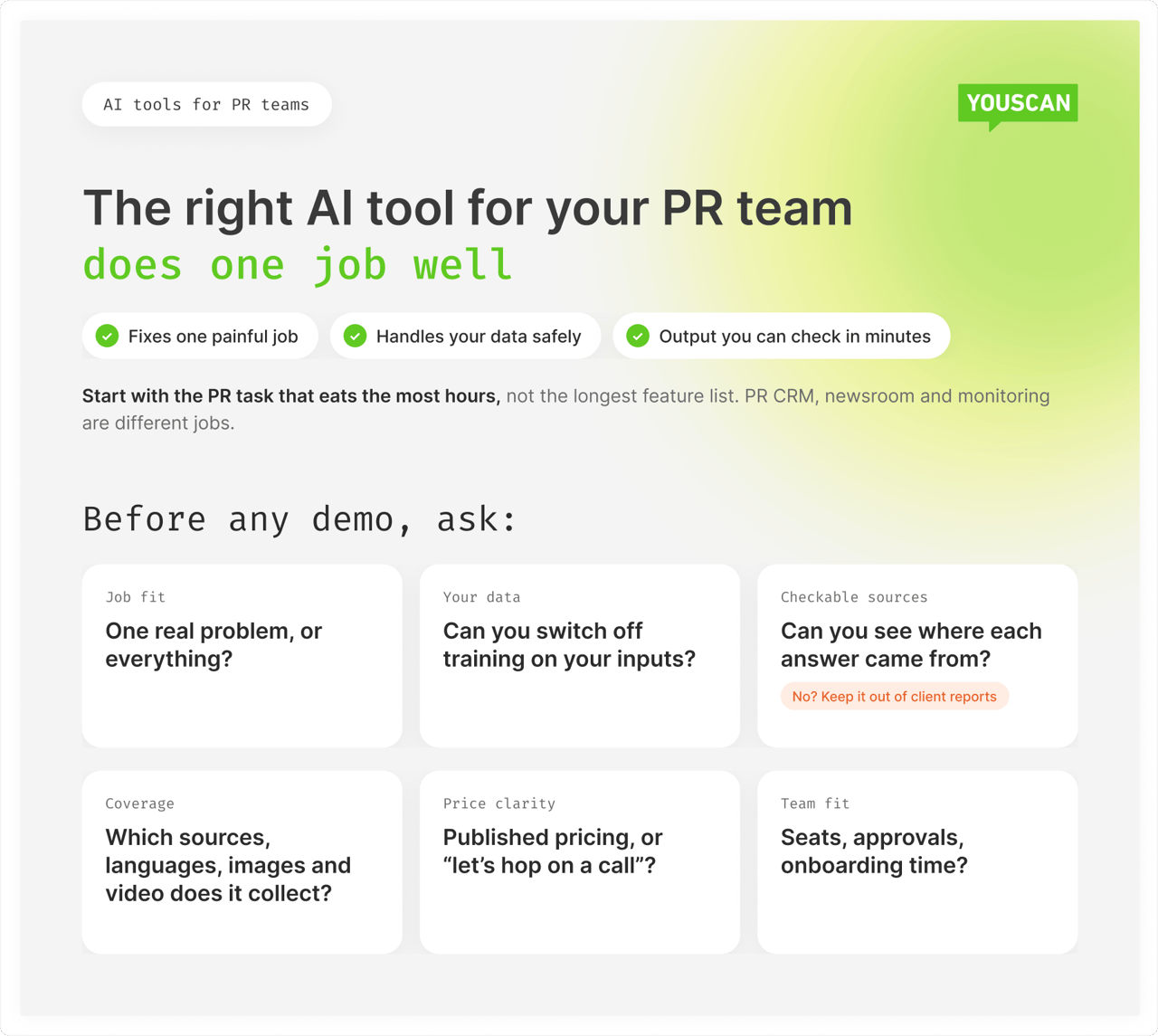
The best AI tool for your team fixes one painful job, handles your data safely, and produces output a human can check in minutes. Start with the task that eats the most hours, not the longest list of AI features. A PR CRM, newsroom management, and monitoring are different jobs, and one suite rarely does all three well.
Before any demo, ask:
Job fit: Does it solve one real problem, or promise everything?
Your data: What happens to text you paste in? Can you switch off training on your inputs?
Checkable sources: Can you see where each answer came from? If not, keep it out of client reports.
Coverage: For brand monitoring platforms, which sources, languages, and formats (images, video) get collected?
Price clarity: published pricing, or “let’s hop on a call”?
Team fit: seats, approvals, onboarding time.
Most PR teams skip the data question. Don’t: see the responsible-use section below.
Run a two-week pilot before you sign anything
Demos are designed to impress, so test with your own work instead. Pick one real task from last month, like a product launch, a tricky quarterly report, or a crisis that kept you up at night, and run it through the tool.
Then compare honestly. Did it catch what you caught by hand? Did it save time, or just move the work to a new tab? Ask a teammate who skipped the sales call to use it alone for a day. If they get stuck, the rest of your team will too.
The best AI tools for PR in 2026, sorted by job
The strongest AI tools for PR in 2026 fall into five groups: YouScan, Meltwater, and Determ for monitoring; assistants and an AI writing tool for drafting; Muck Rack and Prowly for media outreach; Otter.ai and DeepL for meetings and translation; and Signal AI and Brandi AI for measurement. Third-party prices are flagged.
AI-powered media monitoring and media intelligence
Writing a release takes an afternoon. Spotting a story turning against you at 7 a.m. on Saturday takes software that never sleeps. Yet Cision found only 40% of PR pros use AI-driven media monitoring. Too low, we think. (For depth, see social listening for PR, AI social listening, and our social listening tools list.)
1. YouScan
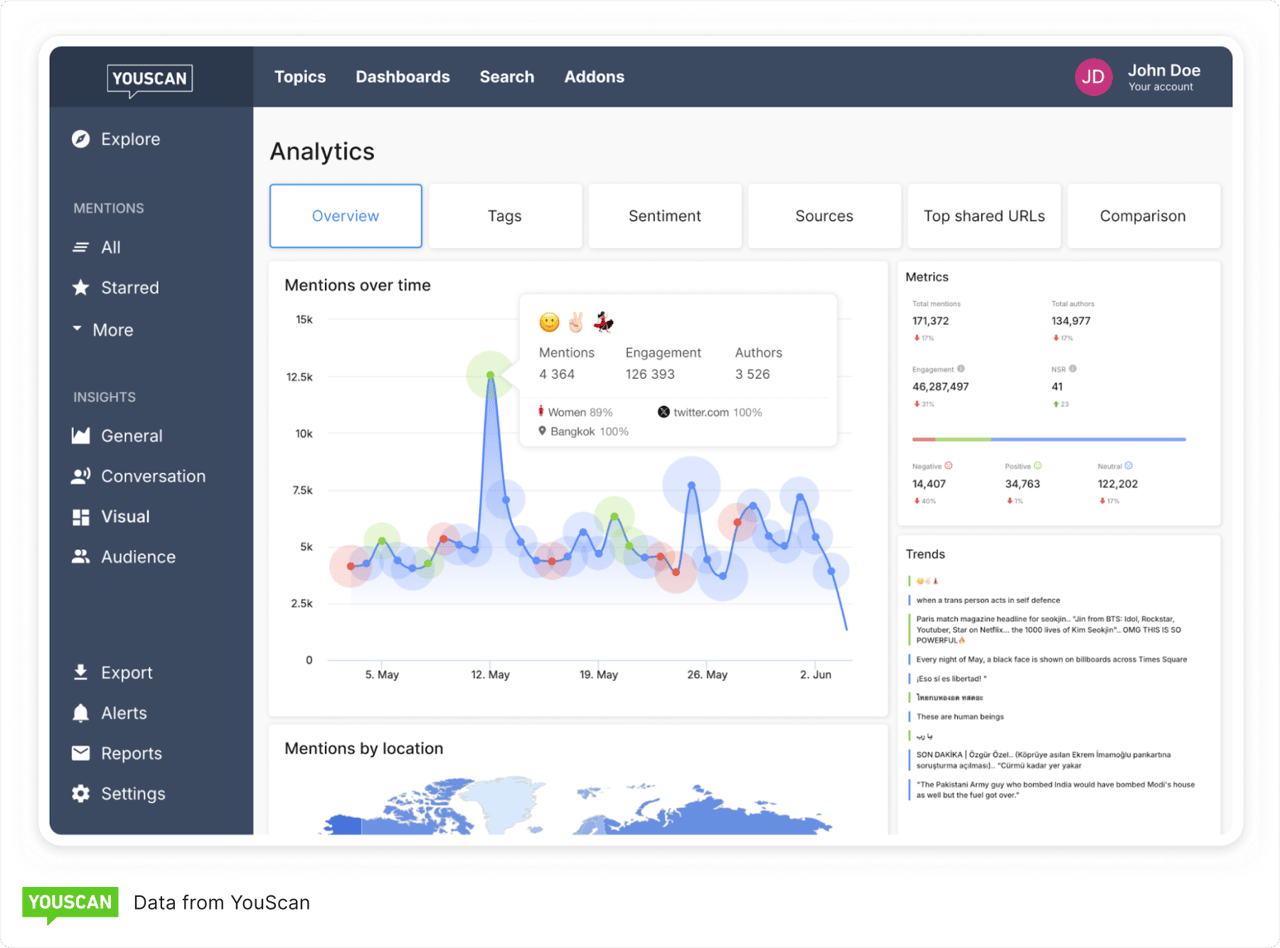
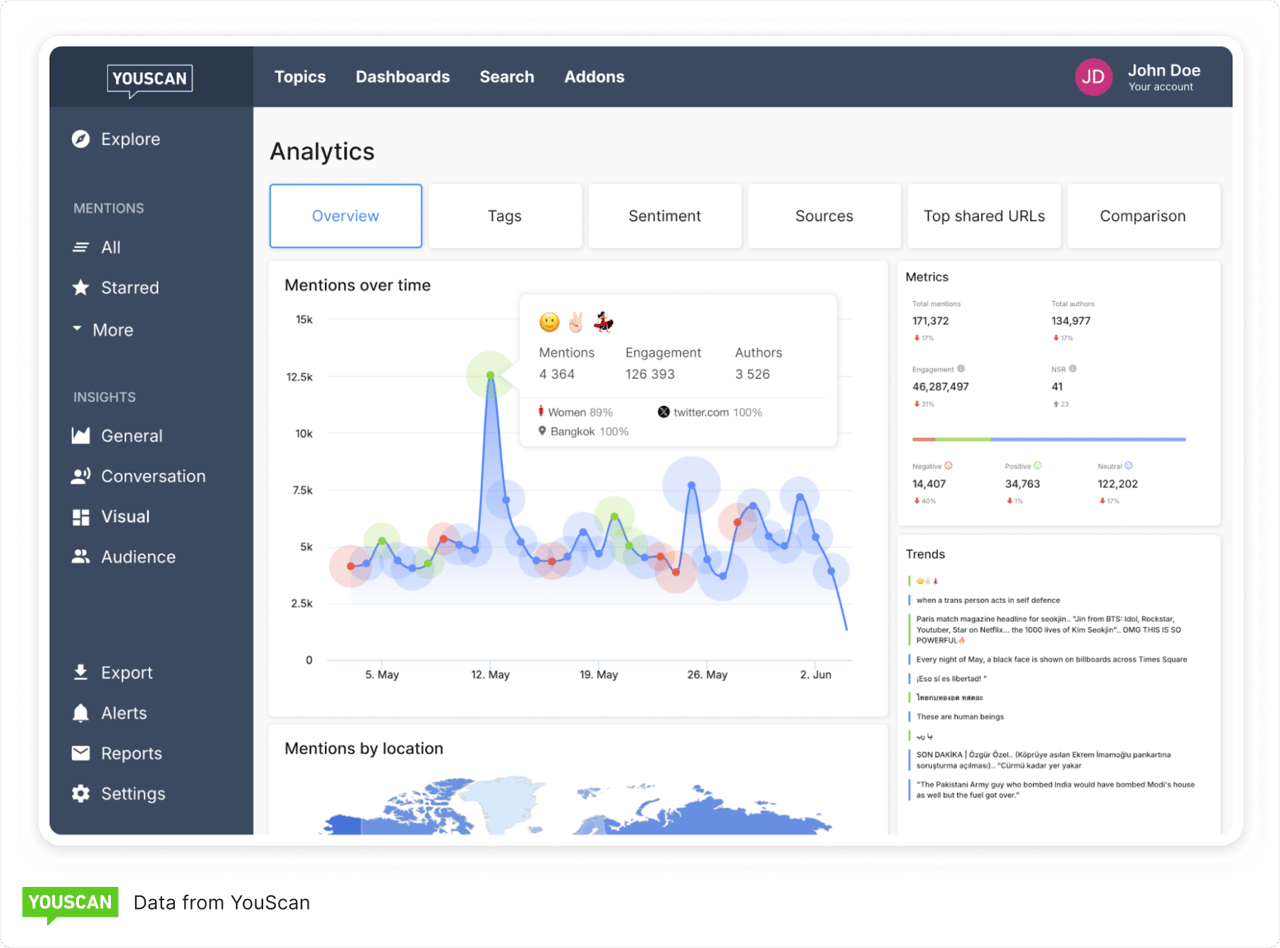
YouScan is an AI-powered listening platform that tracks brand mentions across social media platforms, blogs, forums, review sites, and news. Its strength is context: who’s talking, how they feel, and what’s in their photos. For PR professionals, that means seeing how a story moves from a news article into comment sections and reviews.
Key features:
Brand sentiment analysis and emotion detection
Visual Insights spots logos in images and video with no brand name in the text
Synthetic Audiences that help you test your PR brief on a set of synthetic personas before it goes live
Insights Copilot, an AI agent for plain-English questions; Insights Copilot 4.0 compares you with every competitor in one query and builds shareable reports
Real-time alerts to Slack or Teams, and unlimited users on every plan
Pricing: Starter is $499/month, billed annually (3 topics, 15,000 mentions, unlimited users); Unlimited is custom.
Trade-offs: no press release writer, press release distribution, journalist database, or AI-visibility tracking.
Best for: teams that need early risk detection, sentiment shifts, and visual mentions.
2. Meltwater
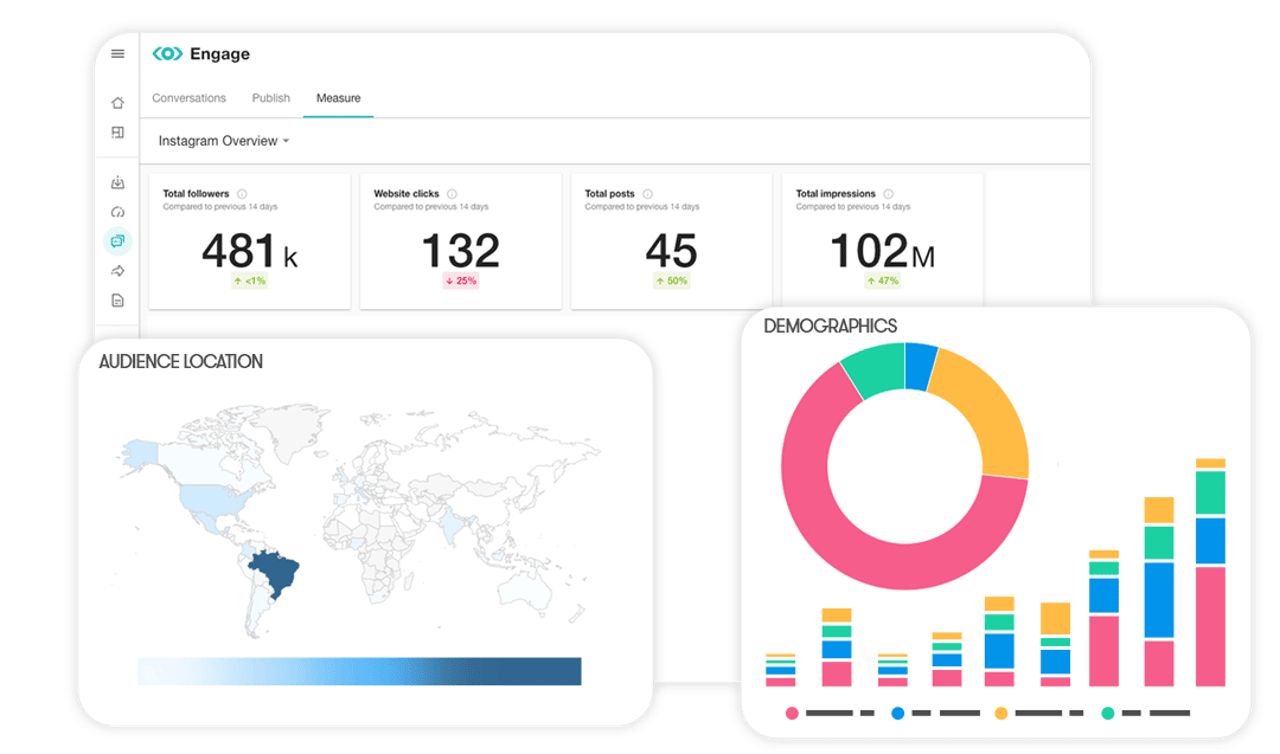
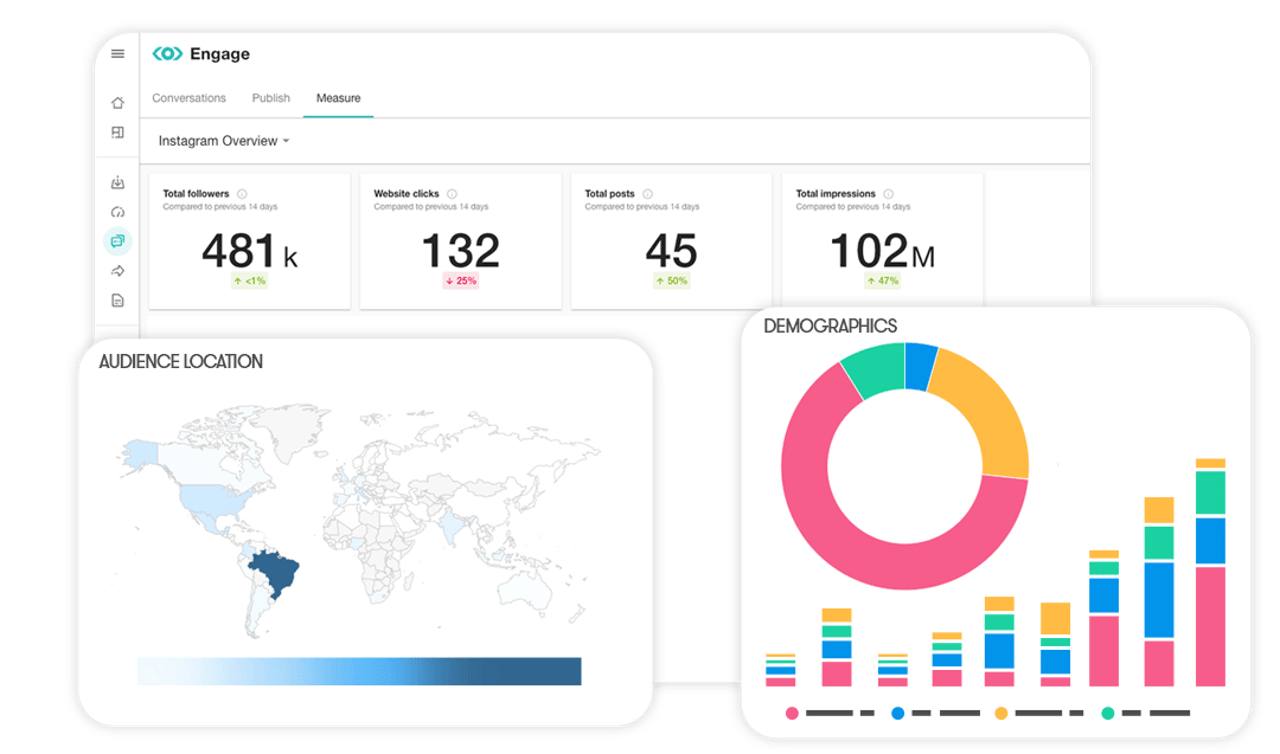
An enterprise media intelligence suite with the Mira AI assistant and GenAI Lens for AI visibility. It’s the closest thing to a one-vendor setup for traditional media, social, and outreach.
Key features:
News, broadcast, print, and social coverage
Database of journalists and key influencers
AI summaries and sentiment analysis
AI visibility tracking on every plan, with API access on bigger tiers
Pricing: quote only; Meltwater tailors pricing to your modules and scale.
Trade-offs: a dense interface and more suite than small teams need. Compare Meltwater competitors first.
Best for: global communications teams that want everything in one place.
3. Determ
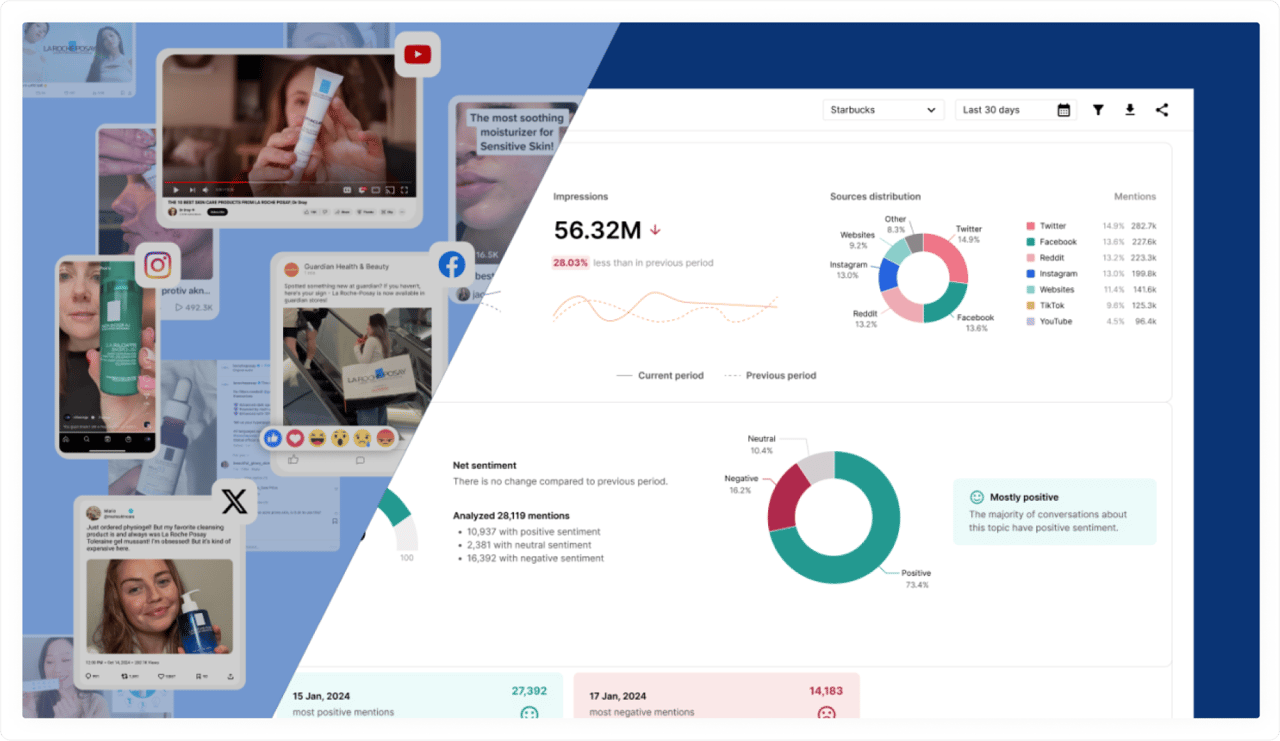
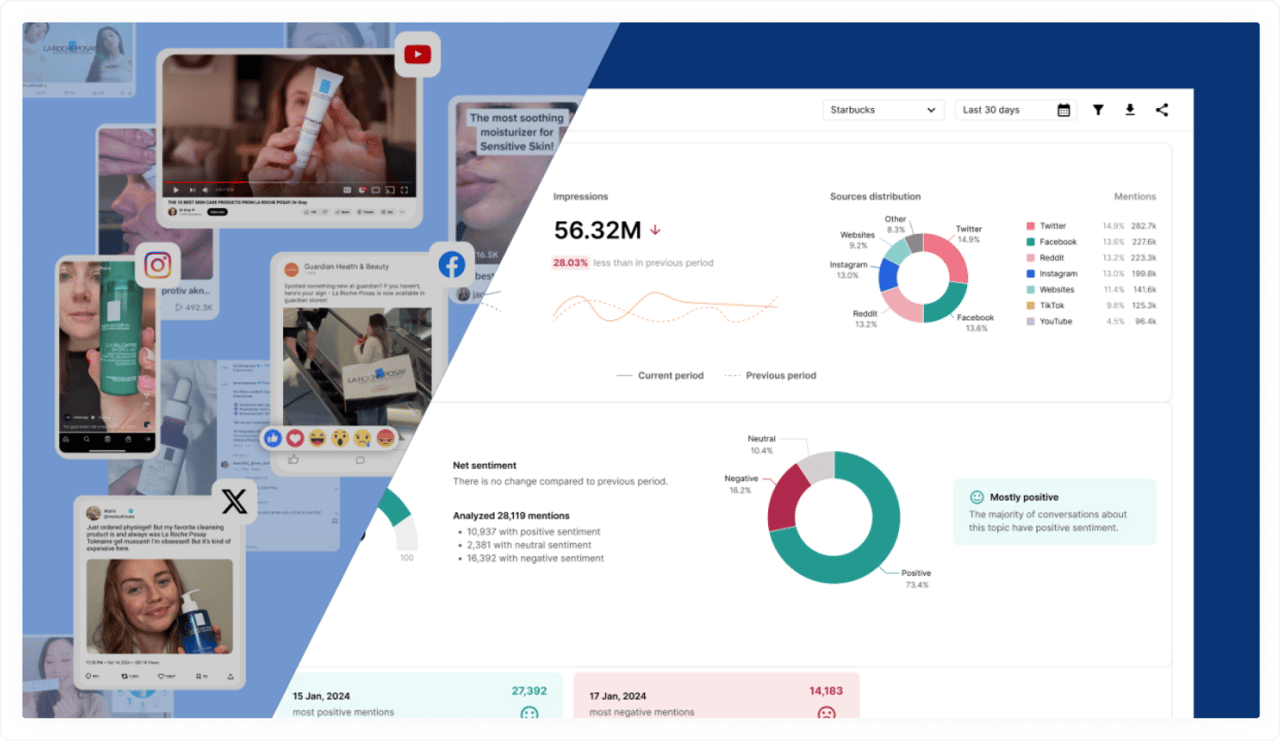
An AI-powered media monitoring tool with alerts, summaries, and PR reports. It’s one of the few platforms here that shows prices upfront, which makes budgeting easier.
Key features:
Keyword alerts with spike detection
Sentiment analysis and AI coverage summaries
Unlimited users and keywords
A 5-day free trial, extended to 14 days after a demo
Pricing: from €249/month billed annually (€299 monthly).
Trade-offs: no journalist database or press release distribution.
Best for: mid-sized teams that want transparent prices.
Writing and content generation: generic AI tools vs. an AI writing tool
This is where most AI-driven PR starts, and where most bad pitches come from. Cision’s 2026 State of the Media report found 53% of journalists oppose AI-generated pitches. Use them for content creation and content drafting, then rewrite like a person. (For social media posts, see AI in social media and PR in social media.)
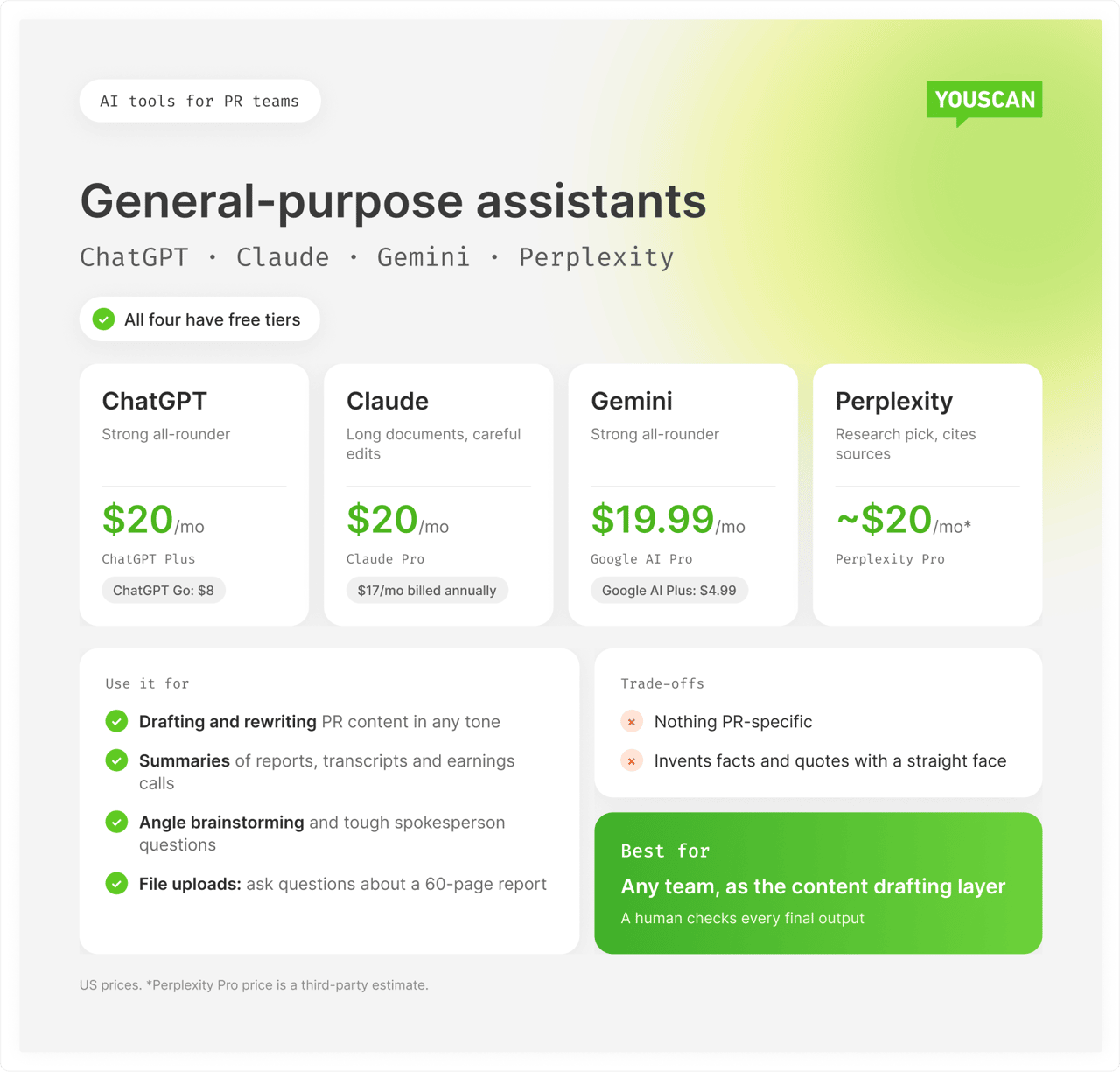
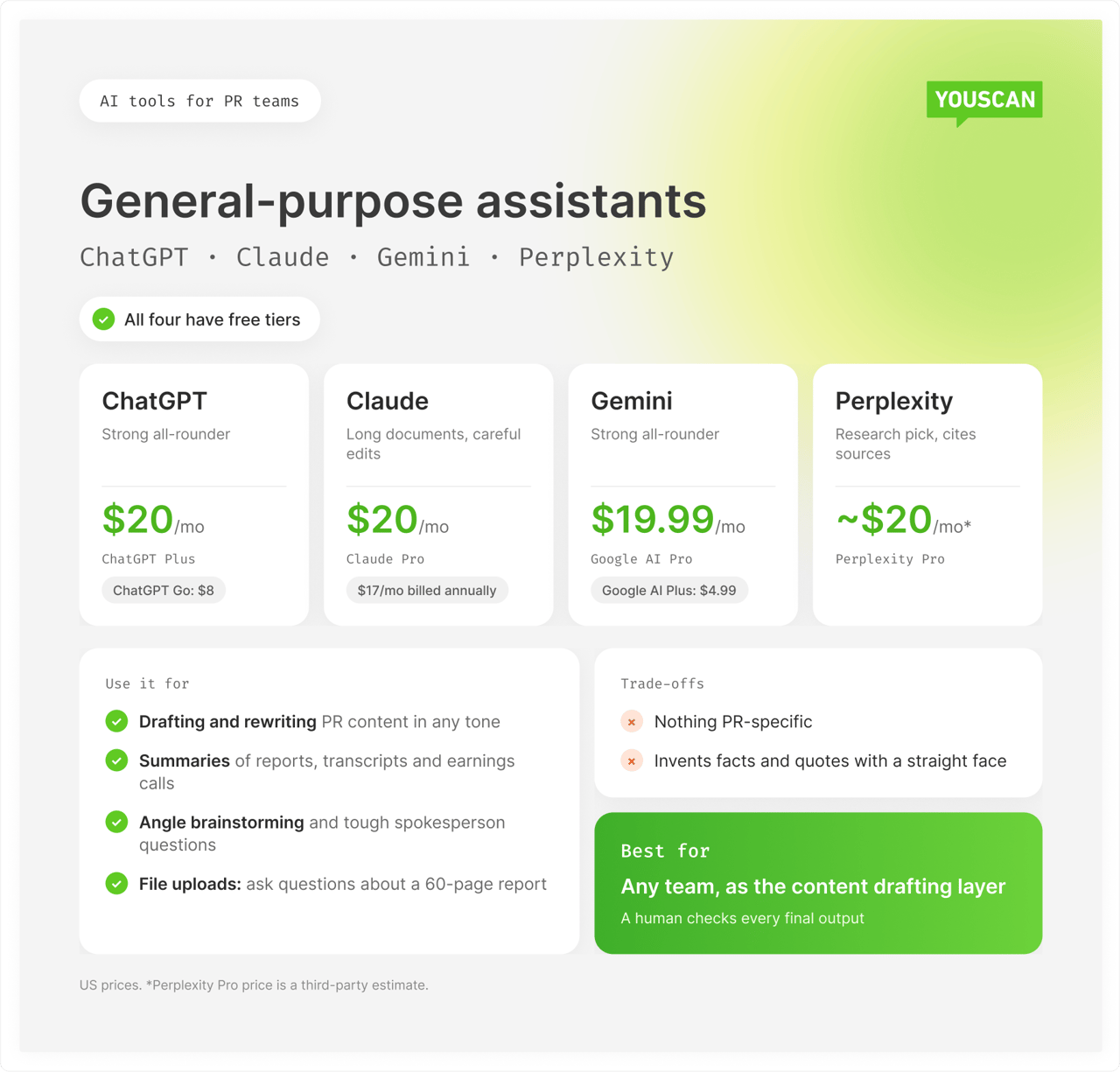
4. General-purpose assistants: ChatGPT, Claude, Gemini, and Perplexity
These generic AI tools handle first drafts of press releases, headline options, summaries, and Q&A prep. ChatGPT and Gemini are strong all-rounders, Claude is good with long documents and careful edits, and Perplexity is the research pick (it cites sources).
Key features:
Drafting and rewriting PR content in any tone
Summaries of reports, transcripts, and earnings calls
Angle brainstorming and tough spokesperson questions
File uploads, so you can ask questions about a 60-page report
Pricing: all four have free tiers. In the US, ChatGPT Plus and Claude Pro cost $20/month (Claude Pro drops to $17 billed annually), Google AI Pro $19.99, and Perplexity Pro about $20 (third-party estimate, verify). Cheaper tiers exist, like ChatGPT Go at $8 and Google AI Plus at $4.99.
Trade-offs: nothing PR-specific, and they invent facts and quotes with a straight face.
Best for: any team, as the content drafting layer, with a human checking every final output.
5. Grammarly (now part of Superhuman)
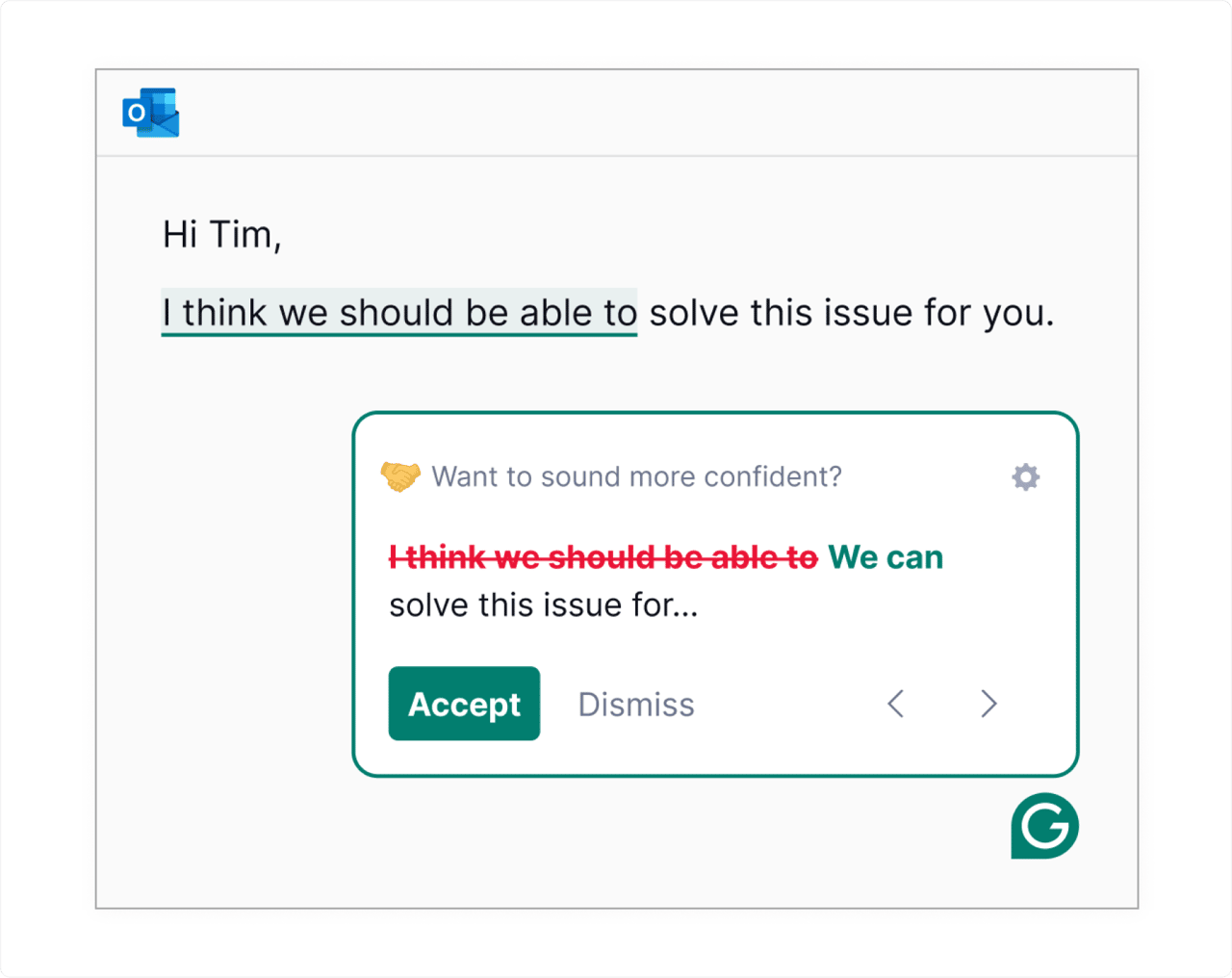
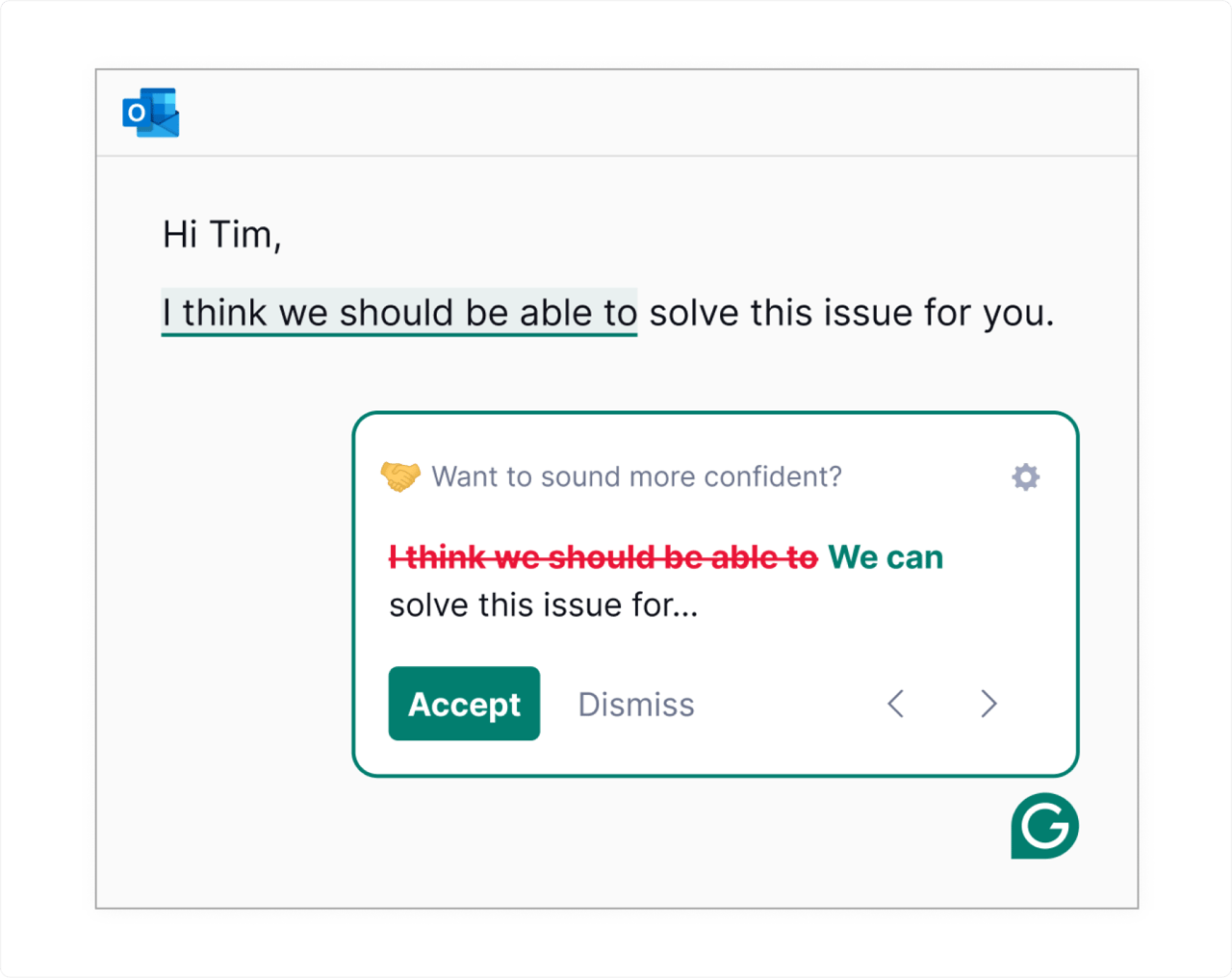
Checks grammar, tone, and clarity wherever you type. Its parent company is now called Superhuman.
Key features:
Tone and clarity checks across email and docs
Team style guides and brand tone
Generative rewrites for faster content creation
Superhuman Go, an AI assistant that works across your apps
Pricing: free plan; Pro is $12 per member/month billed annually ($15 monthly), and Business is $33 ($40 monthly).
Trade-offs: it polishes; it doesn’t research or fact-check.
Best for: clean, on-brand press releases and PR content.
6. Hypotenuse AI
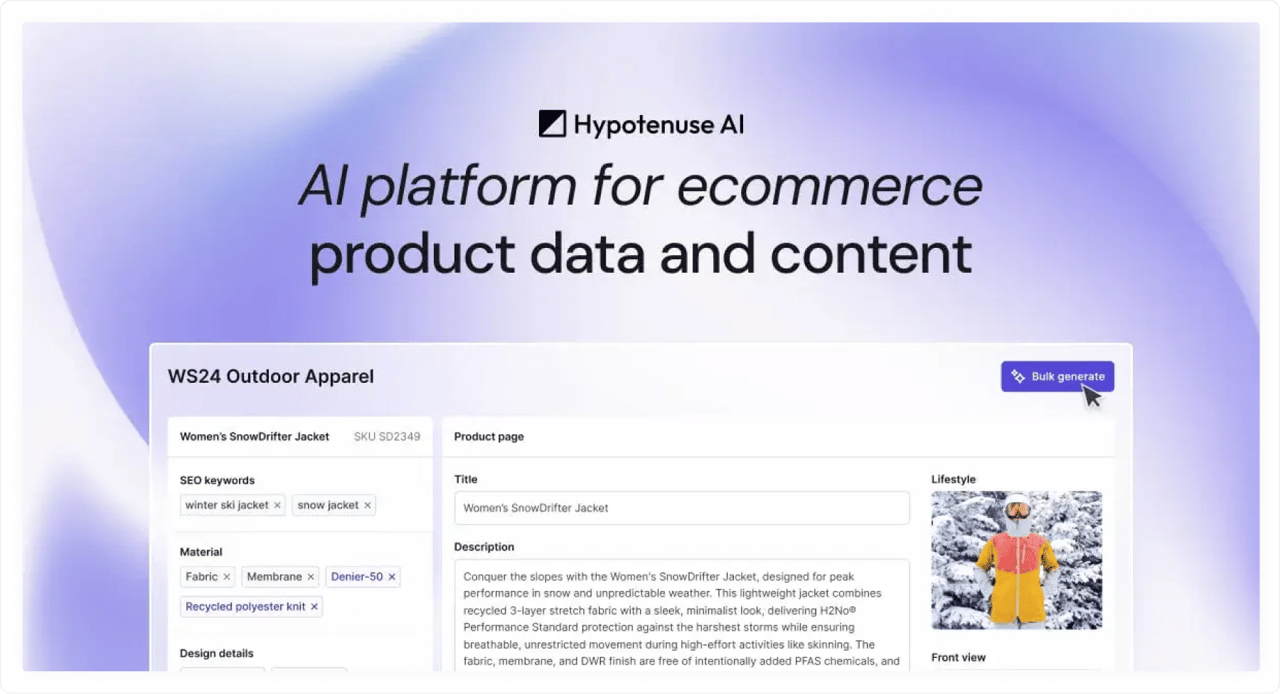
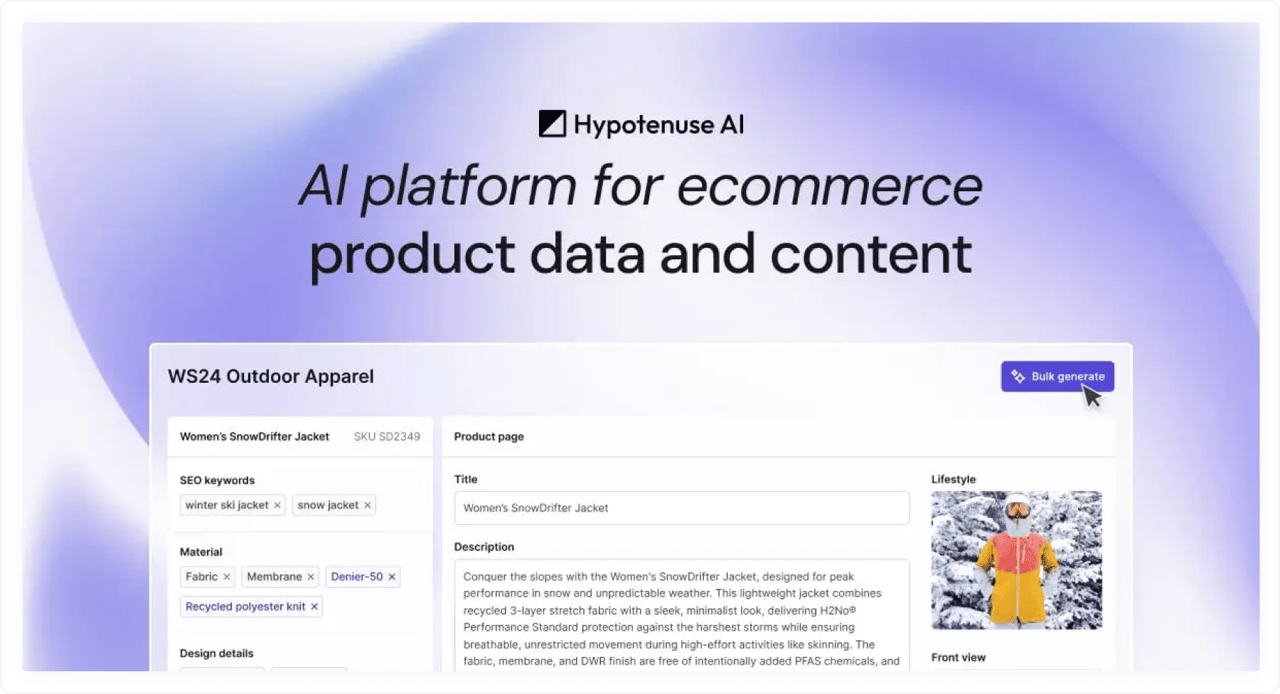
A content generation platform that now focuses on ecommerce. Product-heavy PR teams use it to generate content at volume: boilerplate and release variations.
Key features:
Bulk long- and short-form content creation
Brand voice settings
Product content workflows
Catalog descriptions at scale
Pricing: custom only, with a “Try for free” sign-up.
Trade-offs: built for marketing copy; embargoes and quotes are on you.
Best for: consumer brands mixing PR with content marketing.
Media relations and pitching
Here’s the thing: AI finds a reporter in seconds, but relationship building still happens one email at a time. These tools handle the list. You handle the person. (Leaving Cision? See Cision alternatives.)
7. Muck Rack (including PressPal.ai)
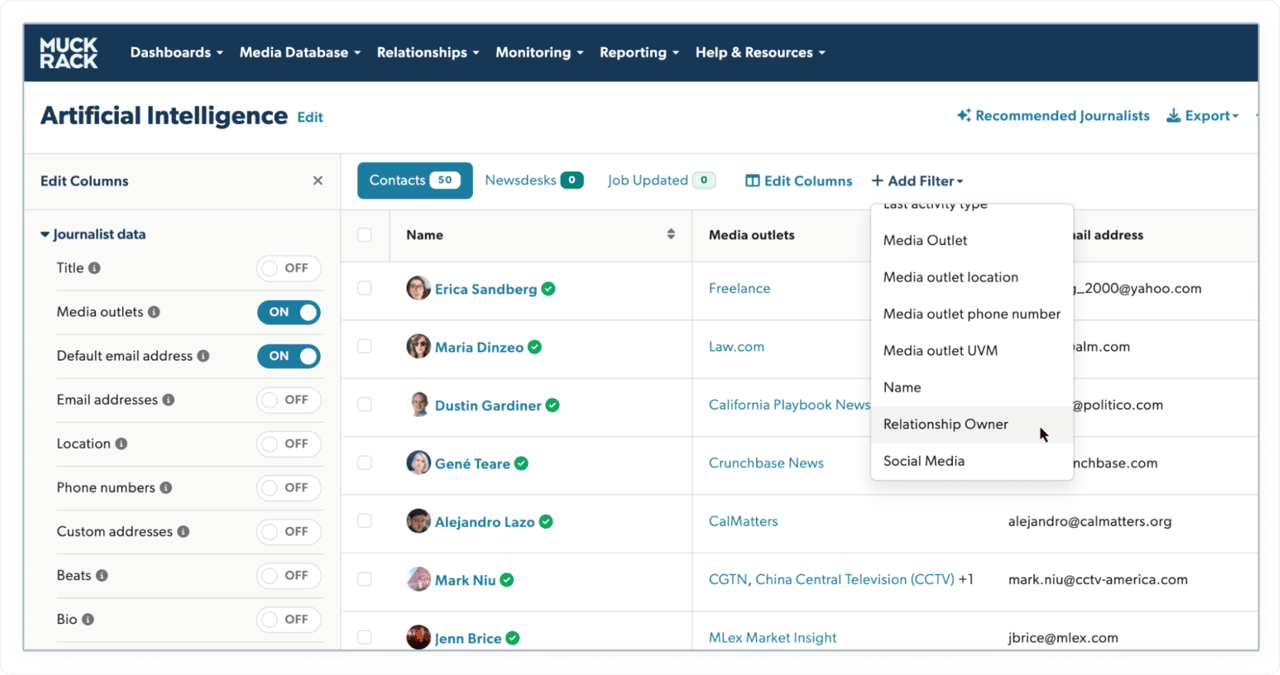
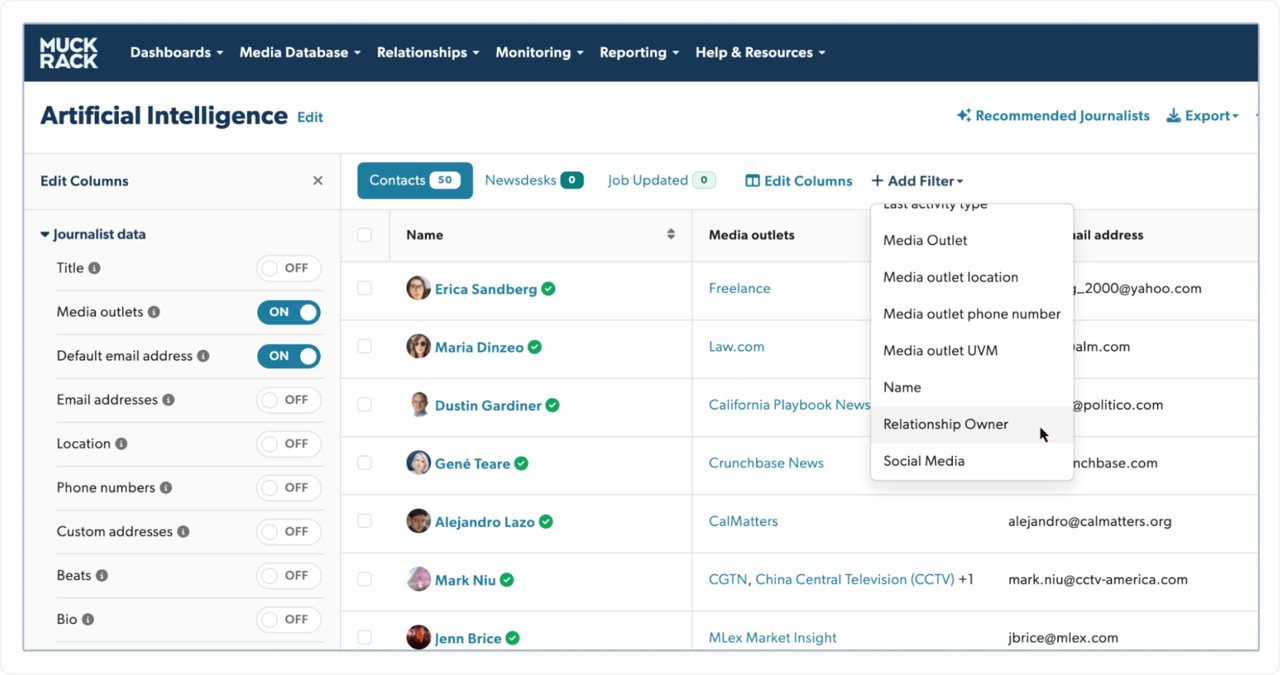
A media relations platform built around a journalist database. Its built-in PressPal.ai drafts press releases and suggests journalists. The Generative Pulse add-on tracks how AI models describe you.
Key features:
Journalist profiles with recent articles
Pitch tracking and a PR CRM
Media monitoring and coverage reports
Shared workspaces for agencies and in-house PR teams
Pricing: quote only (Starter, Standard, Premier), with separate plans for brands and agencies. Generative Pulse comes with Premier.
Trade-offs: custom quotes that can be steep for small teams, and no shortcut for relationship building.
Best for: PR professionals whose main job is finding the right reporters.
8. Prowly (Semrush AI PR Toolkit)
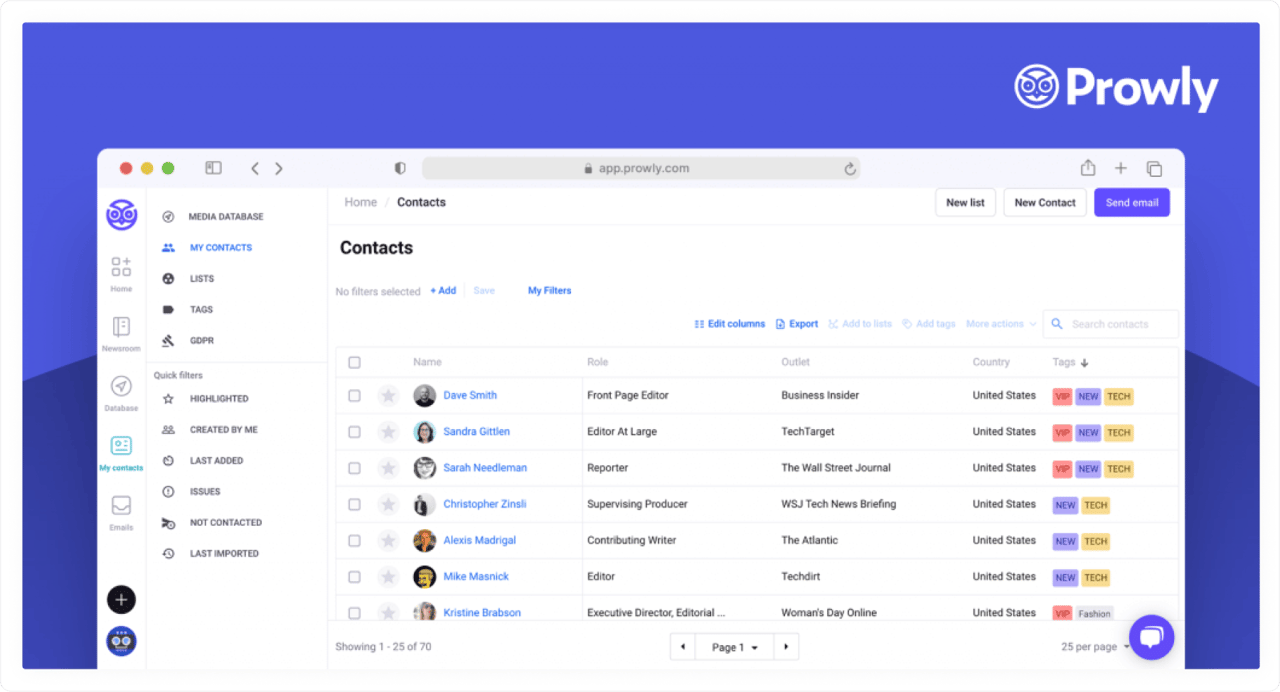
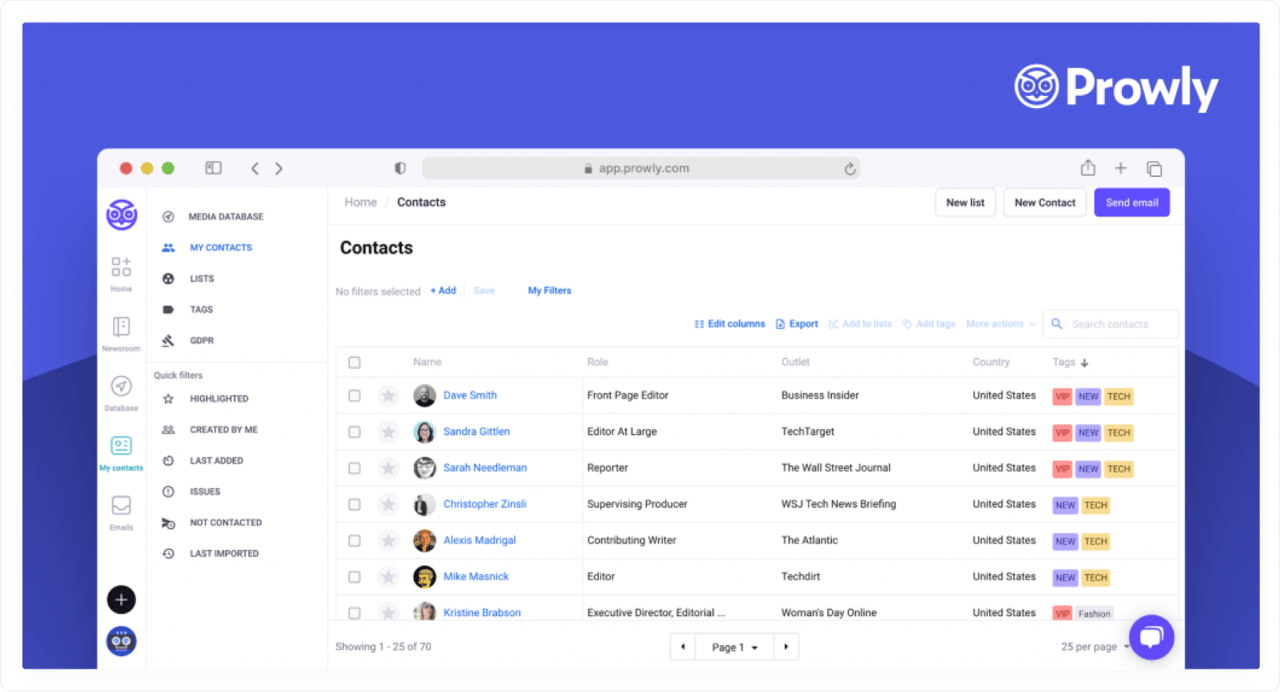
Semrush now sells Prowly as its AI PR Toolkit: media databases, email pitching, and coverage tracking.
Key features:
Media databases plus pitching with follow-ups
AI help writing press releases and pitches
Reports on which outlets AI chatbots cite
Email analytics and media monitoring from Pro up
Pricing: $149, $279, or $499 per month; 7-day free trial.
Trade-offs: monitoring starts on Pro, and listening is light.
Best for: small PR teams that want media outreach at a clear price.
Meetings and translation: where you win back team hours
Nobody brags about transcribing a 50-minute interview. Why would they? These tools take over repetitive tasks, so you save time for thinking.
9. Otter.ai
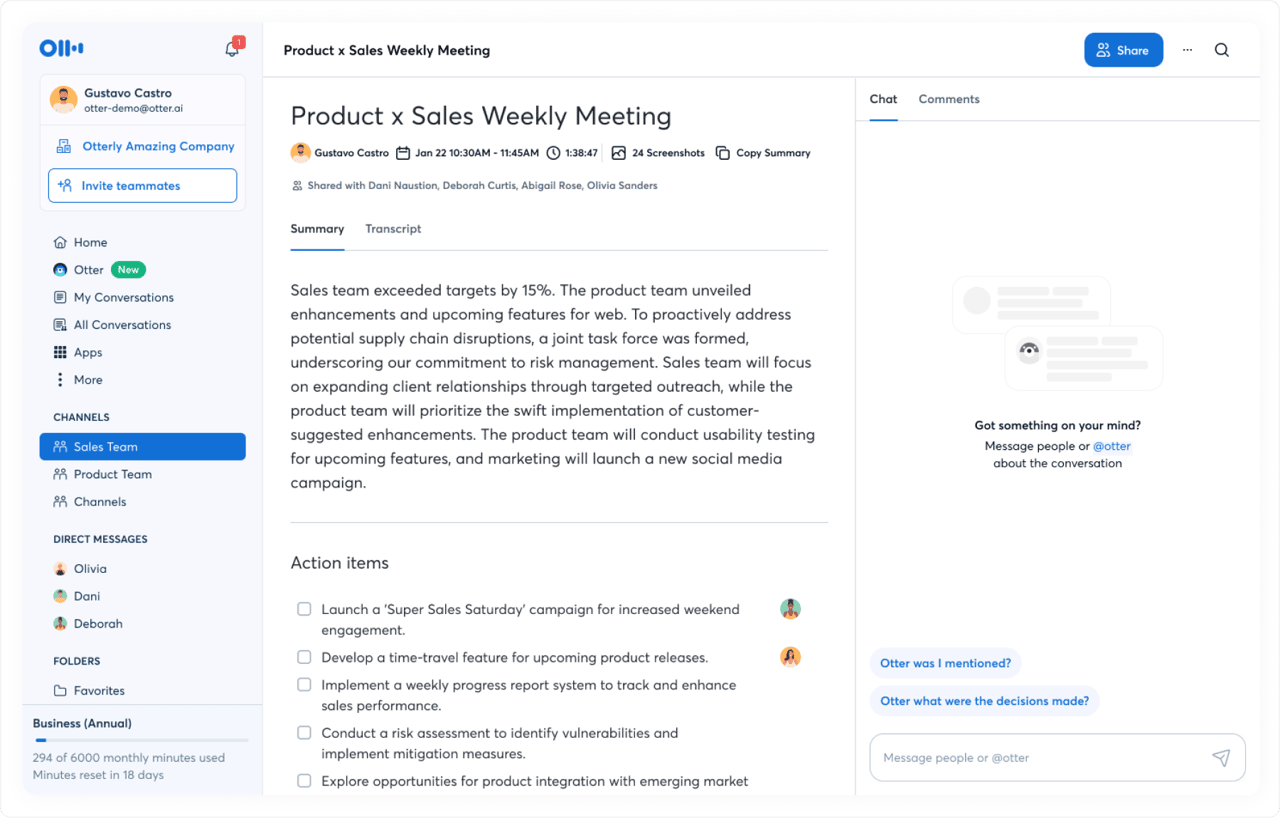
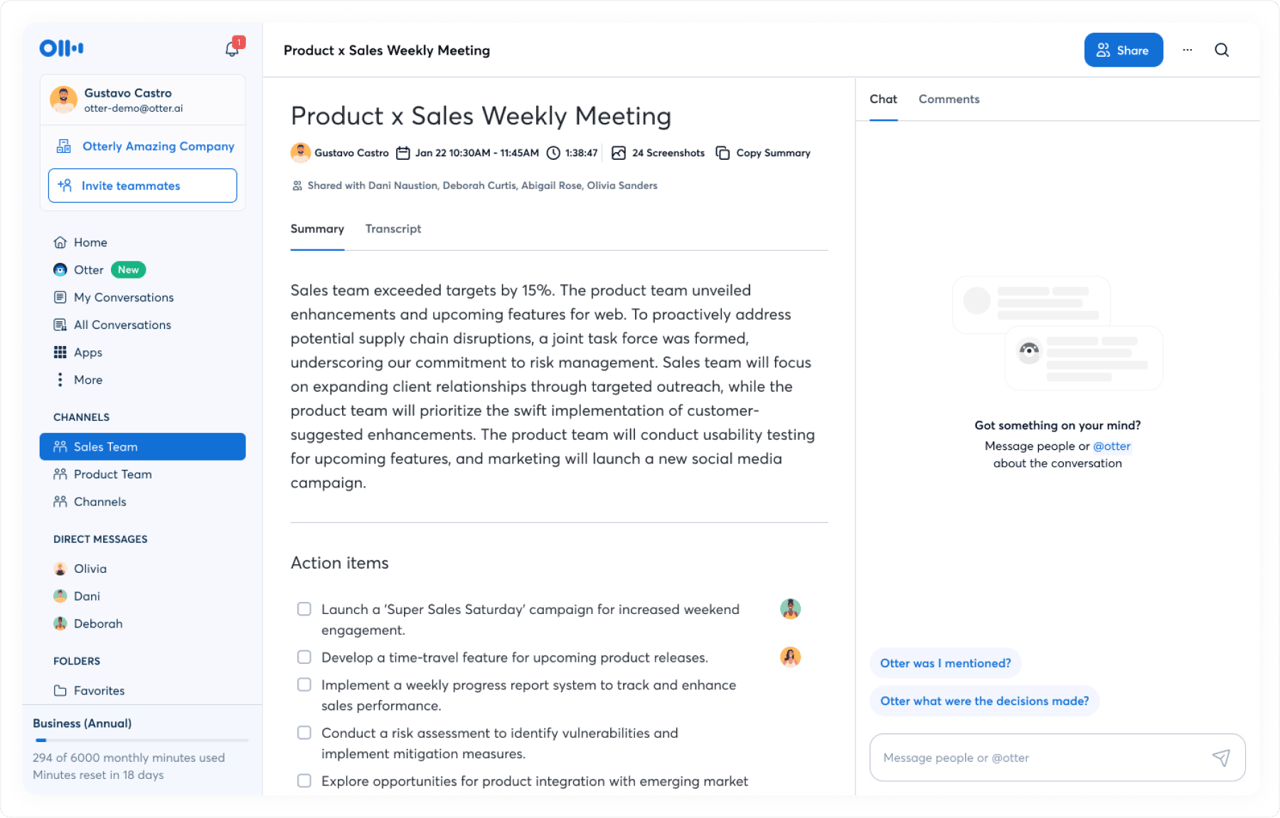
An AI meeting assistant that records, transcribes, and summarizes calls. It’s handy for interviews, spokesperson prep, and those client check-ins where everyone remembers the decisions differently.
Key features:
Live transcription with speaker labels
Summaries and action items
Searchable archive
Works with Zoom, Google Meet, and Microsoft Teams
Pricing: free Basic plan; Pro $16.99/user/month ($8.33 annually), Business $30 ($19.99 annually).
Trade-offs: accents and crosstalk hurt accuracy, and you need consent to record.
Best for: PR professionals who live in interviews and media training.
10. DeepL Pro
A translator known for natural-sounding output, handy for localizing press releases and holding statements.
Key features:
Document translation
Glossaries and tone controls
Data protection on paid plans
Desktop and browser apps
Pricing: Individual is €7.49/month billed annually (300,000 characters a month); Team is €24.99 per user. These are EU prices with VAT.
Trade-offs: a native speaker should review anything public, especially crisis wording.
Best for: international comms teams.
Measurement and AI visibility: your media mentions inside AI answers
AI assistants are now an audience. Do you know what they say about you? Nic Newman of the Reuters Institute writes that “search engines are turning into AI-driven answer engines, where content is surfaced in chat windows.” The PRCA’s How to Measure GEO guide (June 2026) covers brand visibility in AI answers, and co-lead Jonny Bentwood was blunt: “GEO is too important to hand to vanity metrics.”
11. Signal AI
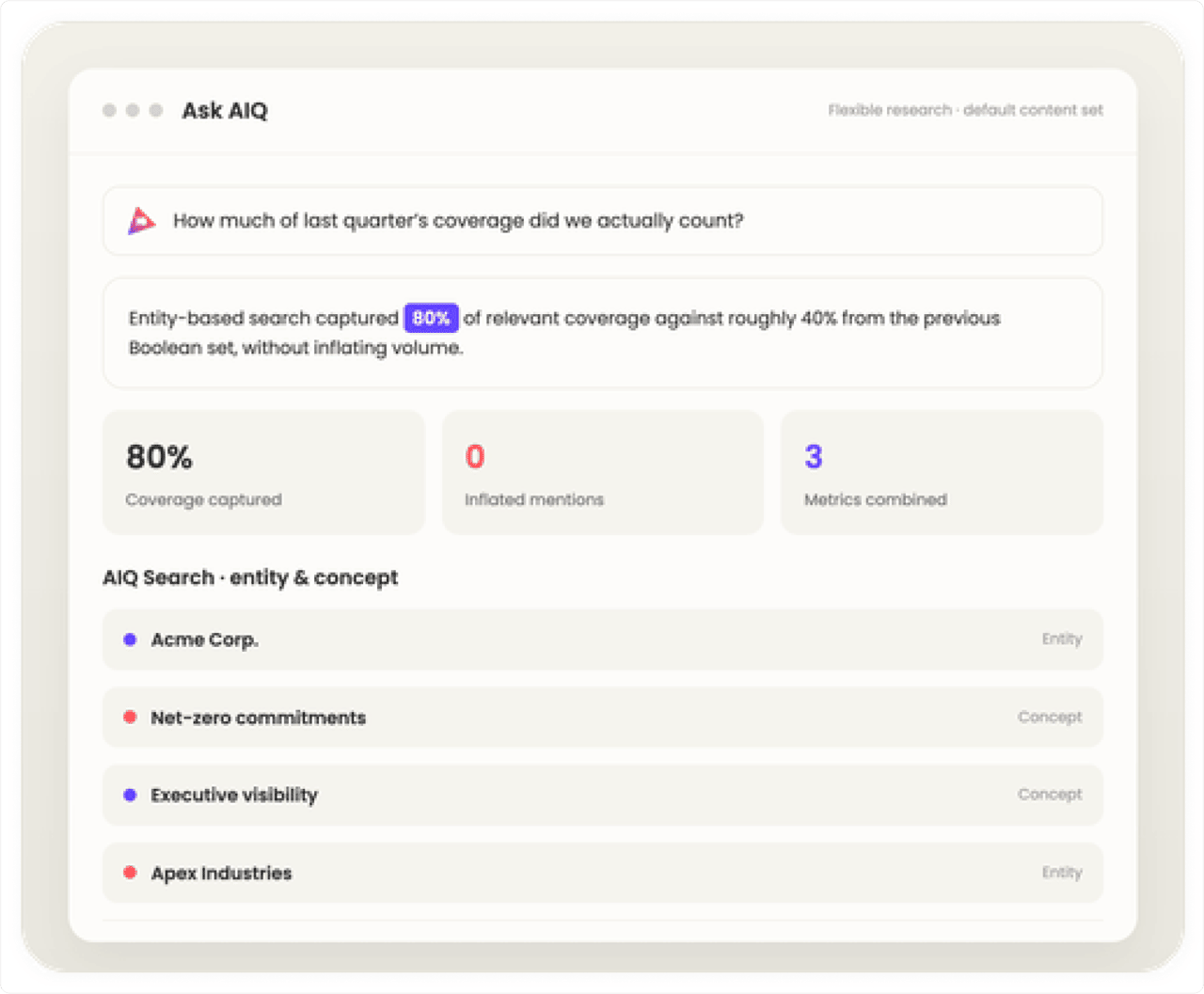
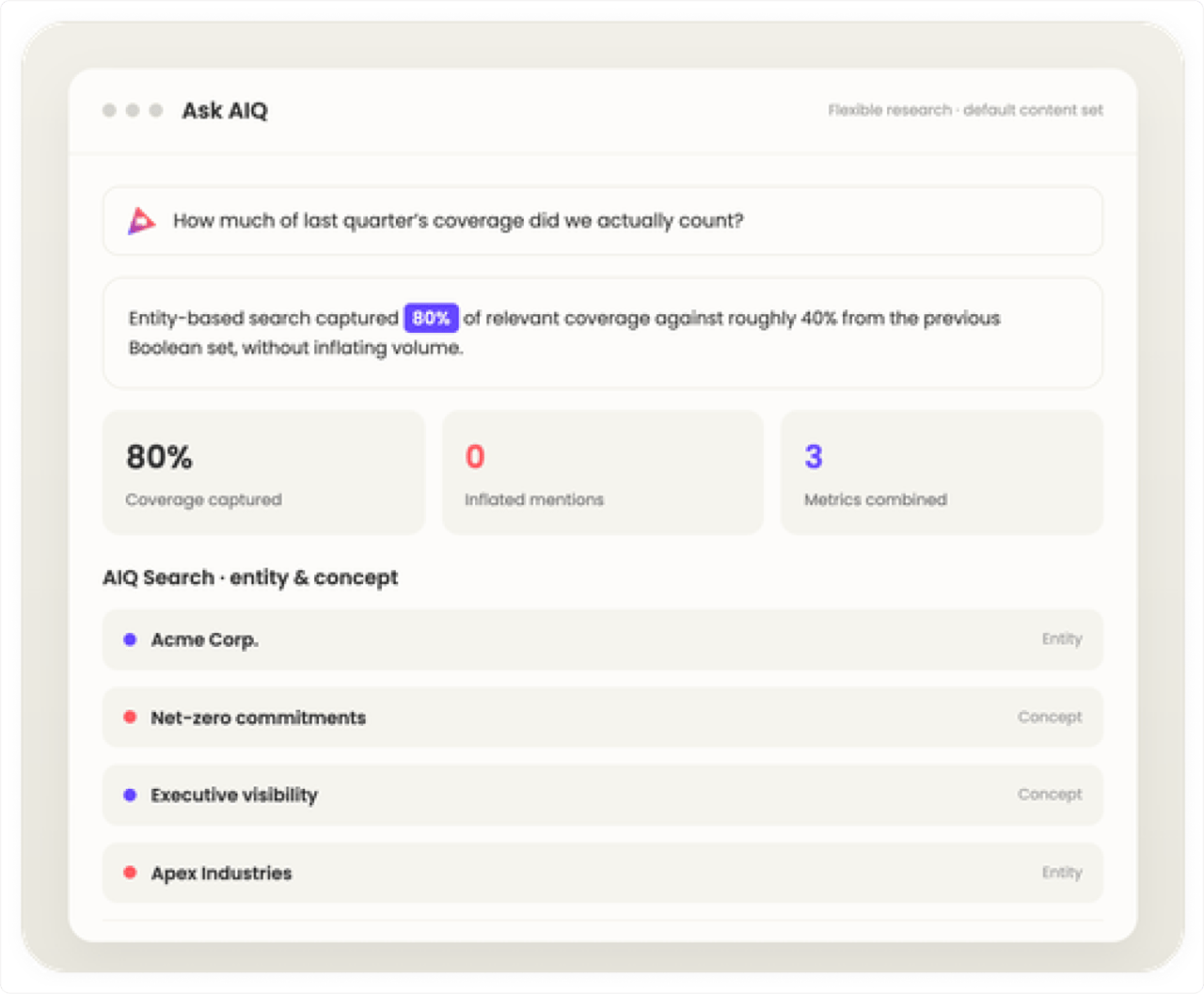
An enterprise intelligence platform for reputation and issues, built on its SIGNAL AIQ engine.
Key features:
Ask AIQ assistant for questions about coverage
Risk Scanner for emerging issues
Connectors to Claude, ChatGPT, and Copilot
AI Citations reporting for how AI models source answers about you
Pricing: quote only.
Trade-offs: enterprise-sized in price and setup.
Best for: communications leaders reporting reputation to the board.
12. Brandi AI
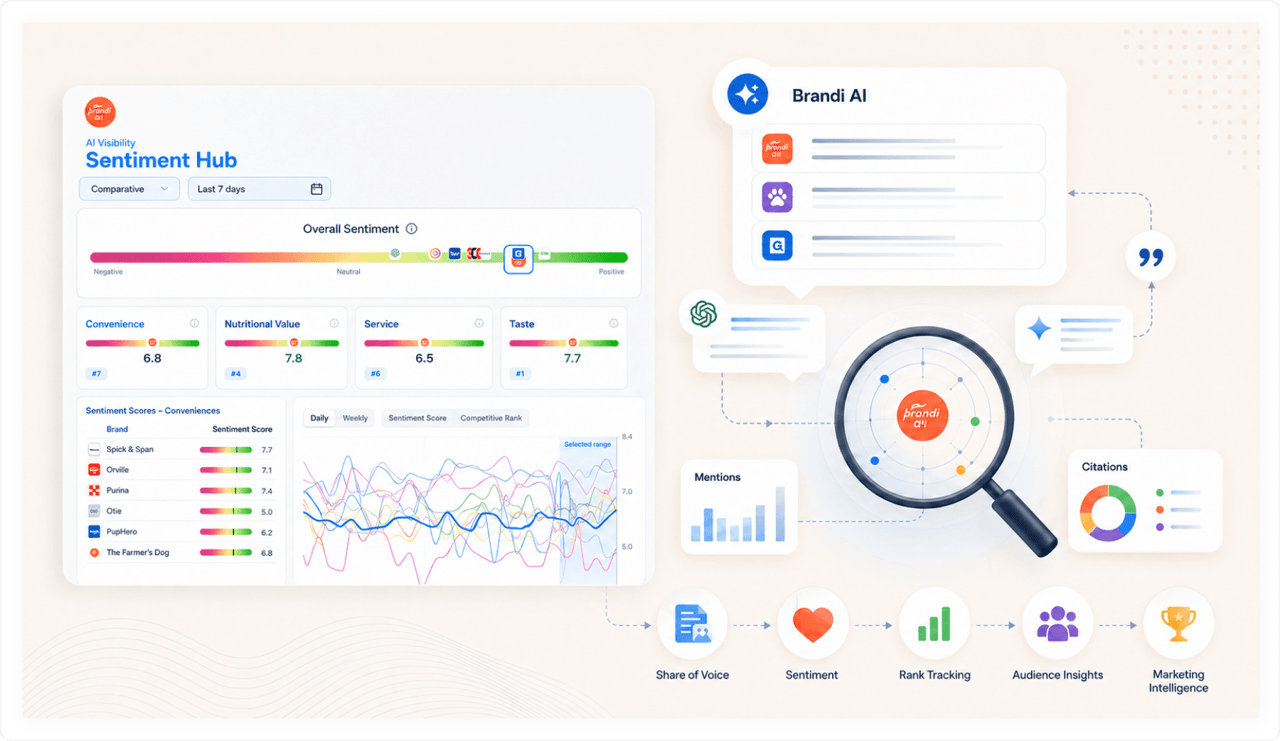
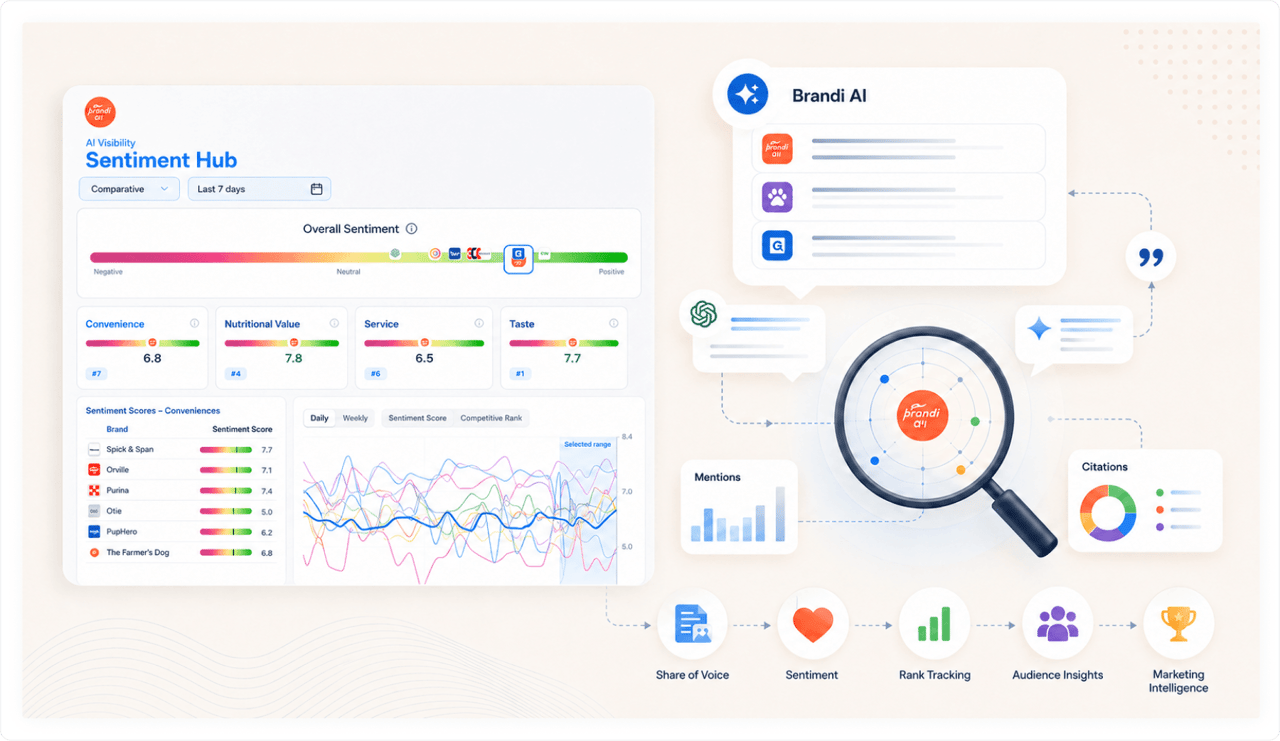
A generative engine optimization (GEO) tool that shows how AI assistants describe you and which sources they use.
Key features:
Brand mentions in AI answers
Citation and share of voice tracking
Competitor comparison
Pricing: from $349.99/month for up to 100 prompts across 2 AI models (from G2; Brandi’s own site lists no prices, so confirm in a demo).
Trade-offs: a young category with few independent benchmarks.
Best for: brands and agencies measuring how they show up in AI answers, and which coverage feeds those answers.
Should AI generate content or offer decision support?
AI tools are better at decision support than at writing for you. A weak draft costs ten minutes; a missed crisis costs a client. The strongest PR teams use generative AI for content drafting, and trust tools that read monitoring data, identify patterns, and show how stories evolve across social platforms.
Think of a Monday at an agency. Someone exports 600 mentions, tags them by hand, and by Wednesday the narrative movement they charted is old. Manual workflows like that are why automated reporting exists. Now flip it: a Saturday alert flags a sentiment drop, the summary traces it to one TikTok video, and you’re drafting a holding statement before the client calls.
Which of those Mondays sounds like yours? If it’s the first one, a better writing tool won’t help much. Your bottleneck is reading.
And no, predictive analytics won’t write tomorrow’s headline. Getting from data analysis to strategic interpretation takes strategic thinking, human creativity, and someone who knows your PR strategy. That’s strategic counsel, the part of PR work that’s still yours.
Which AI tools fit your communications teams?
Match the tool to your biggest PR job, then check what’s most likely to go wrong. Most communications teams end up with two or three AI tools: an assistant, one platform for outreach or monitoring, and something for reporting.
Your biggest PR job | Tools to look at | What to check first |
Monitoring and crisis early warning | YouScan, Meltwater, Determ | Source coverage, visual recognition, alerts |
Drafting, editing, research | ChatGPT, Claude, Gemini, Perplexity; Grammarly | Data handling and a review step |
Finding journalists and pitching | Muck Rack, Prowly | Database freshness and contract length |
Interviews, calls, translation | Otter.ai, DeepL Pro | Recording consent and confidentiality |
Reporting and AI visibility | Signal AI, Brandi AI, Meltwater GenAI Lens | Methodology and prompt coverage |
Everything, enterprise scale | Meltwater, Muck Rack | Budget and onboarding time |
Ethical considerations: how to use AI in PR responsibly
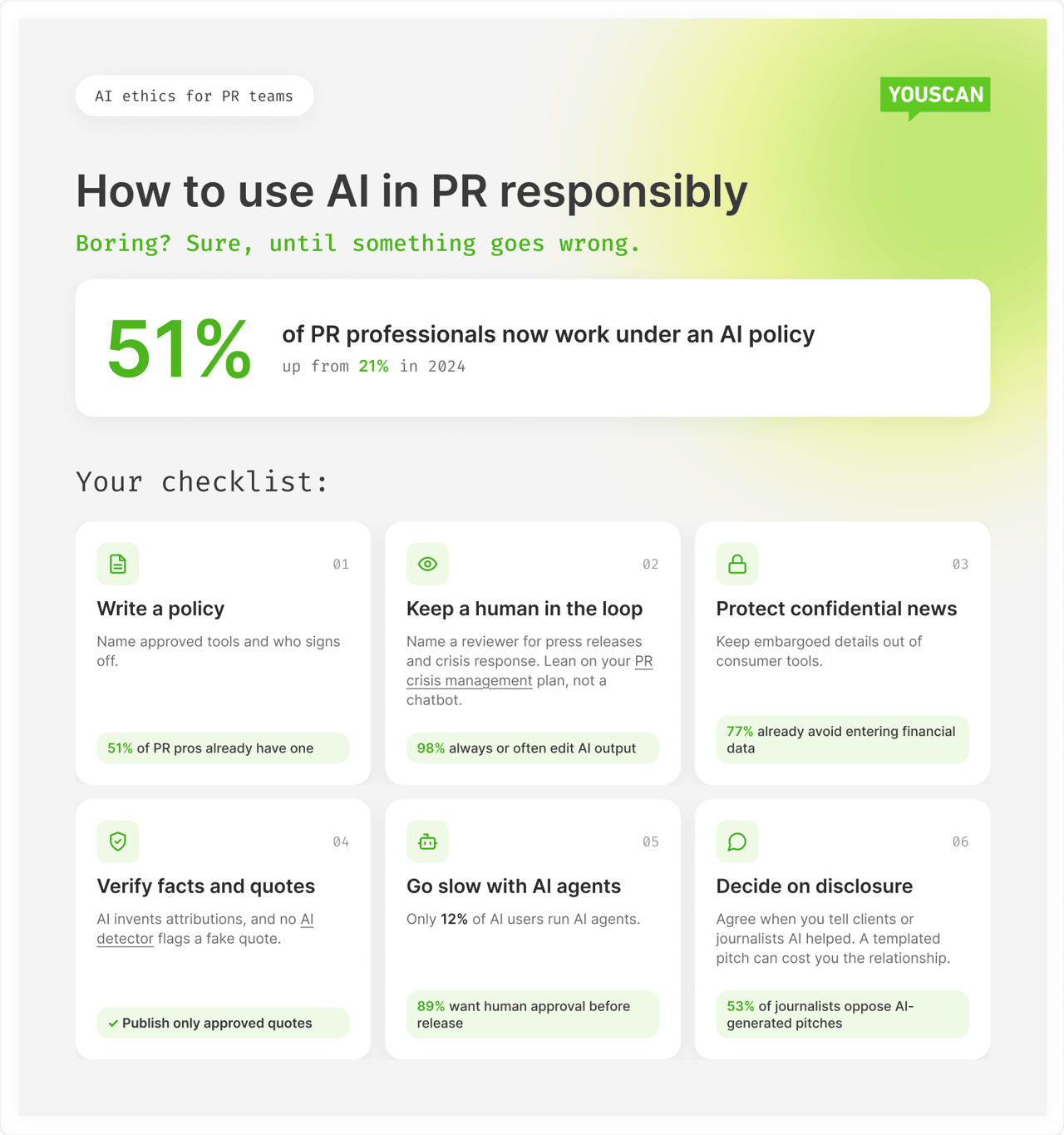
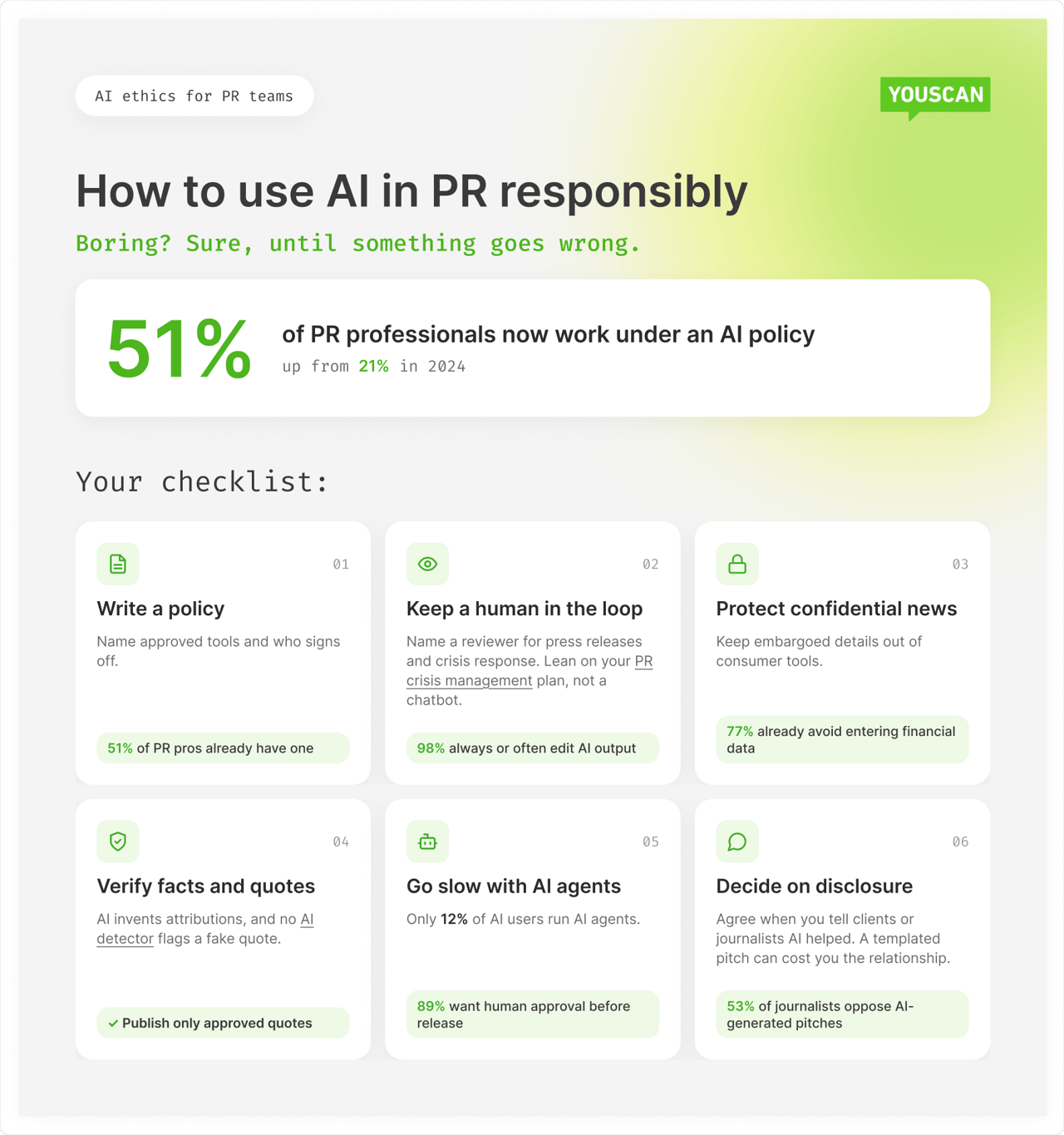
Using AI in PR responsibly means a written policy, human oversight of everything that goes out, careful handling of unreleased news, and checking every fact and quote. Boring? Sure, until something goes wrong.
Muck Rack found 51% of PR professionals now work under an AI policy, up from 21% in 2024. “Without that, AI either goes unused or creates more risk than value,” said Greg Galant, Muck Rack’s CEO, on tools, training, and permissions.
Your checklist:
Write a policy. Name approved tools and who signs off.
Keep a human in the loop. In the same survey, 98% always or often edit AI output. Name a reviewer for press releases and crisis response, and lean on your PR crisis management plan, not a chatbot.
Protect confidential news. Keep embargoed details out of consumer tools; 77% already avoid entering financial data.
Verify facts and quotes. AI-generated content invents attributions, and no AI detector flags a fake quote. Publish only approved quotes.
Go slow with AI agents. Only 12% of AI users run AI agents, and 89% would feel better with human approval before release.
Decide on disclosure. Agree on when you tell clients or journalists AI helped. With 53% of journalists opposed to AI-generated pitches, a pitch that reads like a template can cost you the relationship.
Cision CEO Guy Abramo said it well: “The teams that can blend human insight with intelligent automation will be the ones who define the next era of PR.”
So, what’s the best AI tool for public relations?
There isn’t one, just the right tool for each job in public relations: drafting, pitching, transcripts, monitoring, and measurement.
If you’re starting from zero, here’s a simple order. Pick the job that costs your team the most hours each week. Pilot one tool for that job for a month, with a named reviewer for every output. Count the hours you got back, then decide whether to add a second tool.
That’s slower than signing up for five tools on a Friday afternoon. It’s also the version that survives the next budget review. Let AI take the grunt work; human creativity does the rest.
If your painful task is knowing what people say before your CEO does, book a YouScan demo to see AI-powered monitoring, sentiment, and visual recognition on your own data.
Frequently asked questions (FAQs)
What are the best AI tools for public relations?
It depends on the job. YouScan, Meltwater, and Determ monitor media coverage and sentiment. ChatGPT, Claude, Gemini, and Perplexity handle drafting and research. Muck Rack and Prowly cover media lists and pitching. Otter.ai transcribes meetings, while Signal AI and Brandi AI handle measurement. Most PR teams combine two or three AI tools.
How is AI used in public relations?
PR teams use AI to draft press releases and pitches, summarize research, build media lists, transcribe interviews, monitor coverage and sentiment, and report results. A growing number of teams also track how AI assistants describe their brand. Humans still review the output, because AI invents facts and quotes, and journalists can usually spot a templated pitch.
Will AI replace PR professionals?
No. AI speeds up drafting, research, transcription, and monitoring, but PR depends on judgment, journalist relationships, and accountability. Practitioners almost always edit AI output before it ships. The realistic change is that routine tasks get faster, while strategy, ethics, and trust with reporters matter more than before.
How do PR teams track their brand in AI search answers?
They use AI visibility tools that run a fixed set of prompts across ChatGPT, Gemini, and Perplexity, then record whether the brand appears, how it’s described, and which sources get cited. Brandi AI and Meltwater’s GenAI Lens are examples. Results change as AI models update, so teams track them monthly, alongside news and social monitoring.