What Is Share of Voice? Why and How to Measure It


Here’s the uncomfortable truth about market share: you can’t really see it. Not in real time, anyway. Your competitors aren’t going to email you their sales figures, and by the time the industry reports land, the quarter’s already gone. So marketers do the next best thing. They measure the noise instead of the money — how much of the conversation a brand owns versus everyone else.
That’s share of voice. Used well, it’s one of the few numbers that tells you where you’re going instead of where you’ve been. Used badly, it’s a vanity metric. We’ll get to that part.
What is share of voice, really?
Share of voice (SOV) measures your brand’s visibility against your competitors on a given channel. That’s the whole idea. It was born in advertising, back when it literally meant the percentage of category media spending you owned. Outspend the field, own the loudest voice, done.
That version still works for paid media. It just stopped being the whole story a long time ago.
These days, share of voice measures your brand’s presence wherever people bump into brands: social media platforms, organic search, paid advertising, and PR. Social teams watch social media SOV through brand mentions and social media conversations. SEO teams watch search visibility in organic search results. The PPC crowd watches impression share inside their Google Ads account. Different inputs, same question underneath — out of everything being said, searched, and served in your category, how many points back at you?
Ten brands fighting for attention, people talking, clicking, and scrolling. What slice is yours? That slice is your share of voice.
Share of voice vs. market share
People treat these as the same number. They’re not, and the gap matters.
Market share is money — the cut of total sales or customers one company holds. Share of voice is attention — the cut of the market conversation your brand owns compared to your competitors. One you bank. The other you earn inside people’s heads, which is harder to fake.
But here’s why marketers actually care: the two track together, and voice tends to lead. This isn’t a new idea — decades of marketing research have found the same pattern over and over. When a brand’s share of voice runs ahead of its market share, it usually grows, and when it lags, it usually shrinks. Voice is the leading indicator. Revenue is the rear-view mirror. Read only the mirror, and you’ll always be a quarter late to your own brand’s position shifting.
Why anyone bother measuring it in digital marketing
Fair question. Plenty of metrics get tracked because a dashboard has a spare slot. Share of voice earns its keep because it answers things revenue can’t.
A few of those things:
How many people actually know and discuss your brand, and how often, against direct competitors
Where you’re strong and where you’re getting dragged, read through brand sentiment instead of raw counts
Which media channels your mentions come from
Who’s doing the talking: the demographics, jobs, and interests of your audience
Those last two pull more weight than they look like they do. Say customer service keeps surfacing as a sore spot for two fast-food chains, but one of them still racks up praise for taste and atmosphere. That’s a market research finding sitting in your mentions feed, free of charge, and it should shape your marketing strategy and your next campaign.
And when finance asks whether the last push did anything? Share of voice data is your receipt. If brand mentions and your slice of the market conversation jumped after launch, that’s evidence of your brand’s performance — the kind that protects budget for the next round of marketing campaigns.
The marketing channels it actually shows up on
Here’s where people get tripped up. There isn’t one share of voice number. There’s one per channel, each measuring something a little different, and you should only bother with the channels your target audience actually lives on. Tracking PR SOV when your buyers are entirely on TikTok is busywork dressed up as rigor.
Social media share of voice
This is the volume of social media mentions you pull versus the rest of your category, built from social media conversations across social platforms like Instagram, TikTok, X, and Reddit.
It’s the closest thing to a live brand-awareness read you’ll get, and the reason is dumb-simple: nobody’s being asked. These are unsolicited opinions. People just talk, and the volume tells you whether your social mentions are keeping pace with the industry conversations that matter or whether you’re watching from the sidelines.
The catch is coverage. You need media monitoring tools or a social listening platform doing the counting, because nobody tallies mentions by hand at scale. YouScan, for one, pulls from roughly 500K sources — which matters more than it sounds, and I’ll come back to why.
How to measure SEO share
Search is its own animal. SEO share of voice (search share of voice, same thing) measures how much organic search traffic you grab for your target keywords next to the competitors ranking on the same keywords.
Quick math. Your category does 10,000 monthly searches across relevant keywords, your pages show up for 2,000 of them, your SEO share is 20%. The other 80% is organic traffic — website traffic you’re not getting — landing on someone else’s pages.
Pull the search volume, check where you sit across the search engines, weight the top positions heavier (position one earns far more clicks than position nine), and you’ve got your search visibility as a percentage. Specialized tools do the weighting so you don’t have to. The real payoff is the gap: tracking SEO share shows you the relevant keywords you own, the ones you don’t, and where your search results relative to rivals leave room to climb. Get the SEO strategy right and your SEO campaigns pull more organic search traffic without you paying per click — which is revenue growth that doesn’t quietly eat your margin.
Paid, and why Google Ads just tells you
Paid is the easy one. Share of voice here is impression share — how often your ads ran out of the total impressions they were eligible for.
You don’t even have to estimate it. Your Google Ads account hands it to you in the impression share columns, straight from the source, which beats whatever a third-party tool guesses. Weighted SOV in advertising goes further and factors in position, so a top slot counts for more than something buried at the bottom. Advertisers use that advertising share to win bids, judge keywords, and clock direct competitors. PPC share, plainly, is how much of the paid spotlight you’re standing in.
PR and news coverage
Earned media is where SOV gets slippery. PR teams measure it through news coverage — how often you turn up across outlets, blogs, and broadcast versus competitors. It’s load-bearing for them; a third of PR pros check their brand’s SOV daily.
But news coverage SOV will lie to you if you let it. One bad story can balloon your numbers overnight, and a spike that reads like a win is sometimes a brand reputation fire with good lighting. Which brings up the thing nobody who only counts volume wants to hear.
The share of voice formula: measuring share without losing your mind
The math is almost insultingly simple. The voice formula:
SOV = (your brand’s metric ÷ total metric for the market) × 100
Drop in whatever fits the channel. Social mentions for social, impressions for paid, clicks for SEO. The structure never changes — what your brand owns compared to the whole market, as a percentage. That’s all voice measures at the core.
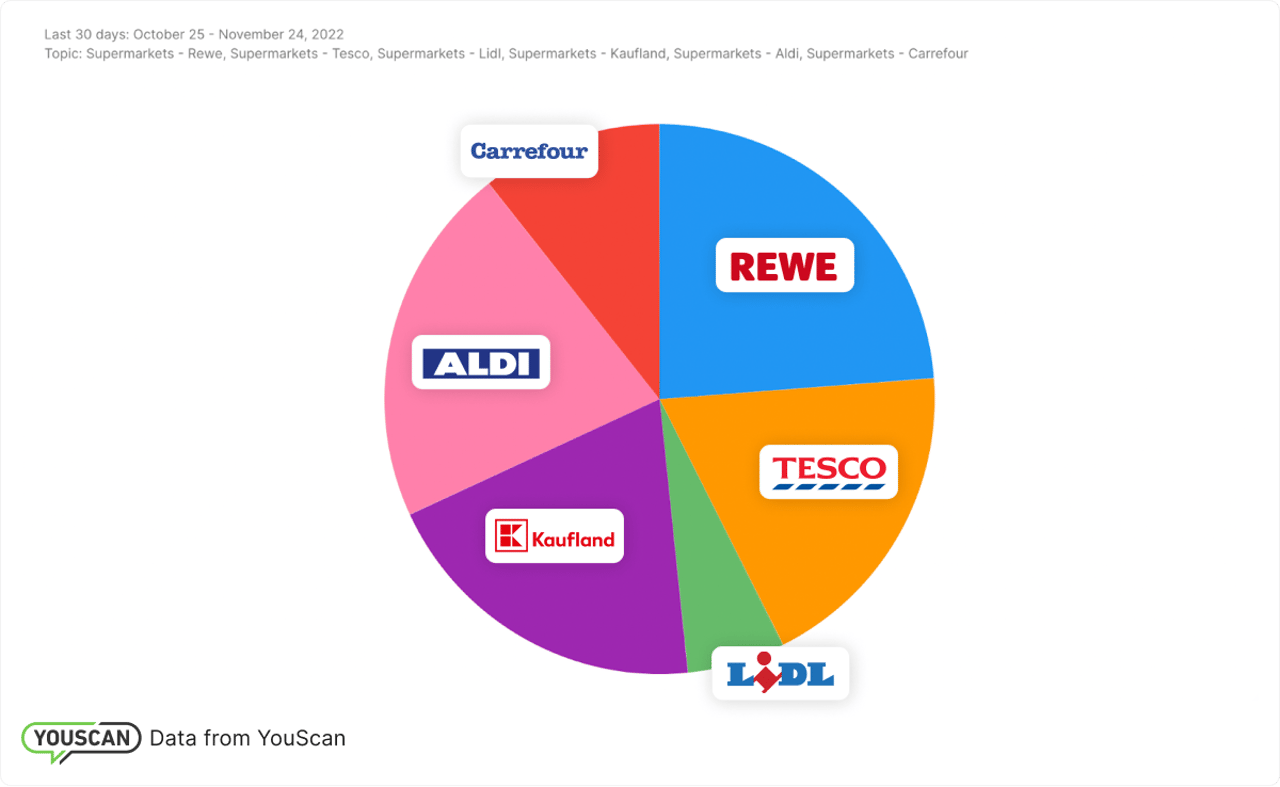
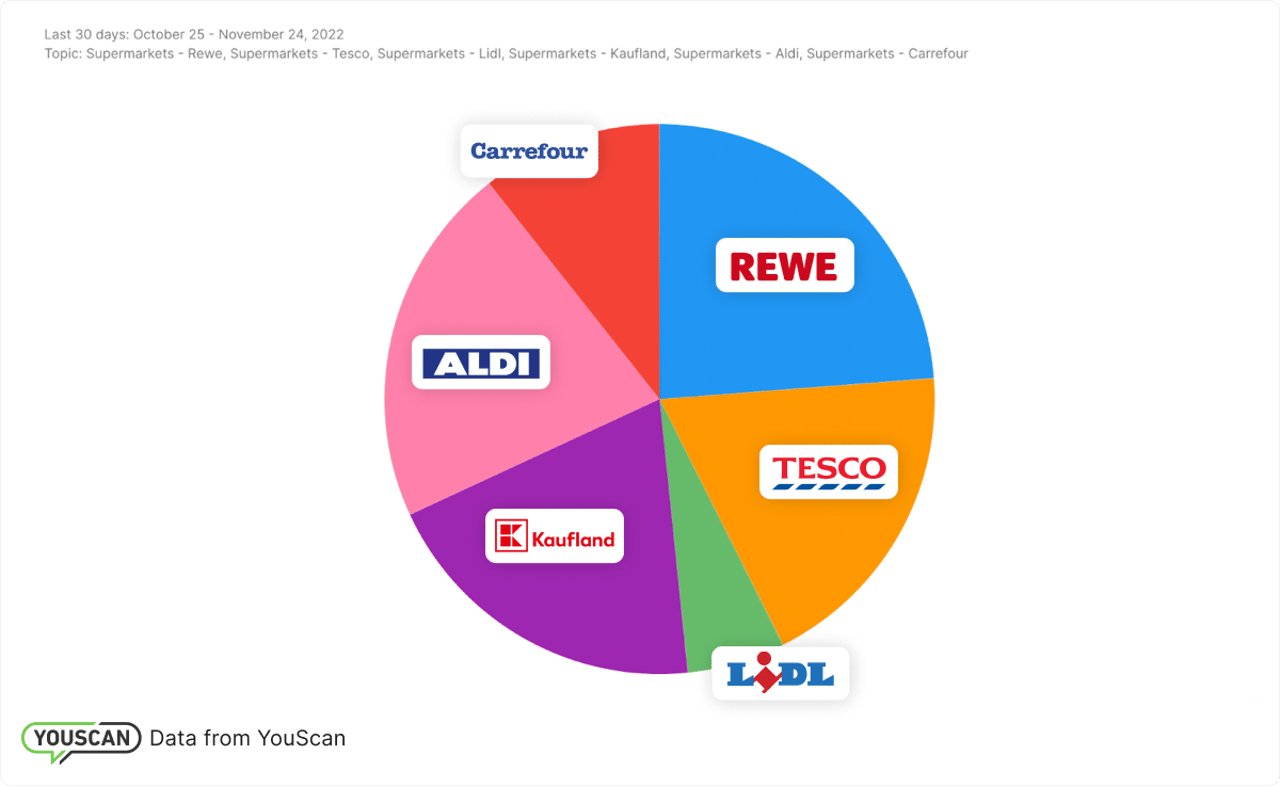
Want it concrete? We ran the social media data on Europe’s big supermarket chains. Rewe came out on top with almost 24% share of voice; Lidl was the outsider at 5% of mentions. The full breakdown lives in our competitor analysis if you want to see how the rest stacked up.
Could you do this with a spreadsheet? For one brand, one snapshot, sure. But the moment you’re tracking several competitors across multiple social media channels over weeks, the manual version falls apart. Voice tools do the gathering and the arithmetic, so you spend your time reading, not counting. And when some acronym throws you, the social listening glossary is right there.
Why volume alone is a vanity metric for your brand’s visibility
Here’s the part I promised. Two brands can post identical mention counts and have almost nothing in common.
Volume tells you how loud. It says nothing about whether people like you. That gap is exactly where sentiment analysis earns its keep. Picture two chains neck-and-neck on mention volume, but one gets dragged far less — say 9% negative against 18%. On a volume chart, they look like twins. In reality, one’s brand sentiment is twice as healthy, and that’s the one quietly pulling ahead.
So when you measure your brand’s visibility, read the tone, not just the tally. A mention spike driven by a complaint thread looks like growth and isn’t — check the sentiment before you celebrate. Beating competitors means winning the positive feedback, not just the post count.
This is also, bluntly, where most SOV reporting falls down. It counts. It doesn’t listen.
Tools, and seeing how your brand stacks up
You can’t track mentions you never see, and you’d be surprised how much of the conversation slips past text-only tools. The quality of your share of voice analysis comes down to coverage. Miss a chunk and your voice data is skewed before you run a single number.
Match the tool to the job. For social and brand listening, YouScan does the thing I keep hinting at — it reads images. Around 500K sources, 95% sentiment accuracy, and its visual insights catch brand logos and on-image text in photos where your name never gets typed at all. It listens to audio and video too. Flip on image recognition alone and your mention stream can grow by up to 80%, and the social listening dashboards let you see how your brand stacks up against the field without exporting a thing. Watching newer or niche sources? YouScan now does Moltbook monitoring in English and Ukrainian. Tiger Finder is another social listening option worth a look.


For paid, skip the extra software — your Google Ads account already has the impression share columns.
For organic, position-tracking platforms measure your SEO share against competitors by location and topic, and they’ll surface the latest industry news and industry trends moving your keywords while they’re at it.
Using it for market research and marketing strategy
The scoreboard is the boring use. The interesting one is everything you learn by watching the conversation over time.
Stick with it and you’ll catch industry trends before they crest, see which messages get message pull through with your audience, and notice what industry leaders are doing that you aren’t. You’ll also find out whether your brand values actually landed — whether the things you say you stand for line up with what people associate with you. It’s a straight read on how your brand stands in the market conversation, no survey required.
Feed that into your marketing strategy and the decisions stop being guesses. You know which marketing campaigns connected, which marketing channels deserve more media spending, and where various marketing channels are stepping on each other. That’s a clear picture instead of a hunch — the kind of competitive intelligence that quietly compounds and steers your future growth.
How to grow it once you know the number
Knowing where you stand is the easy half. Moving the number is the job. What actually works:
Show up where the conversation already happens. Find the social media channels and the search results relative to your category where your target audience gathers, and be there on a schedule — not in a panic the week before a launch.
Make content around the keywords your competitors rank for, then go take the relevant keywords they ignored. That’s the loop your SEO campaigns run on. Local events, a timely opinion, an actual point of view — those pull mentions that bland content never will.
Win on tone, not just volume. Fix whatever your voice metrics keep flagging. A brand people speak well of grows its share faster than one that’s merely everywhere.
Then keep measuring. Share of voice moves — competitors launch, campaigns land, attention drifts. The brands that own their space treat it as a number they watch, not a one-off audit. You’ve got direct control over more of it than you’d guess.
Share of voice and market share are joined at the hip, and social media data makes voice the easier of the two to actually measure. It tells you where your brand sits today and which way it’s drifting. Curious what yours looks like? Book a demo of YouScan, the social listening platform, and see how much of the conversation is already yours.


FAQ
What is a good share of voice percentage?
No magic number. Five real players in a market means an even split is 20% each, so clearing that means you’re punching above your weight. The trend matters more than the absolute — is your brand’s share climbing or sliding against direct competitors?
Is share of voice the same as impression share?
No. Impression share is share of voice for paid advertising only — the share of eligible ad impressions you caught, sitting in your Google Ads account. Share of voice is the bigger idea that also covers social media, organic search, and news coverage.
How often should you measure share of voice?
Often enough to catch a shift. Plenty of social and PR teams check weekly, some daily. It depends how fast your market moves and how much media spending is riding on a given campaign.