Social Listening for PR: A Practical 2026 Playbook

By the time a story about your brand gets published, the framing is locked. A reporter picked the angle hours ago. Media monitoring shows you that finished story. Social listening for PR shows you the conversation that produced it, while it is still forming.
Here is the strange part. PR teams have never had more social media monitoring tools pointed at more social media channels, and never felt more reactive. Most can report coverage volume. Very few answer the question a CEO actually asks: did any of it move what people believe?
Keep on reading and find out.
What is social listening for PR?
Social listening in PR means monitoring brand mentions, sentiment shifts and emerging narratives across social media platforms, forums, news sites and review sites in real time, so communications teams detect stories as they form rather than after they publish. It buys the lead time to shape a narrative instead of answering one.
Be clear about what social listening is not. Not media monitoring, which reports coverage that already exists. Not social media management, which is publishing. Not to mention alerting alone, which is social monitoring without analysis.
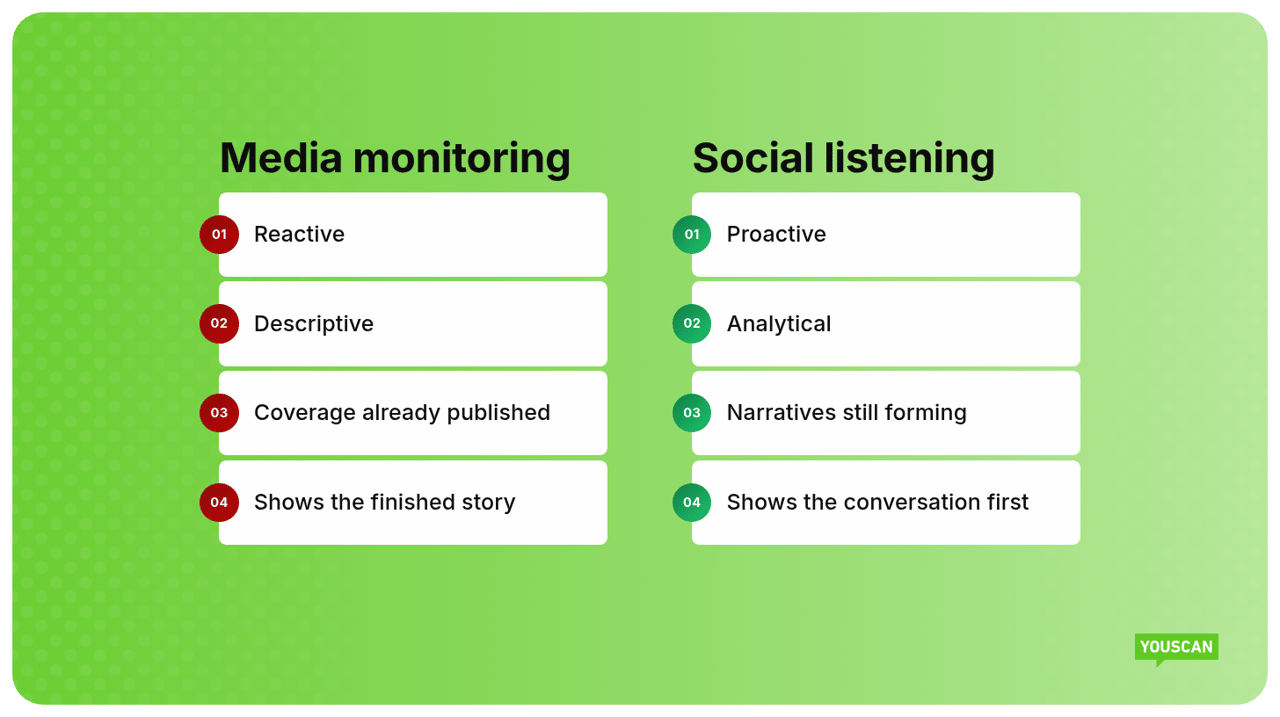
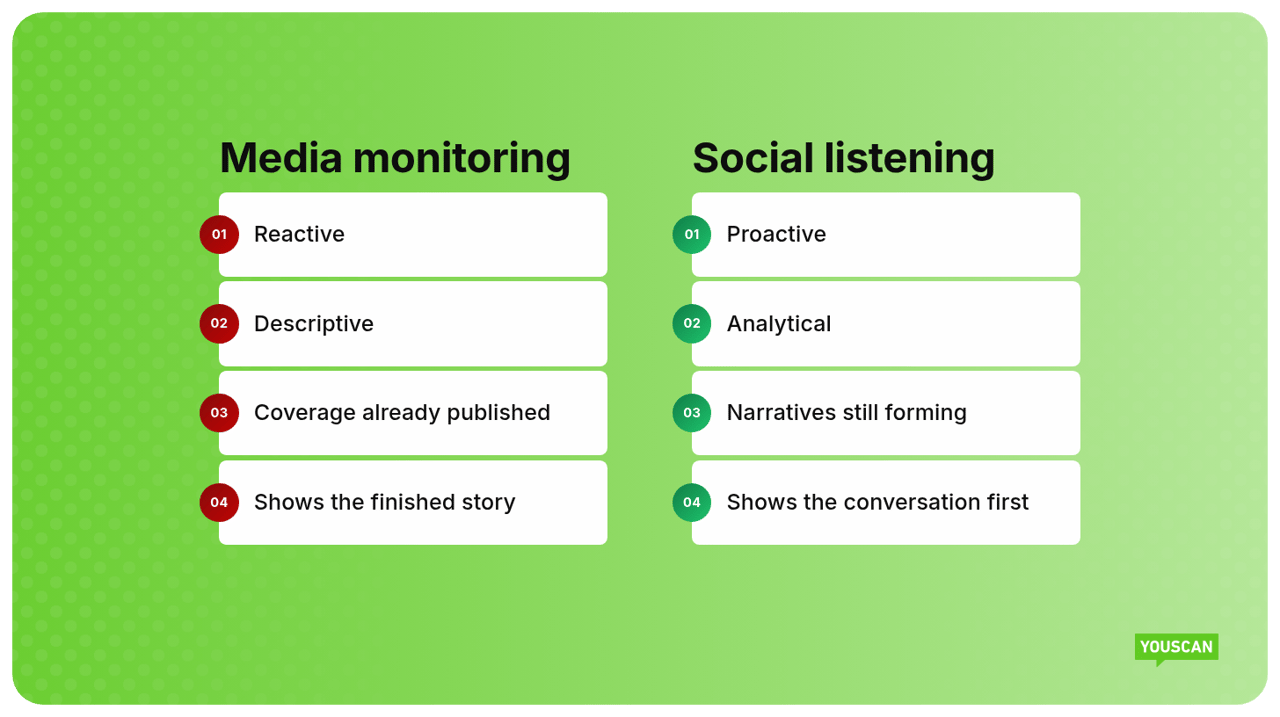
Social listening is proactive and analytical. Social monitoring is reactive and descriptive. Every recommendation below rests on that distinction.
(If a term here is new, the social listening glossary has the vocabulary.)
Social listening vs. media monitoring for PR teams
Media monitoring tracks what has already been published. Social listening captures the social media conversations forming right now. The interval between those two signals is the only window in which your PR team can influence how a story gets framed, and it closes fast.
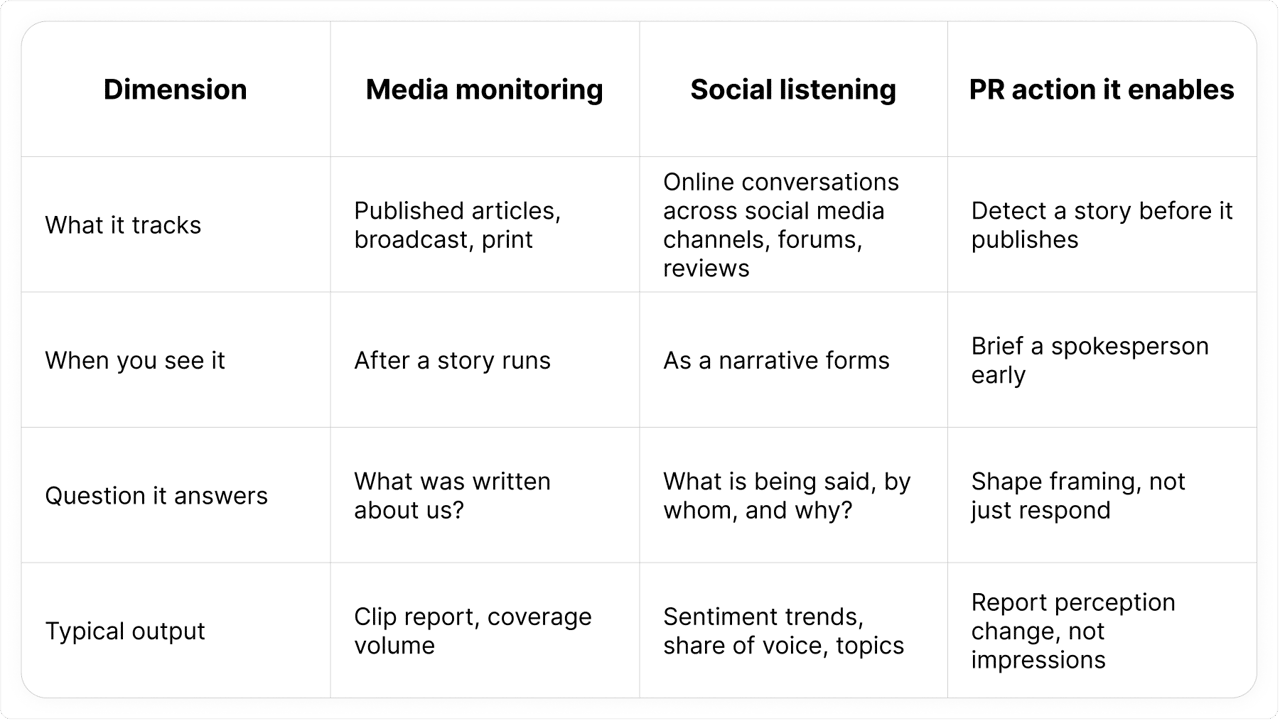
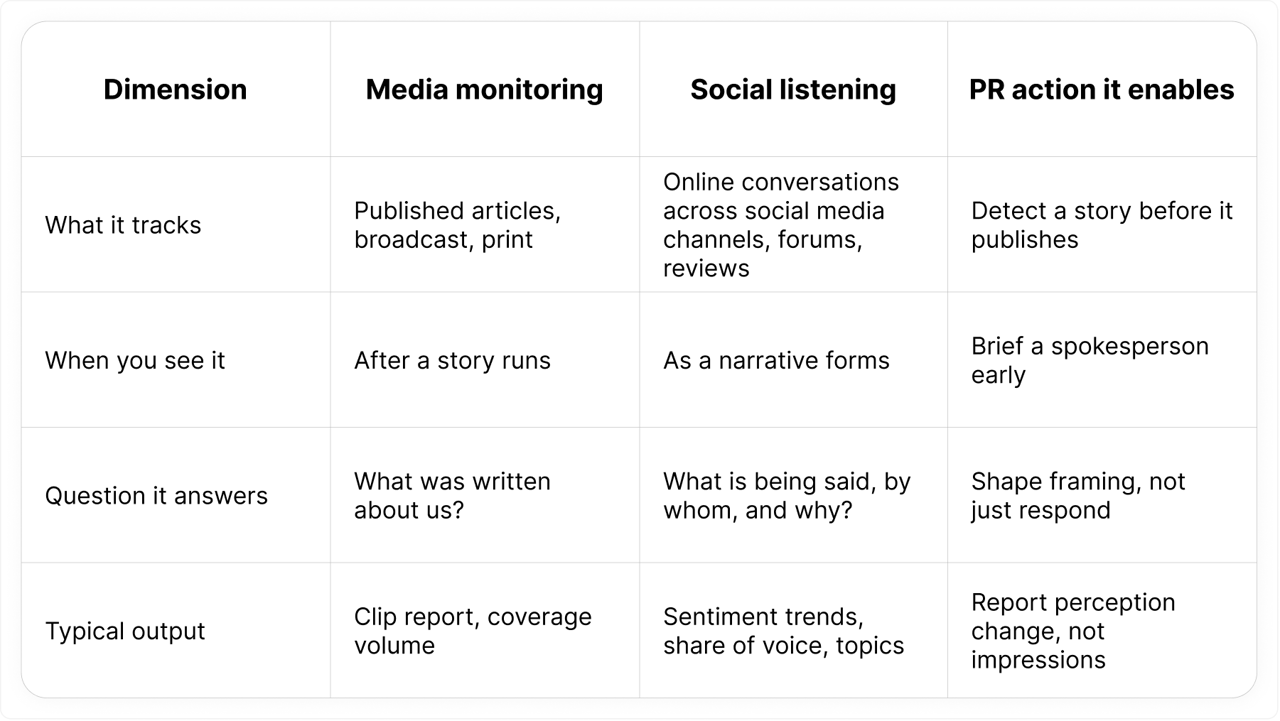
The two are complements. Coverage tracking proves the placement landed. Social listening reads the online conversations underneath it and tells you whether anything has changed. Here is the difference between listening and monitoring in depth.
Why social listening matters for your brand's reputation in 2026
Three shifts changed the maths. One habit has not caught up.
The audience left the outlets you monitor
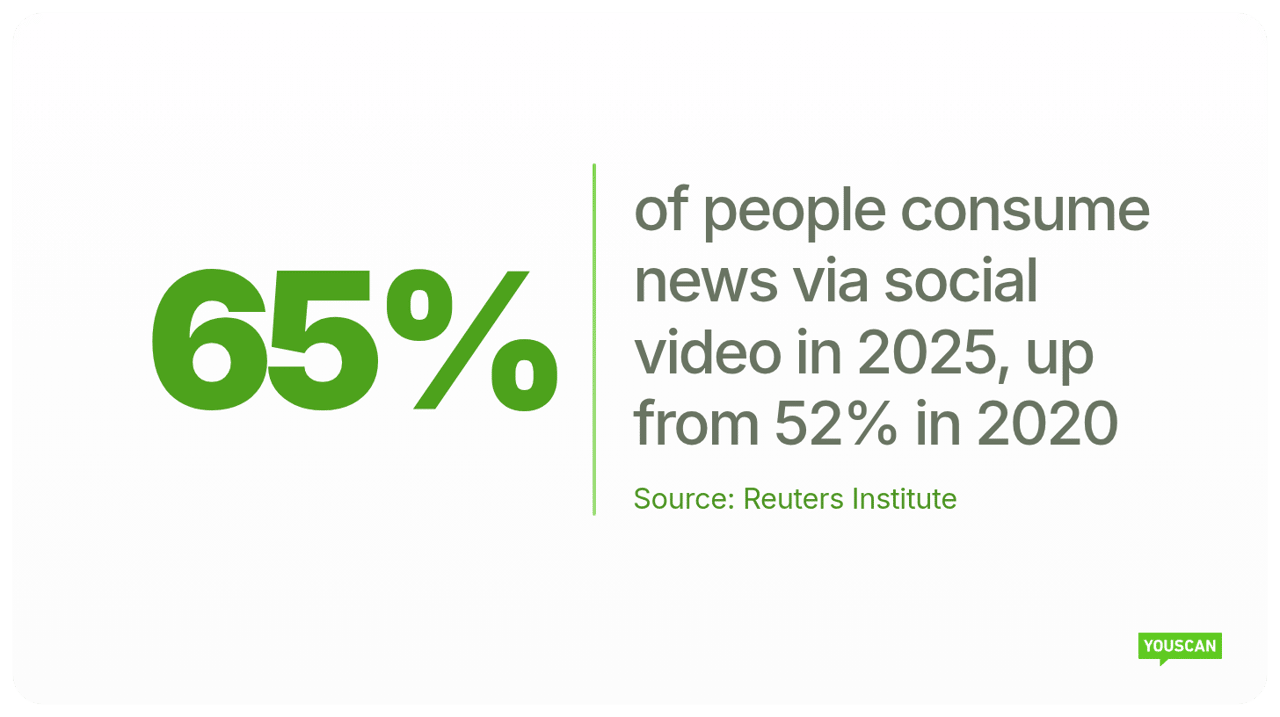
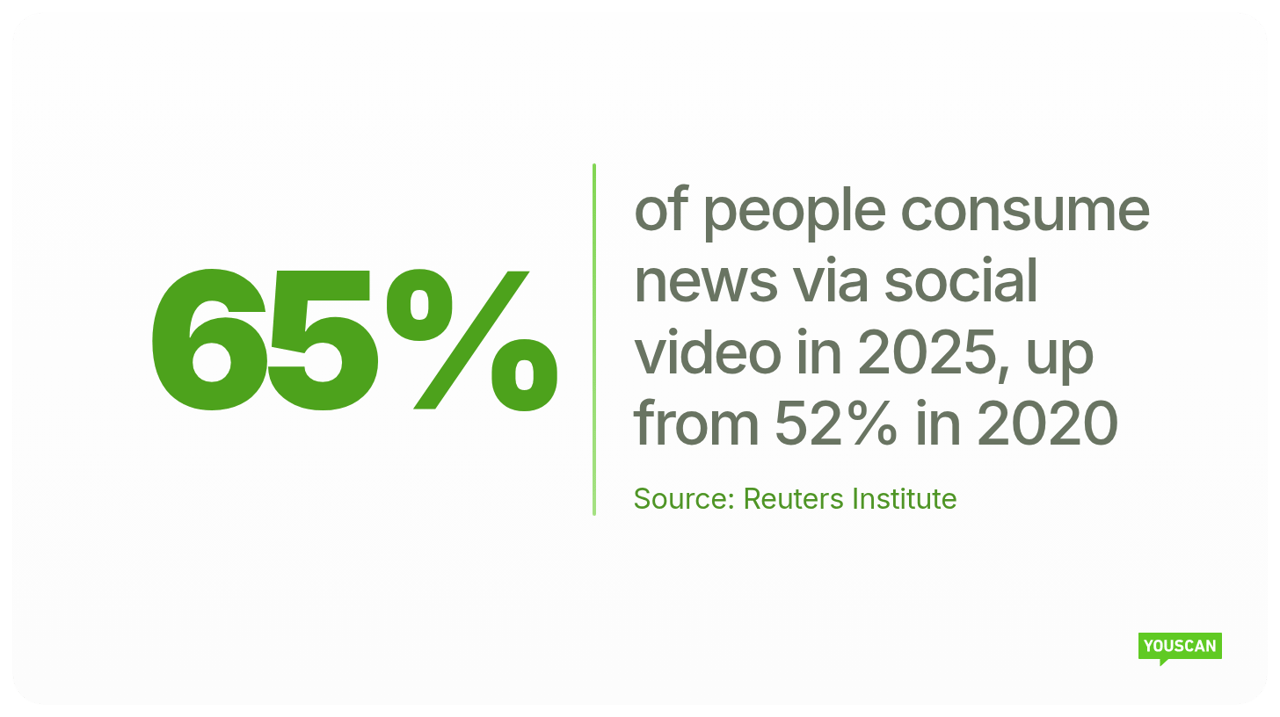
The Reuters Institute found that in the United States, social media and video platforms (54%) overtook TV news (50%) and news websites and apps (48%) for the first time. Social video news consumption climbed from 52% in 2020 to 65% in 2025. Watching the outlets alone misses where your target audience now sits, and no target audience announces the move.
Crisis is the default operating condition
PwC's Global Crisis and Resilience Survey found that 96% of organisations experienced disruption in the past two years, and 76% said their most serious crisis had a medium-to-high impact on operations. The question is not whether your team faces a crisis. It is how much warning you get.
Misinformation lands on primed ground
58% of people worldwide worry about telling real from fake news online. A false claim about your brand now lands with an audience already braced for one. Detection speed, not rebuttal quality, decides whether it hardens into public opinion.
The reactive trap in your PR strategy
The USC Annenberg Center for Public Relations describes a function increasingly asked to counsel leaders on “when to speak and when to stay silent.” You cannot give that counsel from a clip report. A social listening strategy is the only mechanism that turns a reactive function proactive, because social listening is the only one operating before publication. More on how PR works on social media today.
The six PR use cases for social listening
PR teams use social listening for six jobs. Each produces a different report.
Reputation monitoring: protect your brand's reputation and increase customer advocacy
Social listening tracks how perception moves, not how often you get mentioned. When social media posts about an $18 Big Mac meal spread, McDonald's answered with a $5 meal deal. The price was an outlier. The negative sentiment was not, and customer feedback had said so for months. Answer the real grievance, and you increase customer advocacy.
Crisis early warning and crisis management
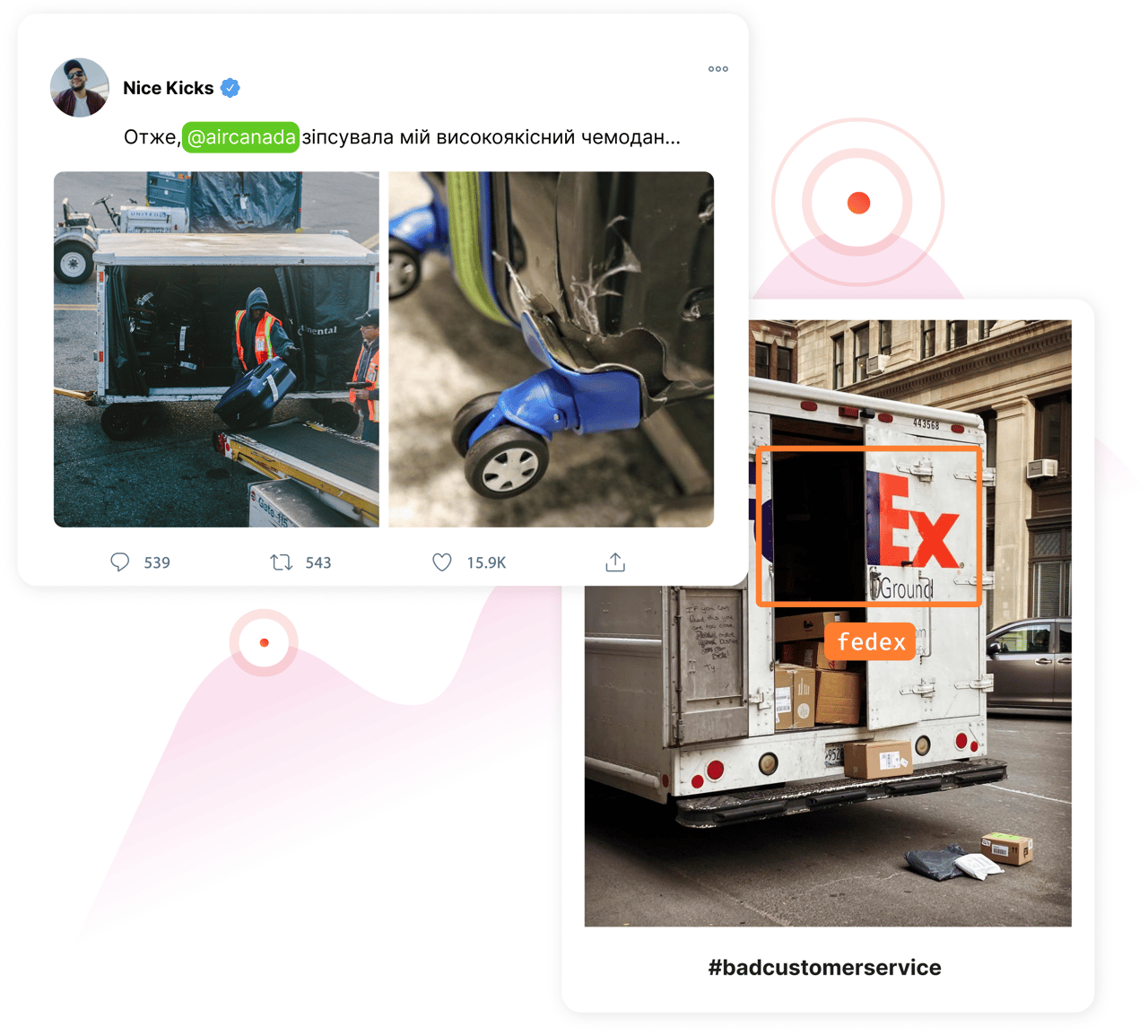
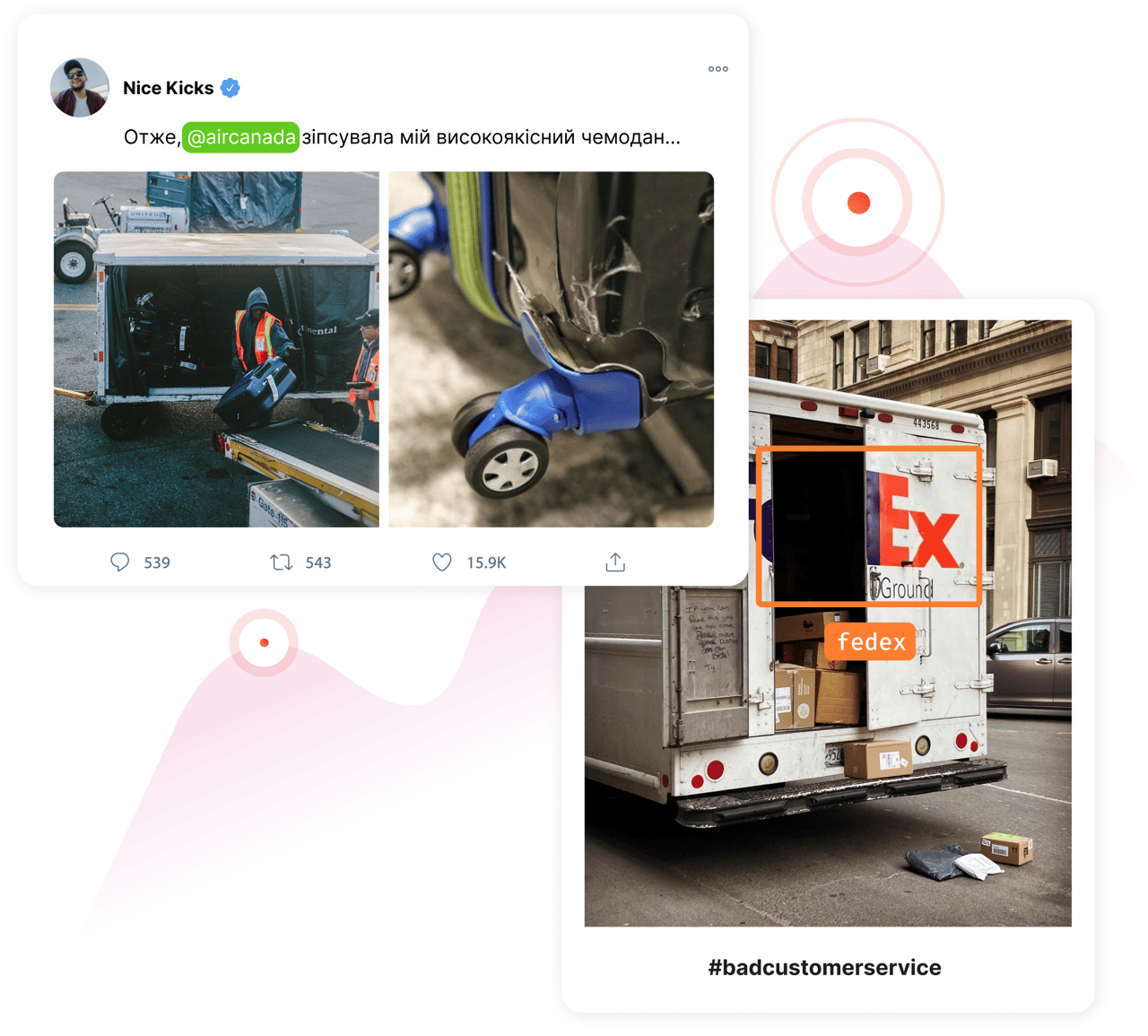
Catch the narrative before the headline. When a rider's social media posts about a cat left in a Lyft passed millions of impressions, the company mobilised search alerts and its CEO conceded that “our first response was awful,” per Fortune. The cat came home. A brewing crisis became a community story. That reversal needs a structured crisis management plan, not luck.
Media relations and journalist research
Use social listening to find what a journalist covered lately and which angles are gaining traction. A pitch acknowledging the relevant conversations happening now beats one arriving as though the reporter works in a sealed room. Industry trends move weekly, your content strategy should follow, and it is free market research.
Campaign and announcement measurement
Set a social listening baseline first: sentiment ratio, share of voice, trending topics. The before-and-after comparison is the only honest way to show PR moved perception rather than volume. That baseline also tells your marketing strategy and content marketing teams which topics are worth writing about.
Competitive analysis and share of voice
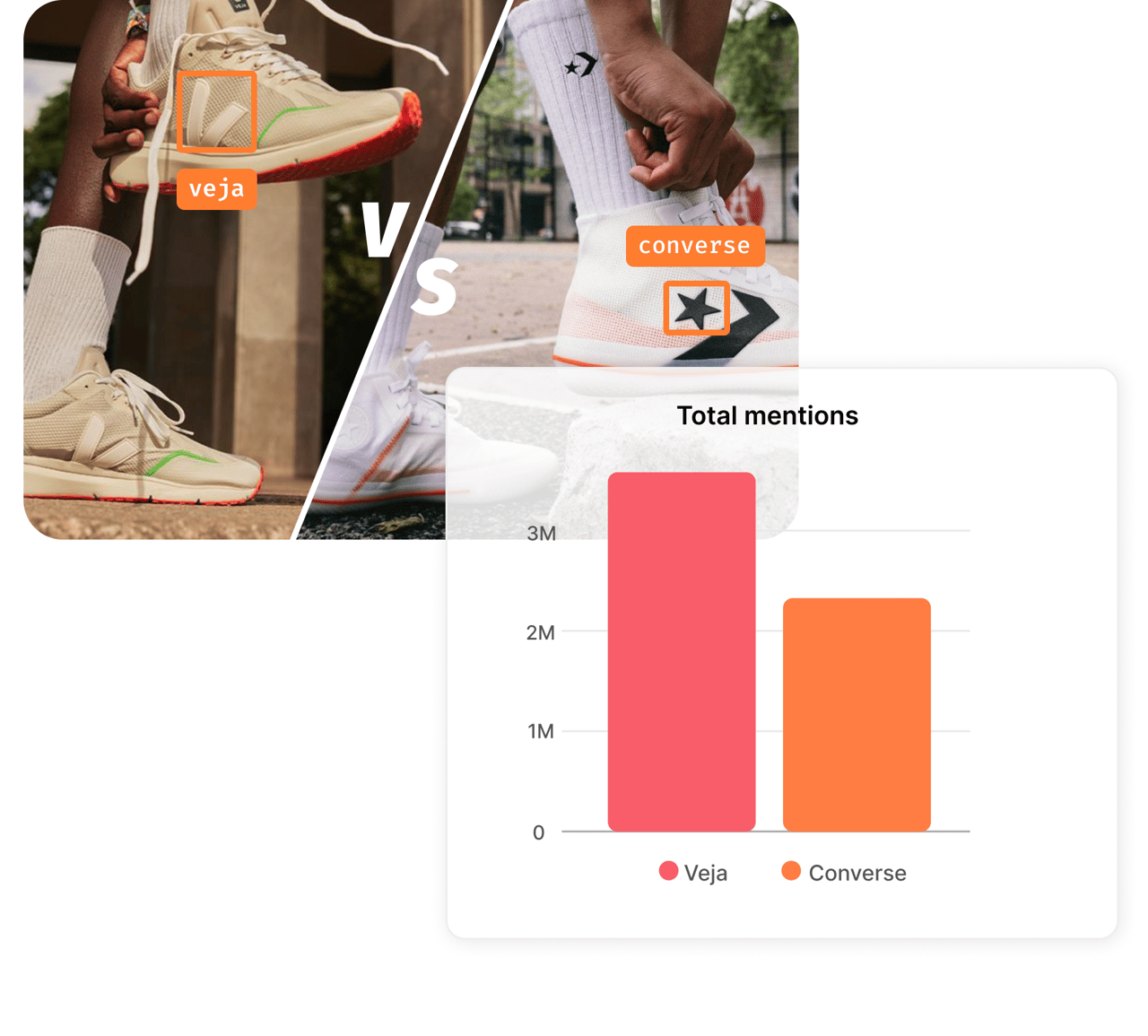
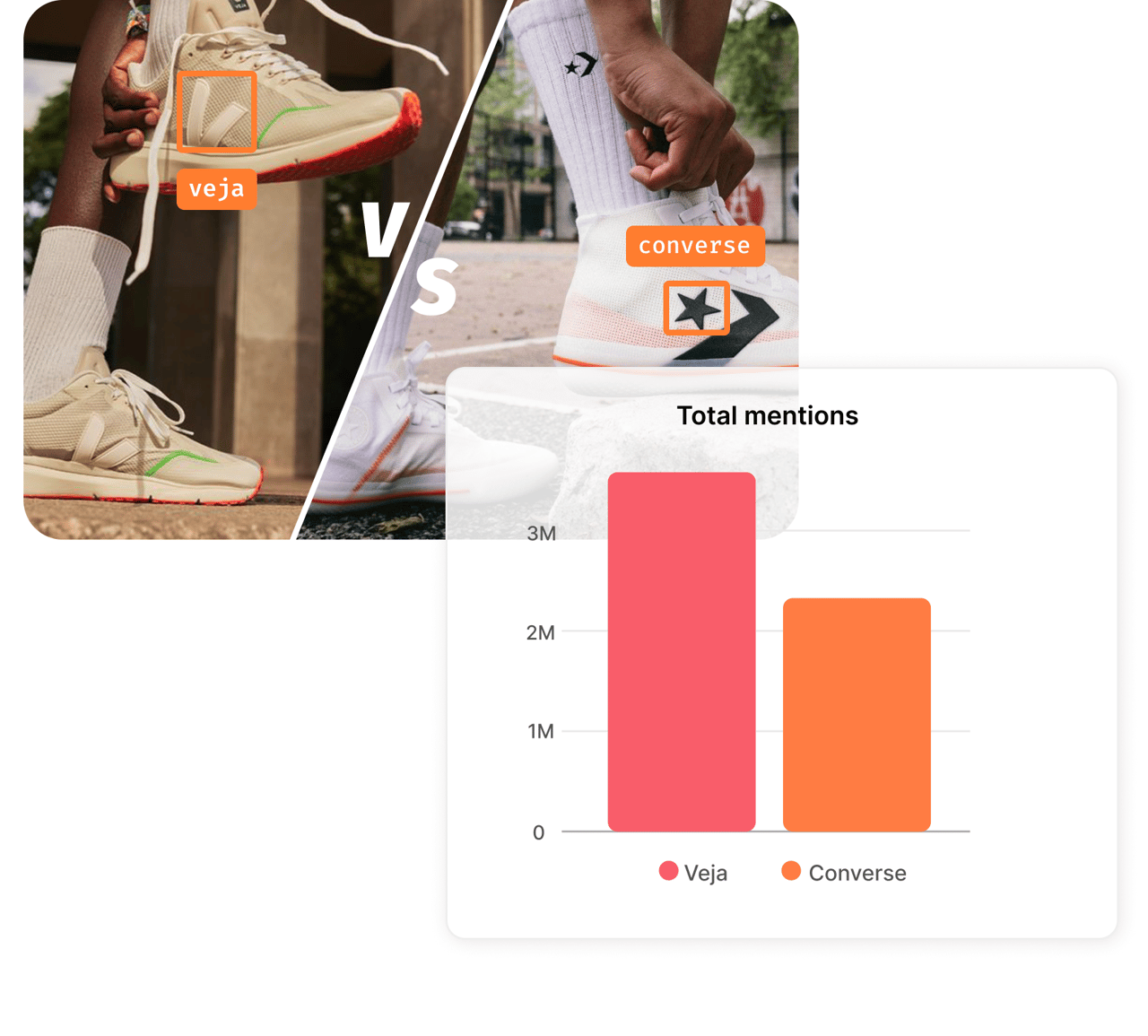
Track what share of the category conversation you own. Competitor brand mentions reveal which features get praised and where a gap sits open. Competitive analysis built on social listening data costs less than commissioned market research and moves faster. That is the competitive edge.
Executive and spokesperson monitoring
Track named executives as separate social listening queries. Reputational risk attaches to individuals before the organisation, and by the time it reaches the brand handle, it has been running for a while. Tracking sentiment around a CEO is an early warning, not vanity work. Pair it with sentiment shifts over time.
How to build a social listening workflow your PR teams will actually run
An effective social listening strategy is a routine, not a tool purchase. The discipline lives in steps two and four.
Build queries that survive contact with reality. Configure searches for your brand name and its misspellings, executives, products, relevant keywords, and your top three to five competitors. Use Boolean exclusions to strip noise, because every brand has a namesake band or racehorse. Document the string somewhere shared, so your social listening data means the same thing week to week.
Configure three alert tiers, not one. Real-time alerts for volume spikes, mentions from accounts above 50,000 followers, and sentiment breaches. A daily digest for overnight chatter. A weekly rollup for share of voice. Alert fatigue is the failure mode: a team that over-alerts stops reading alerts within a month, then misses the one that mattered.
Run a daily cadence: 15 / 10 / 10 minutes. Fifteen minutes each morning on overnight alerts. Ten at midday, when narrative acceleration first shows. Ten at day's end, tracking mentions worth watching tomorrow. Thirty-five minutes of social listening to monitor conversations across every source that matters.
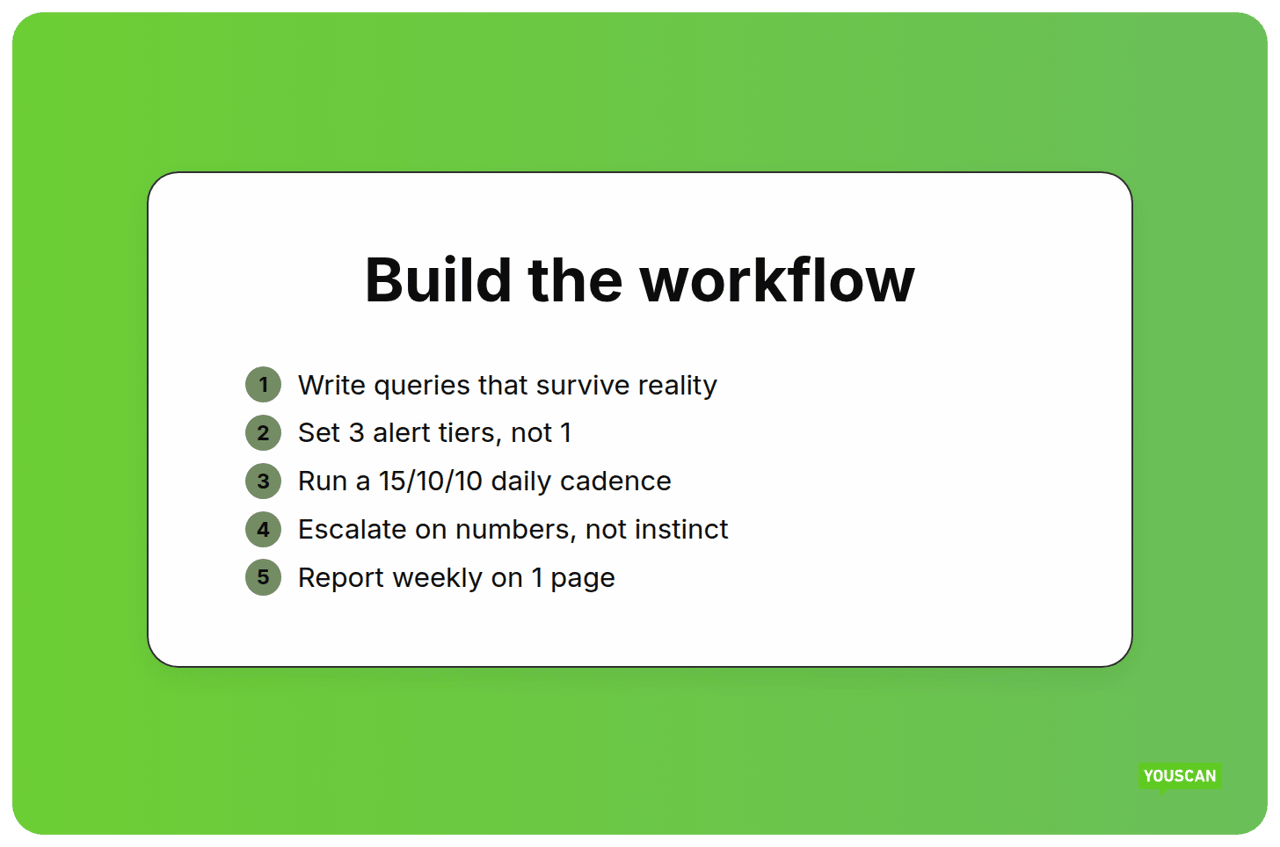
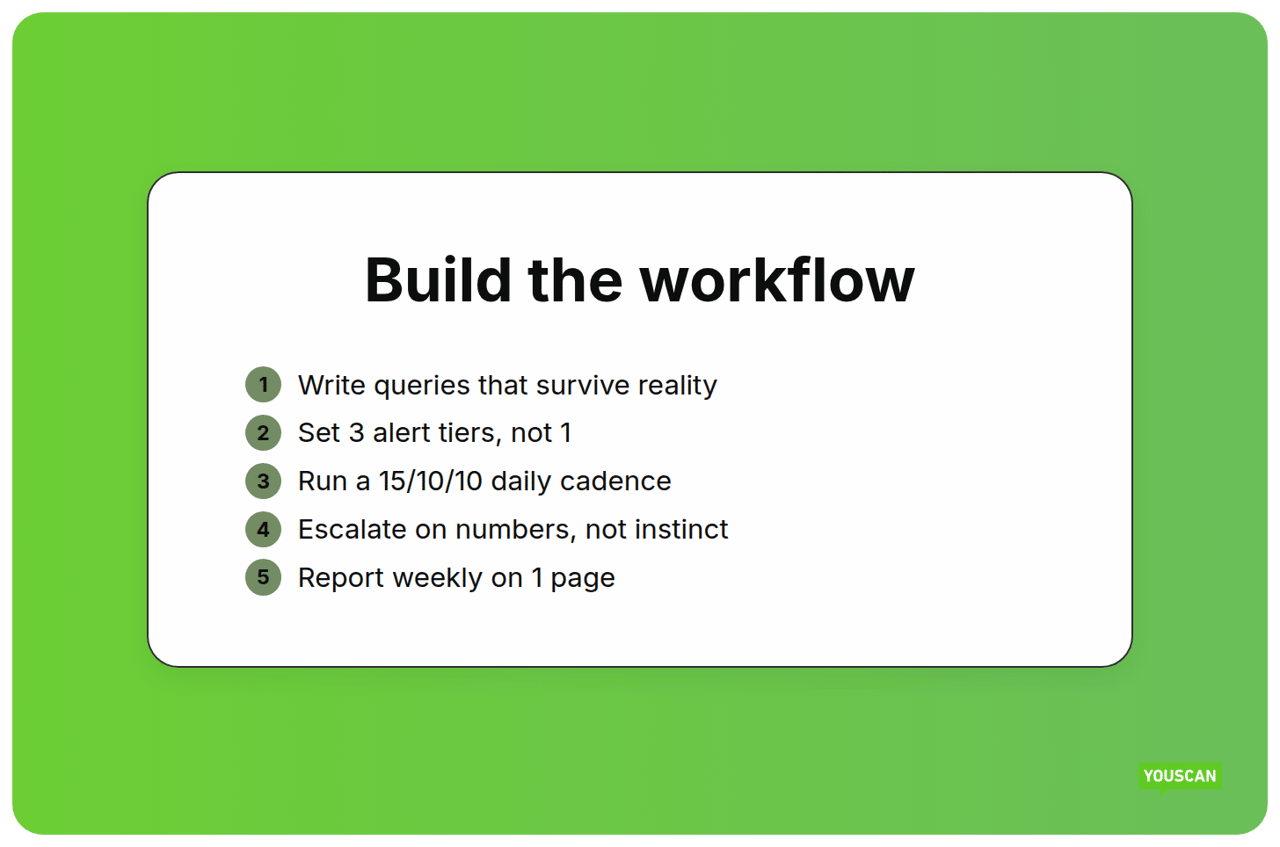
Escalate on thresholds, not on instinct. Write down what triggers escalation: a sentiment drop past an agreed delta, cross-platform spread within four hours, a journalist gathering sources publicly. Escalate on the number, not on how a mention feels at 9 pm. This separates teams that get ahead of stories from teams that panic.
Report weekly in one page. Top three narratives, sentiment trajectory, competitor movement, emerging risks. Actionable insights, not a data dump, with enough continuity to track progress quarter to quarter. Copy content marketing, and whoever owns the social media strategy, since otherwise they work from customer experience anecdotes.
Purpose-built dashboards and decent social listening tools make steps three and five less painful than a spreadsheet. Brand monitoring is where your social listening efforts pay for themselves.
The five signals that precede a PR crisis
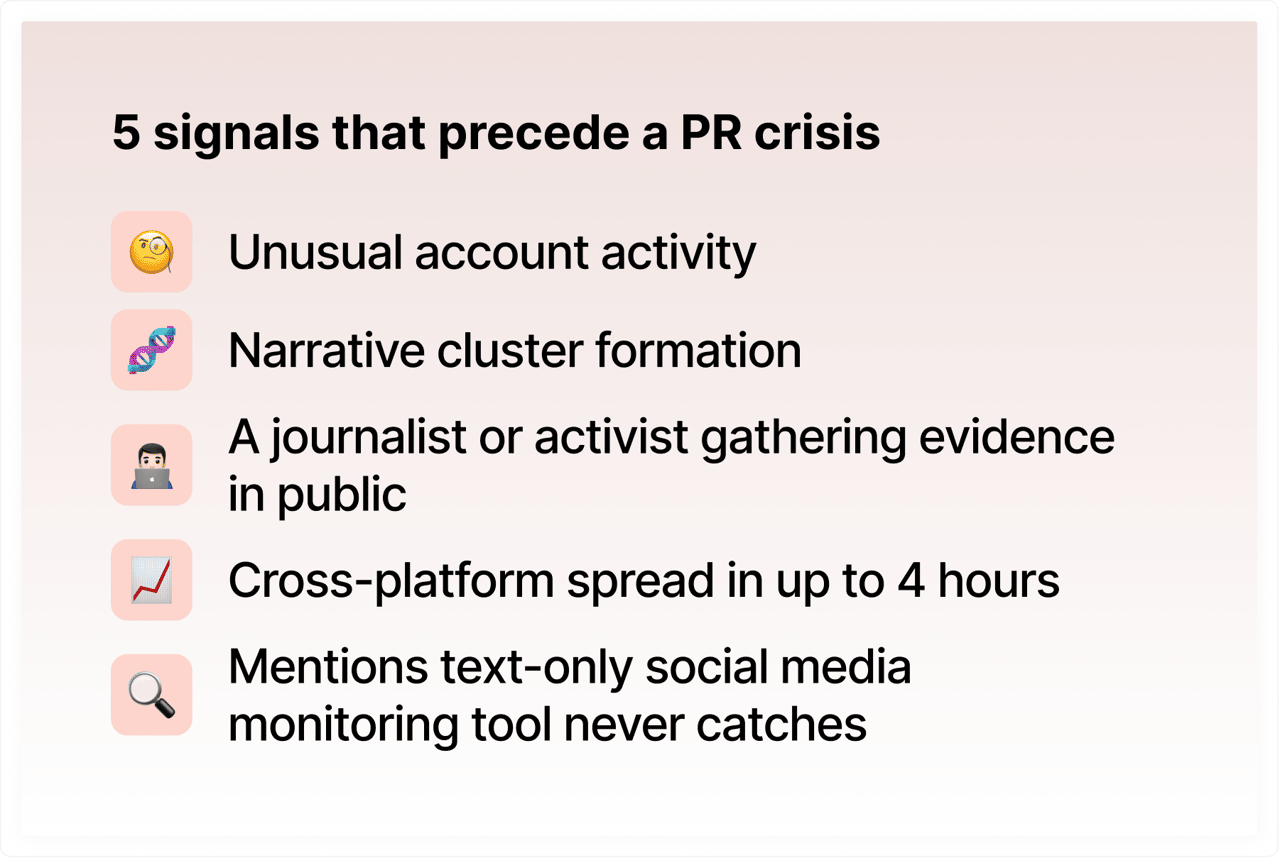
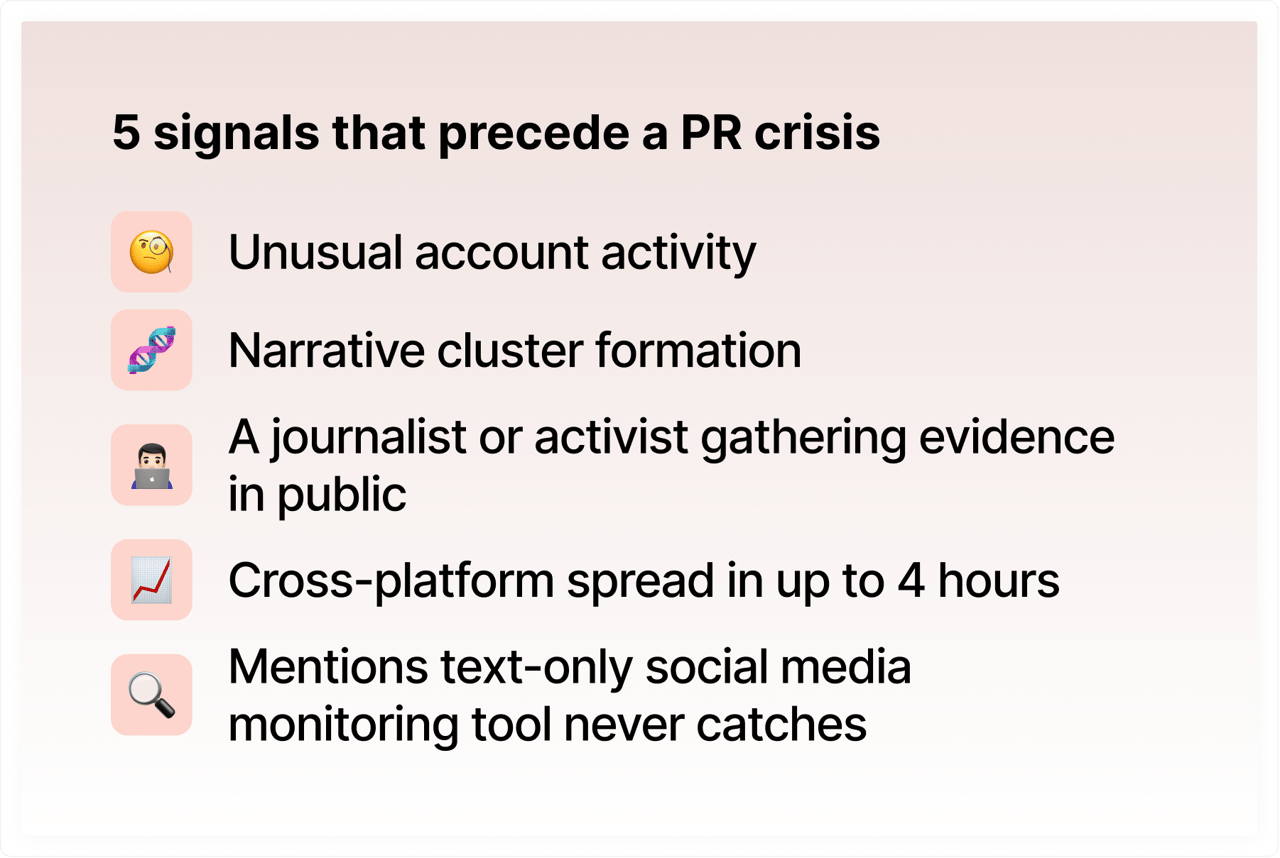
Crises rarely arrive without warning. They arrive without anyone watching for the warning.
Unusual account activity. Accounts that never normally discuss your brand start engaging with brand-critical content. The conversation has crossed into a new segment.
Narrative cluster formation. Independent accounts begin using similar language about one issue with no coordinated trigger. The most reliable early sign a story is forming organically.
A journalist or activist gathering evidence in public. Someone is openly asking for sources, screenshots, or experiences involving your brand. Coverage is being prepared. You have hours.
Cross-platform spread within two to four hours. Online chatter from one of your social media channels appears on others. The narrative travels by itself now, and mainstream coverage follows.
Mentions your text-only social media monitoring tool never sees. A logo in a video. A receipt photo. A product on a shelf, captioned with no brand name. None carry a text mention, and much of your brand's presence online is now visual, which is why YouScan built image and video recognition into its social media listening rather than bolting it on later.


Niche communities: where the story usually starts
Almost none of this begins on the social platforms your dashboard opens to by default. It begins in niche communities: a subreddit, a Discord, a specialist forum, a review thread with 40 replies. Broaden the social platforms you cover, or you will keep catching stories at stage four. Recent reputation crisis examples share that shape.
Telling real outrage from manufactured outrage
Not every spike in negative sentiment is a perception shift, and this matters more than most teams think. When Cracker Barrel's logo refresh drew a backlash in 2025, later analysis found 44.5% of X posts about it in the first 24 hours came from bots or likely bots, according to PR Daily. Researchers called the boycott “bot-assisted amplification seeded by meme/activist accounts,”. The logo was reversed anyway.
Source-authority scoring and anomaly detection tell those two apart. Respond to manufactured outrage, and you kill a strategy that was working. Ignore real outrage, and it costs more. Volume alone cannot say which mistake you are making, which is the argument for social listening software over a raw mention feed.
The PR metrics worth reporting
Crisis response time is the interval between the first detectable social media signal and the first internal escalation. It determines what response is still available. Every other PR metric measures the past. This one measures capability.
Metric | How to calculate it | What good looks like | What it tells leadership |
Share of voice | Brand mentions ÷ category mentions × 100 | Growing quarter on quarter | Whether we own more of the conversation |
Sentiment velocity | Change in positive-to-negative ratio over a window | Direction and rate, not a static ratio | Whether perception is moving and how fast |
Crisis response time | First signal to first internal escalation | Under two hours | Whether we can still shape a story |
Narrative reach | Unique accounts exposed to a narrative | Per narrative, not per mention | How far a story travelled |
Earned media volume | Third-party mentions in a fixed window | Segmented by source authority | Whether coverage grew where it counts |
Narrative topic mix | Share of mentions by topic cluster | Owned topics rising, risk topics flat | What the market thinks we are about |
Tying PR metrics to business strategy
Roll the six into a single brand health score, and a board reads it in fifteen seconds. The same social listening data feeds more than PR: marketing strategy, social media strategy, content strategy, and customer experience teams are all guessing about the same audience and the same customer behavior.
A shared brand health view turns that into strategic insights, and makes marketing communications planning less of an argument. That is the difference between PR being consulted on business strategy and PR hearing about it later.
Social listening tools for PR teams, compared
Choosing between social listening tools depends less on feature count than on six things your communications team needs. Every vendor claims all six, so test them.
Six criteria that matter for communications teams
Source coverage across forums, review sites and news, not just the big social platforms. Vendor support for new sources lags: Moltbook monitoring only reached social media listening tools recently, and brand conversation now happens there among AI agents.
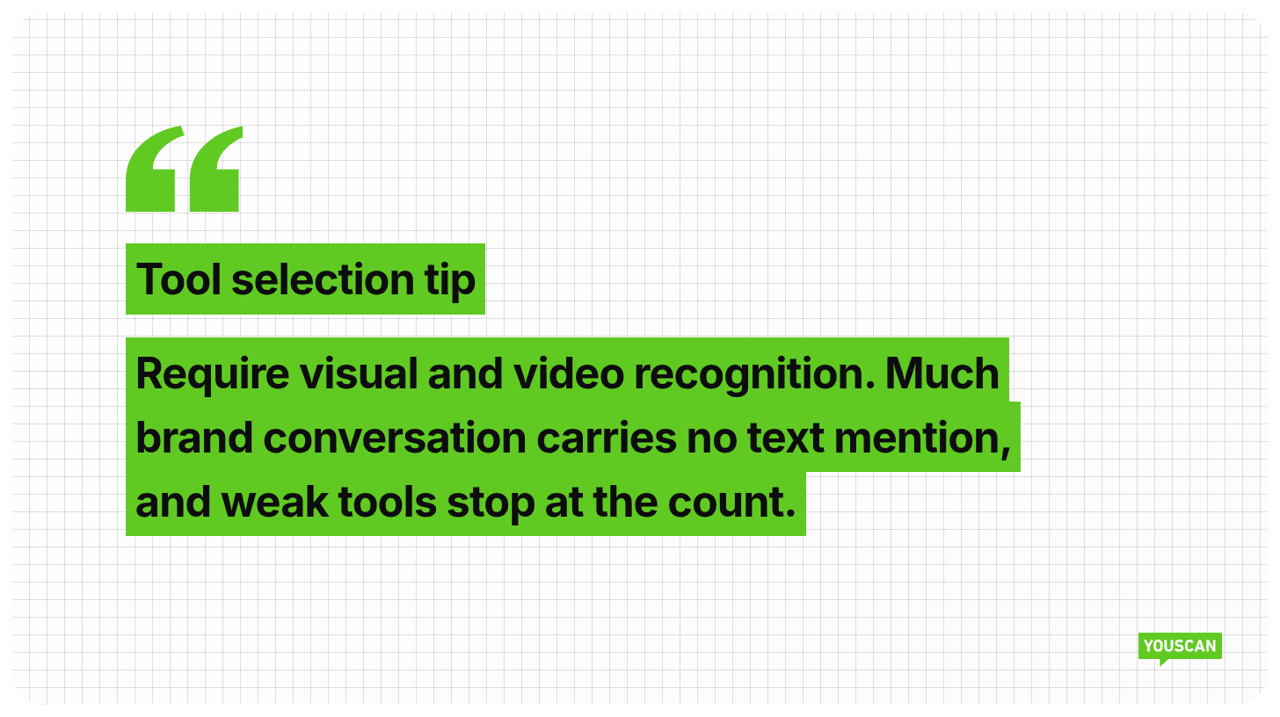
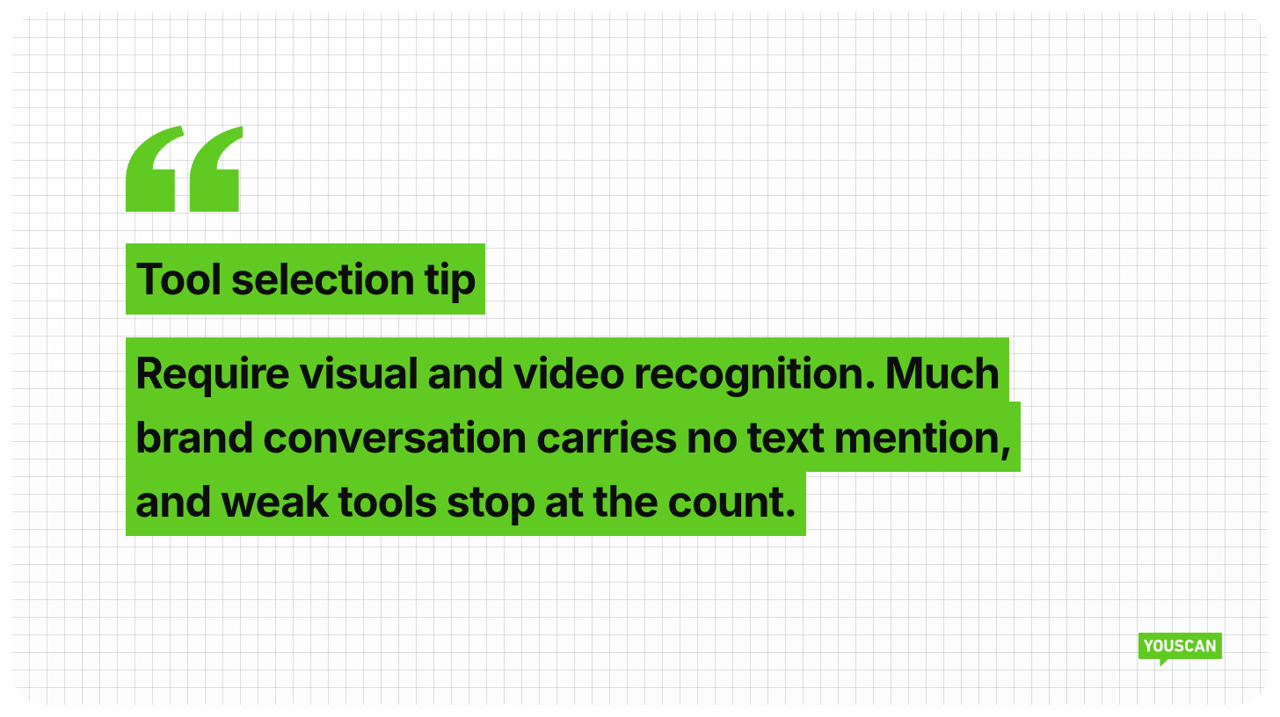
Visual and video recognition, because much brand conversation carries no text mention.
Sentiment analysis with real nuance, past positive/negative/neutral, including sarcasm and emoji.
Crisis alerting speed and tiering, so alert fatigue does not quietly set in.
Competitive share of voice as a native metric, not a spreadsheet you rebuild on Fridays.
Reporting built for marketing communications rather than social media marketing, and in-depth analysis rather than a mention count. Weak social listening tools stop at the count.
Nine tools compared
Tool | Best suited to | Notable strength | Scope to be aware of |
YouScan | Teams where visual brand presence matters | AI visual insights plus Insights Copilot for natural-language questions | Shorter archive than the largest enterprise platforms |
Brandwatch | Large brands and agencies needing depth | Extensive historical archive, advanced Boolean querying | Enterprise pricing and a real learning curve |
Meltwater | Teams bundling listening with journalist outreach | Media contact database and press distribution in one place | Listening depth is narrower than that of dedicated platforms |
Talkwalker | Global multilingual programmes | Broad language coverage and visual listening | Part of Hootsuite; the product spans two toolsets |
Cision | Traditional PR with heavy earned-media reporting | Established newsroom and media-relations workflow | Listening is one module in a broader suite |
Sprout Social | In-house teams are also running social publishing | Listening sits alongside scheduling in one workflow | Listening is a premium add-on |
Brand24 | Small agencies and solo practitioners | Accessible pricing, anomaly detection, AI summaries | Data depth narrower than enterprise platforms |
Determ | Mid-market teams prioritising crisis detection | Fast spike alerting and clean reporting at its tier | Smaller historical archive |
Mention | Lean teams needing real-time insights | Low-friction setup, multilingual monitoring | Lighter analysis than dedicated platforms |
Choosing by team size and mandate
Solo practitioner or small agency: accessible pricing and reliable alerting. Mid-market in-house team: crisis alerting speed and share of voice, in that order. Enterprise communications: archive depth, language coverage and visual recognition, and accept that no single social listening platform leads on all three. Cheap social listening software will not close that gap. The best social listening tools match your mandate, not a vendor's roundup. Here is a fuller breakdown.
Beyond alerts: using YouScan for deeper insights into narrative formation
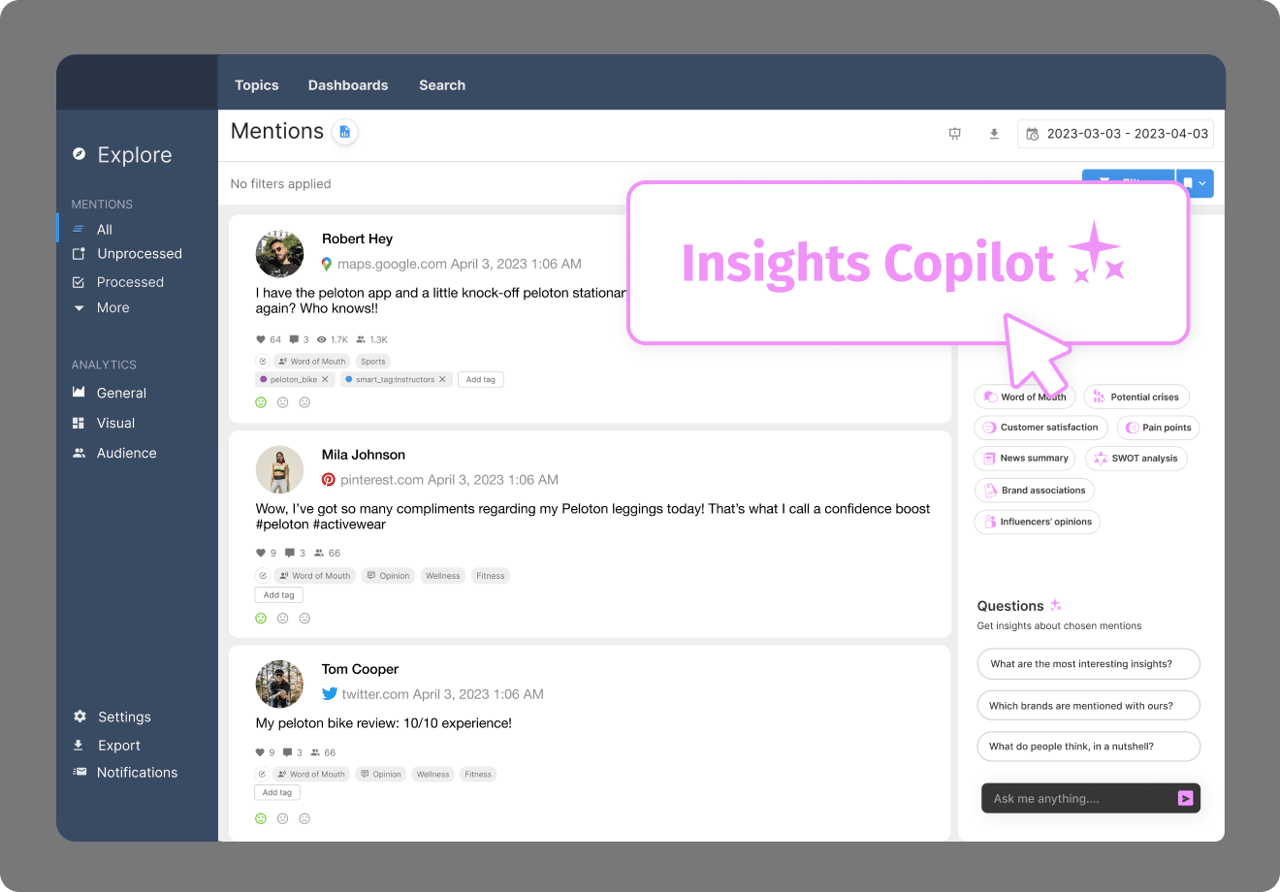
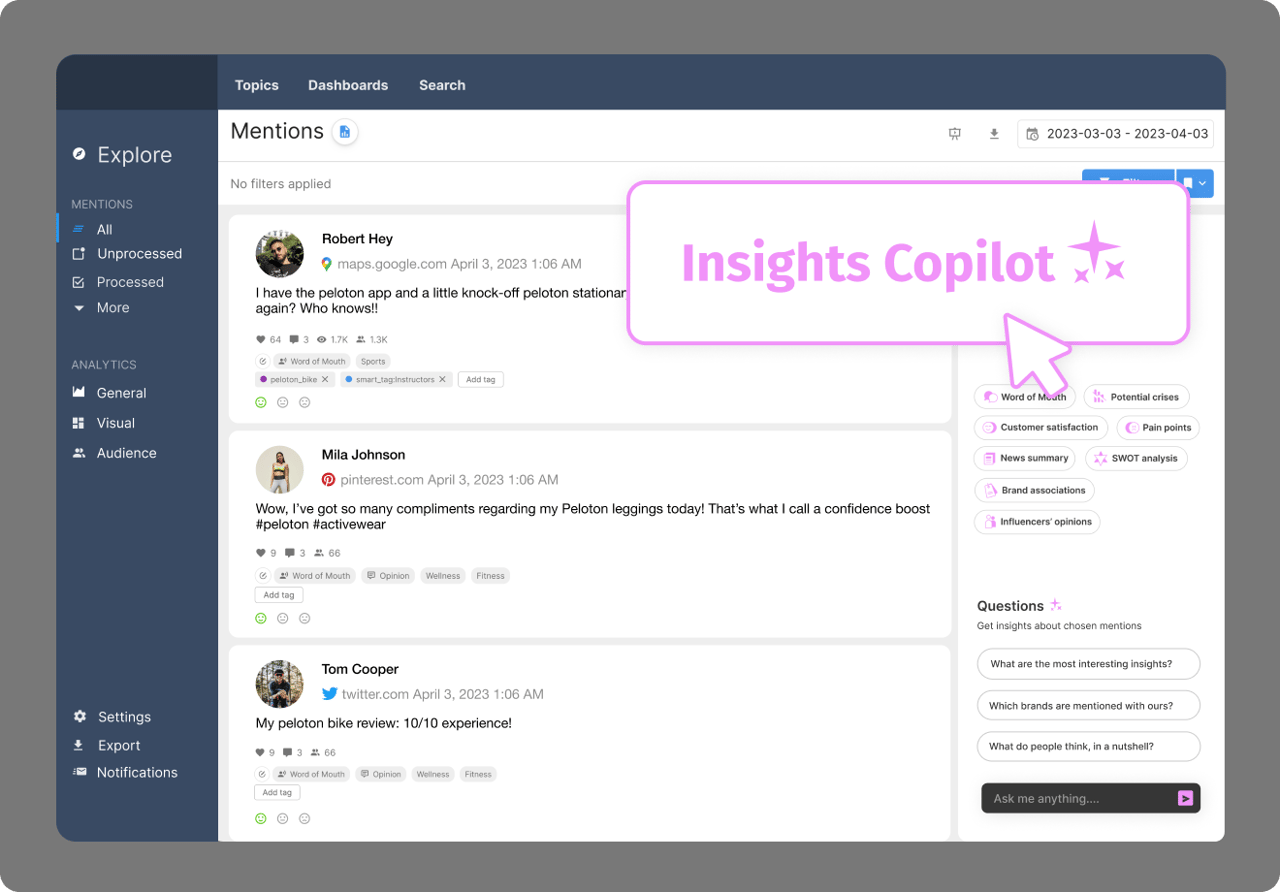
Most social media listening tools alert PR teams at the keyword level. But the gap that matters is not volume. It is formation: which narrative is taking shape, who carries it, and whether it is real.
Visual Insights catches logo and product appearances in images and video, and the brand mentions that never appear as text. That is often the difference between watching a product-quality story develop and missing it.
Insights Copilot lets a comms lead ask the data a question directly (“which narratives drove the sentiment drop this week?”) and get real-time insights in seconds.
Sentiment analysis trained on context and emoji reads sarcasm better than generic NLP, which matters, because the earliest crisis signals are ironic rather than explicit. Source-authority scoring then separates a genuine shift in brand sentiment from coordinated amplification. Those valuable social listening capabilities turn social media listening software into actionable insights: the key insights a comms team can act on, early enough to spot emerging trends and stay ahead.
Conclusion
The distance between reactive and proactive PR comes down to detection time. Effort was never the problem. Media monitoring tells your team what got published. Social listening tells them what is forming, and hands back the hours in which framing can still be influenced.
Run a structured cadence. Escalate on defined thresholds. Report perception change rather than coverage volume. Hold that for two quarters and your own social listening strategy compounds across reputation management, media relations, and competitive intelligence. The right social listening tools make it a habit rather than a project.
Request a YouScan demo to see how narrative detection fits a full cross-channel workflow.
FAQ
How do PR teams use social listening?
PR teams use social listening for six core activities: monitoring brand reputation and sentiment, detecting crises before they surface in the press, researching journalists ahead of a pitch, measuring whether a campaign moved perception, tracking competitive share of voice, and monitoring named executives. The common thread is timing. Social listening operates before publication, the only point at which framing can still be influenced.
How is social listening different from media monitoring for PR teams?
Media monitoring tracks what has already been published across news, broadcast and print. Social listening captures online conversations as they form across social media platforms, forums, reviews and news. The practical difference is timing: media monitoring shows a story after it breaks, while social listening shows the narrative taking shape, often with hours or days of lead time to prepare a response.
How early can social listening detect a PR crisis?
Social listening typically detects a forming crisis hours before it reaches mainstream coverage, and occasionally days. Detection speed depends on what a team monitors rather than how fast it responds. The earliest reliable signals are narrative cluster formation, cross-platform spread within two to four hours, and journalists publicly gathering sources. Teams tracking visual mentions detect earlier still, since much brand conversation carries no text.
What metrics should PR teams track with social listening?
PR teams should track six metrics with social listening: share of voice, sentiment velocity, crisis response time, narrative reach, earned media volume segmented by source authority, and narrative topic mix. Crisis response time, the interval between first social signal and first internal escalation, matters most, because it determines what response remains possible. Raw impressions and advertising value equivalency should be retired.