Social Media Audiences Breakdown: Who's Actually on Each Platform


Most audience decks open with the same slide: a bar chart of monthly active users, biggest to smallest, followed by a confident recommendation about where the brand should post on social media. It's usually the least useful slide in the deck.
Not because the numbers are wrong. Because a social media audiences breakdown built only on platform size tells you where people are, not who they are or what they'll respond to. Those are different questions, and the second one is the one your marketing efforts live or die on.
So this covers both. First, the current numbers: how many social media users exist, how they split across the major social media platforms, and what the gender distribution and age group data look like right now. Then the part most articles skip, which is how you get from global averages to a picture of your own target audience.
What a social media audiences breakdown actually tells you
A social media audiences breakdown is a segmented view of who uses each platform, sorted by audience demographics like age group, gender, location, income level, and interests.
It's useful for three things: deciding which social media channels deserve budget, working out what content performs where, and sanity-checking assumptions your team has been repeating since 2021.
It is not useful for telling you who your target audience actually is. Platform-level social media data describes everyone on a platform. Your potential audience is a sliver of that, and the sliver rarely behaves like the average. More on that below, because it's where most audience research goes sideways.
The social media user numbers everyone quotes first
There were 5.79 billion social media user identities worldwide at the start of April 2026, which means more than two in three people on Earth now use social media every month. Social media users now outnumber non-users by more than two to one. Growth hasn't stalled either: 294 million new user identities appeared over the previous twelve months, annualised growth of 5.4 percent.
The number worth pinning to your wall, though, is this one: 94.7 percent of the world's internet users now use social media each month. Social media reach and internet reach have basically converged. "Are they on social?" stopped being a real question.
Two more figures change how you should plan your social media strategy. The typical social media user actively uses an average of 6.5 different platforms each month, and spends 18 hours and 36 minutes on social media each week. Your target audience isn't sitting on one platform waiting for you. They're moving between multiple platforms in a single evening, and the time spent is split across all of them.
That overlap has a practical upside. You don't need a social media presence on every network at once to reach the majority of social media audiences. Pick the right platforms, one or two of the larger ones, and most of your potential audience is already in range.
Social media audiences breakdown across the major social media platforms
One caveat before the list. Ad reach figures come from the social media platforms' own targeting tools, and they aren't the same as the number of monthly active users a platform reports to investors. They include duplicate accounts, business accounts, and the occasional dog with a fan page. Treat them as a solid starting point, not gospel.
Facebook audience demographics: bigger and younger than the discourse suggests
Facebook keeps getting written off and keeps not going anywhere. Meta Platforms reports ad reach of 2.39 billion for Facebook, and GWI's Q4 2025 survey found 56.3 percent of adult internet users aged 16 and above had used Facebook in the past month, the highest self-reported figure of any platform.
The demographics are the interesting part. Meta's own planning tools show 43.3 percent of Facebook users are female and 56.7 percent male, and the largest age group is 25 to 34, with men in that band making up the biggest single share of active users. Not retirees. Not baby boomers. Millennials.
But that global gender distribution hides enormous regional swings. Female users made up just 27.6 percent of Facebook's potential audience across Southern Asia, against 54.2 percent in Eastern Europe and 53.4 percent in Northern America. If you target people in the US, the global split is actively misleading.
YouTube: the top platform nobody plans for properly
YouTube has the largest social media advertising audience of any platform, reaching 2.65 billion users each month, roughly 10 percent more than Facebook. In the US, it's even more dominant: 84 percent of American adults say they use YouTube, ahead of Facebook at 71 percent.
And yet YouTube usually gets treated as a content archive rather than a social platform with an audience worth researching. That's a gap most brands still haven't closed, and it quietly distorts a lot of digital marketing plans.
Instagram: where the gender split flips
Instagram's reported global ad reach sits at 1.99 billion, and half of US adults use it. The demographic wrinkle: more than half of American women use Instagram, at 55 percent, compared with 44 percent of men. Hispanic (62%), Asian (58%), and Black adults (54%) also report higher use than White adults (45%).
Instagram users also skew toward higher household income in US data. If your audience segmentation stops at age, you're leaving a lot on the table here.
TikTok: short-form video, growing up fast
TikTok's reported ad reach is 2.21 billion, third globally, and 37 percent of US adults now use it, up from 33 percent a year earlier. Steady growth, not the collapse some people predicted. Daily active users skew heavily toward the app's video feed rather than search or messaging, which shapes what content works.
The bigger story is age. TikTok's largest age group has moved upward as the platform matured, and the 25-34 band now carries more weight than the 18-24 band that built the app's reputation. Statista's April 2026 distribution of TikTok users by age and gender is worth a look before you plan short-form video spend on the assumption that everyone there is a teenager. They aren't.
LinkedIn, Reddit, X, and Pinterest
Smaller social media audiences, sharper targeting.
LinkedIn: reported reach of 1.43 billion, though that number counts total registered members rather than the number of monthly active users. Read it accordingly.
Reddit: 26 percent of US adults, up from 24 percent, and men are more likely than women to use it, as are adults with a college degree. Still the best source of unfiltered opinion on the internet.
X: 21 percent of US adults, flat year over year.
Pinterest: heavily female-skewed and one of the few social platforms where users actively want brand content early in the customer journey.
Moltbook: an audience with no humans in it
This one's new and easy to dismiss, so bear with me.
Moltbook is an AI-only social network where bots talk to each other about brands, products, and trends. No people. And those conversations don't stay contained. They surface later on Reddit, X, and LinkedIn, and by the time they reach mainstream social media the narrative is already set. YouScan added Moltbook monitoring as a tracked source in 2026 for exactly that reason.
Is it a priority for most brands today? Probably not. Should it be on your list of social channels to watch? If your category touches software, security, or anything AI agents have opinions about, yes.
Why platform averages wreck your marketing efforts
Here's the thing about every social media statistic above. Not one of them describes your target audience.
Say you sell mid-range skincare. Global Instagram data says the audience skews female. Fine. But it can't tell you that your buyers are mostly women aged 28 to 40 who follow dermatologists rather than beauty influencers, complain about fragrance in the comments, and screenshot your ingredient list to compare it against three competitors before buying.
That gap between platform demographics and real behavior is where most target audience analysis goes wrong. You end up with audience segments like "Gen Z women, 18-25" — technically accurate, completely unusable. Nobody has ever created content for a demographic bracket and had it land.
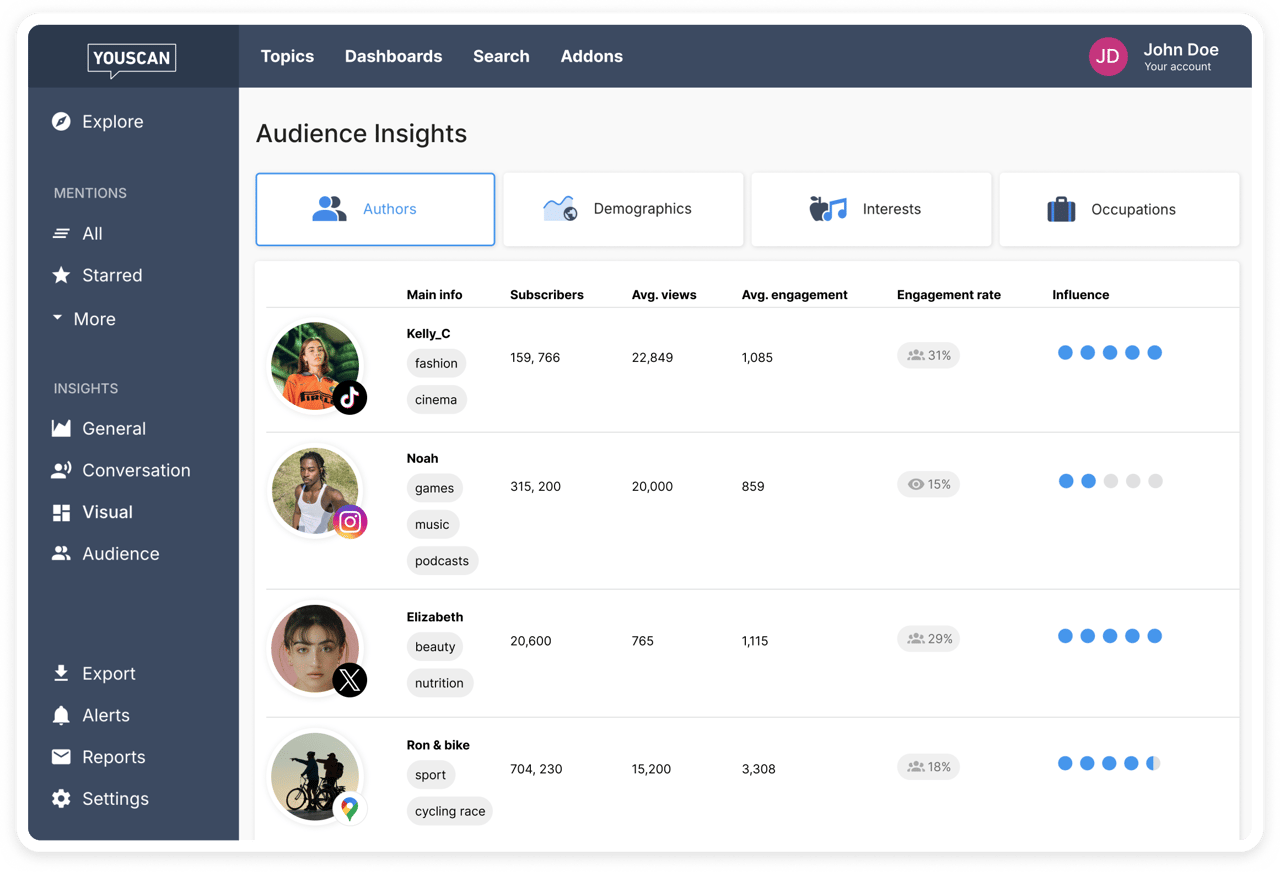
Better segments describe shared traits and behavior. What your audience likes, what they're skeptical of, which creators they trust, what they complain about at 11 pm. That's the layer platform analytics can't reach, and it's the layer that changes what you actually make.
How to build your own social media audiences breakdown
Four steps. None of them needs a research agency.
Start with platform analytics, then stop trusting them
Every platform's native analytics tools hand you audience demographics for your existing followers. Pull them. Note the largest age group, the gender split, top locations, and when your target audience is online.
Then remember the limitations of native social media analytics. Platform analytics only describe people who already follow you. They say nothing about the potential customers who should. If your follower base skews 15 years older than your ideal customer, native analytics will happily confirm your mistake back to you.
Layer in social listening for everything analytics can't see
Social media listening covers the rest of the internet: the relevant conversations happening about your category, whether or not anyone tags you. That's where audience research gets useful, because you're reading unprompted opinion instead of engagement metrics, and it's how social listening tools spot emerging trends before they peak.


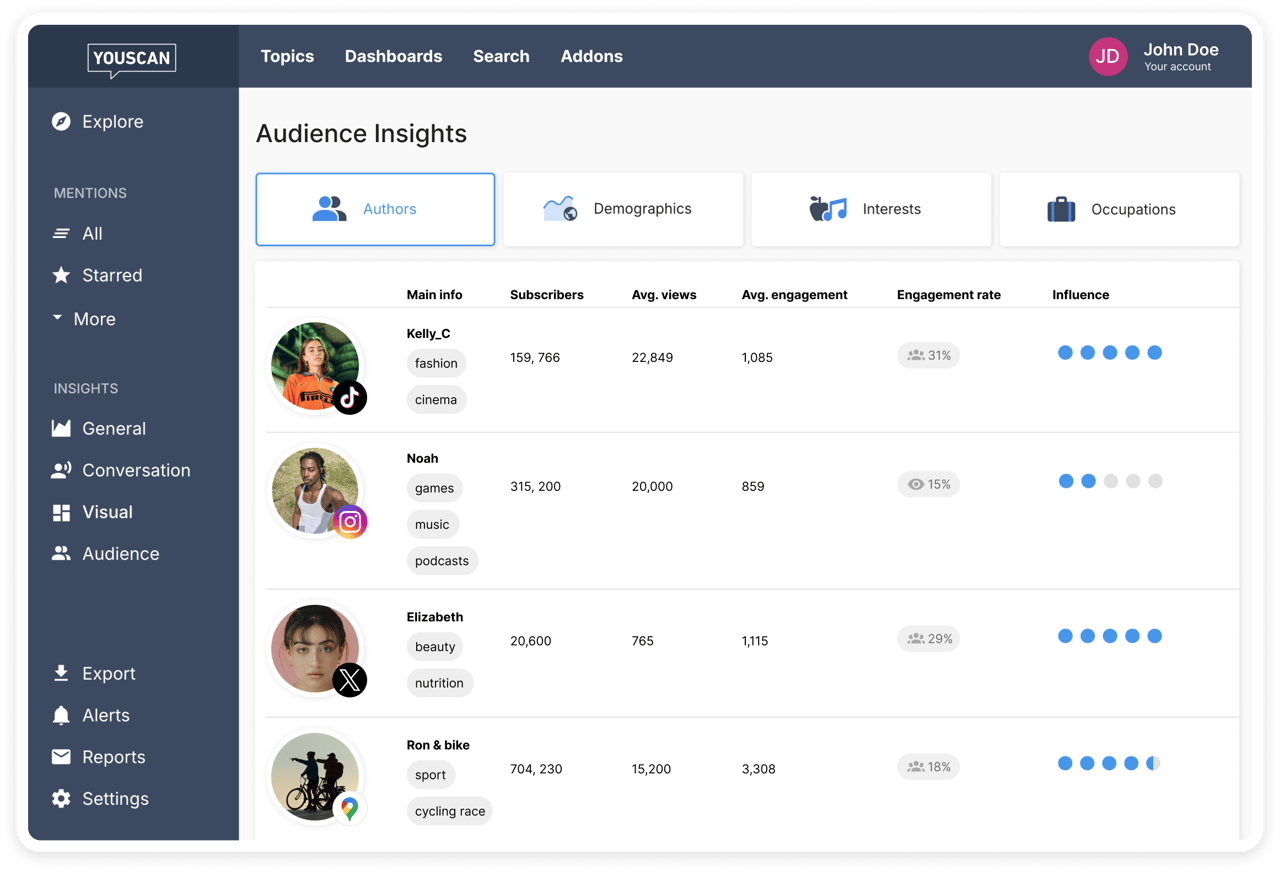
YouScan's audience insights reports build a portrait of the people in those conversations. Age, gender, location, occupations, and your audience's interests, derived from public social media user identities. Not just who follows your brand, but who talks about your category. That second group is usually your real target audience. Those two groups often barely overlap, which is uncomfortable and produces genuinely valuable insights.
You can also flip the query around and collect data by author characteristics instead of keywords. Want every post from UK-based makeup artists, regardless of whether they mention a brand? That's a targeting setup, and it gives you an aggregate view of what a specific audience discusses when nobody's asking them about you.
Audience segmentation: turning raw social data into groups you can use
Now group it. Cluster by interests and pain points, not just demographics. Three to five audience segments is plenty, and each target audience segment should change something you actually do. More than that and nobody on the content team will remember them.
For each segment, write down where they spend their time online, what format gets the most engagement, what they already believe about your category, and which objection stops them from buying. If a segment doesn't change a decision about content strategy or targeting, delete it. Good segments make it obvious what relevant content to create next.
Plenty of audience analysis tools can do this work, and the tools are worth comparing properly. What matters is getting your social media data into a single dashboard rather than five browser tabs. Social listening dashboards give different teams a unified view of the same data without each of them rebuilding the same report. That unified view is usually what turns audience data into something the whole team acts on. And if the terminology gets slippery, share of voice versus social media reach, monitoring versus listening, the social listening glossary sorts it out.
Ask better questions of the data
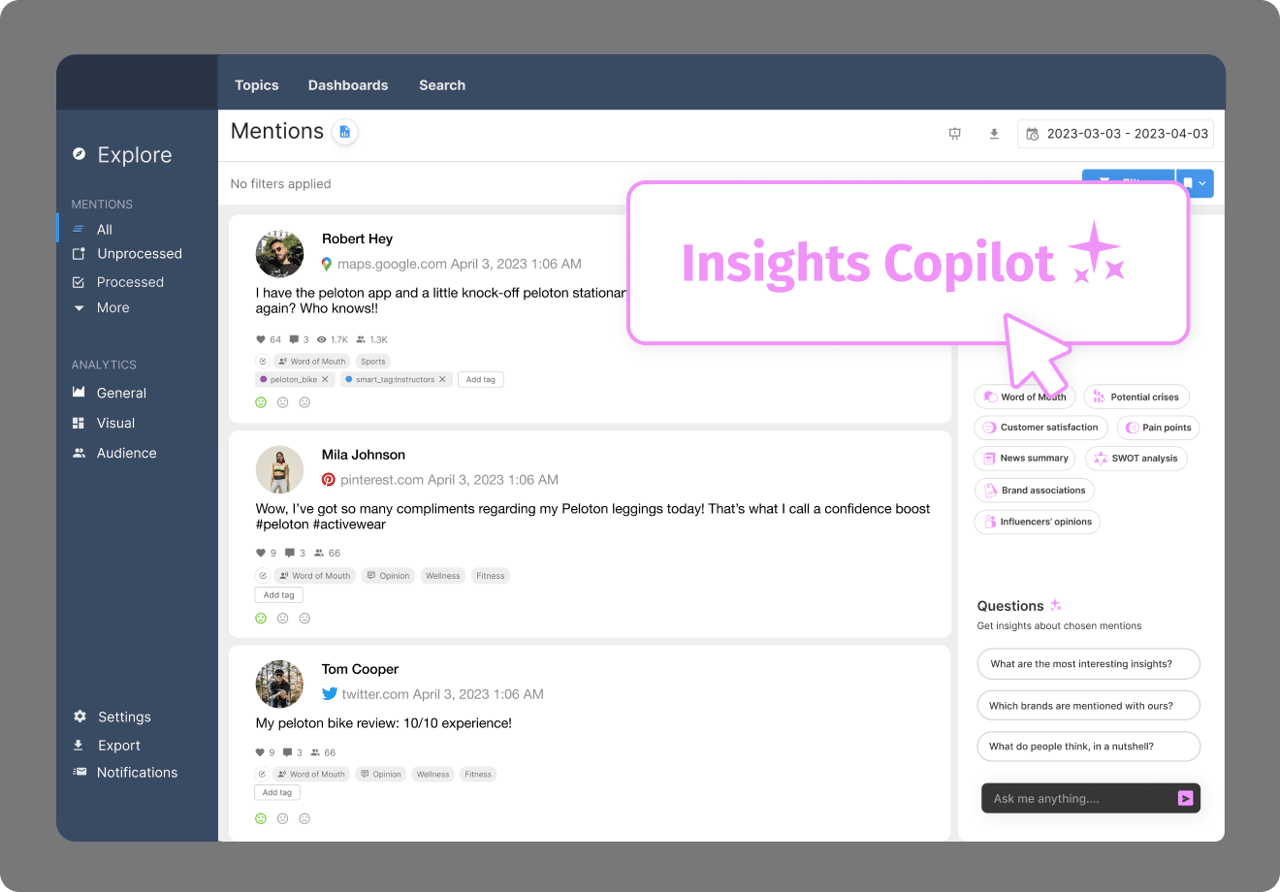
Once you have a few months of data, the bottleneck stops being collection and becomes interrogation. This is where conversational tools like Insights Copilot, YouScan's AI-agent, earn their place. You ask which brands this target audience mentions most, or what changed in a segment's complaints this quarter, and get an answer instead of building another report.
Audience trends worth tracking in 2026
Social media platform data is a snapshot. Audience trends are the movie, and your target audience moves with them. Three matter more than the rest right now.
Gen Z and baby boomers are converging on video
Gen Z built the short-form video habit, and everyone else copied it. Plenty of older social media users just watch it somewhere other than TikTok. Older audiences now watch the same formats, on different platforms, at slightly different hours. The generational gap in what people watch is narrowing faster than the gap in where they watch it.
Discovery has moved into the feed
A growing share of product research starts inside social media rather than a search engine. That shifts your content strategy: the first impression of your brand is increasingly a video from someone you didn't pay, not your homepage. Tracking those emerging trends early is the difference between joining a conversation and reacting to one.
What your audience likes shifts faster than who they are
Demographics move slowly. Interests move fast. A segment's interests can turn over in a quarter while its age and gender profile stay identical, which is why annual research produces stale insights. Trends in what people discuss are the leading indicator; demographics are the lagging one.
Turning the breakdown into marketing decisions
Choosing the right platforms without spreading thin
Given that the average person uses 6.5 social platforms, trying to cover all of them is a reliable way to be mediocre everywhere. Pick two where your ideal customer already spends time and your format fits. Ignore the rest until those two are working.
Rough guide: broad consumer reach favours Facebook and YouTube. Younger audiences and short-form video favour TikTok and Instagram. B2B is LinkedIn plus, increasingly, Reddit. Visual commerce is Pinterest and Instagram.
Adapting brand voice per audience segment
Same brand, different rooms. The tone that works on TikTok reads as try-hard on LinkedIn, and the LinkedIn version reads as corporate sludge on TikTok. The point is to serve more relevant content to each segment, not more content. Your brand voice should stay recognisable across social platforms while the register shifts, so you can reach each target audience effectively without sounding like a different company each time.
One B2B software team we work with ran an identical copy across platforms for a year. Splitting it — technical detail and customer numbers on LinkedIn, one problem statement and a screenshot on X — roughly doubled engagement on both. Same message, different delivery, increased engagement across the board.
Re-checking the data quarterly
Audience profiles move. TikTok's age profile has shifted meaningfully in three years, Facebook's regional gender distribution keeps changing, and social media platforms keep adding and dropping sources. Quarterly re-checks catch most of the trends that matter. Annual is too slow.
Where to start
If you take one thing from all this: the social media platform numbers are context, not strategy. They tell you the shape of the room, and the tools are cheap compared with the cost of guessing. They don't tell you who's in it that matters to you.
Want to see what your target audience actually looks like, including demographics, interests, occupations, and the relevant conversations you're not part of yet? Book a demo and bring a real question with you.
FAQs
What is a social media audiences breakdown?
A segmented view of who uses each social platform, covering audience demographics like age group, gender, location, and interests, alongside behavioral data on time spent and content preferences. Brands use it to decide which platforms to prioritise and how to tailor content for each one.
Which social media platform has the largest audience?
Depends on the measure. By reported ad reach, YouTube leads at 2.65 billion, ahead of Facebook at 2.39 billion. By self-reported use, GWI's data puts Facebook narrowly first at 56.3 percent of adult internet users. Different methodologies, different winners.
What is the largest age group on social media?
Across most major social media platforms, 25 to 34. On Facebook that band accounts for the greatest share of active users, and TikTok's centre of gravity has moved into the same range. The "social media today is for Gen Z" assumption is a few years out of date.
How do I find my own target audience rather than the platform average?
Combine your own social media analytics with social listening. Native analytics tell you about existing followers. Listening tools show you everyone discussing your category, including people who have never touched your account. Layering the two gives you deeper insights than either on its own, and makes it far easier to create content that earns engagement.