Meet Synthetic Audiences by YouScan: Personas Built from Real Data

Long surveys, focus groups, and costly research take time most campaigns don't have. So teams often launch on gut feel and only find out how people react after the budget has been spent.
That is why YouScan is introducing Synthetic Audiences — a new functionality inside our product that gives you a directional read on your creatives in minutes, before you hit publish.
We built Synthetic Audiences on real people's posts and comments. Reactions to the content you test on them can be traced back to actual mentions. Here are more details.
What's new: Synthetic Audiences in YouScan
Synthetic Audiences is a new YouScan capability that turns the real conversations in your YouScan Topics into behavior-based personas. It lets you test your next creative campaign against them before it goes live: think creatives, messages, or concepts.
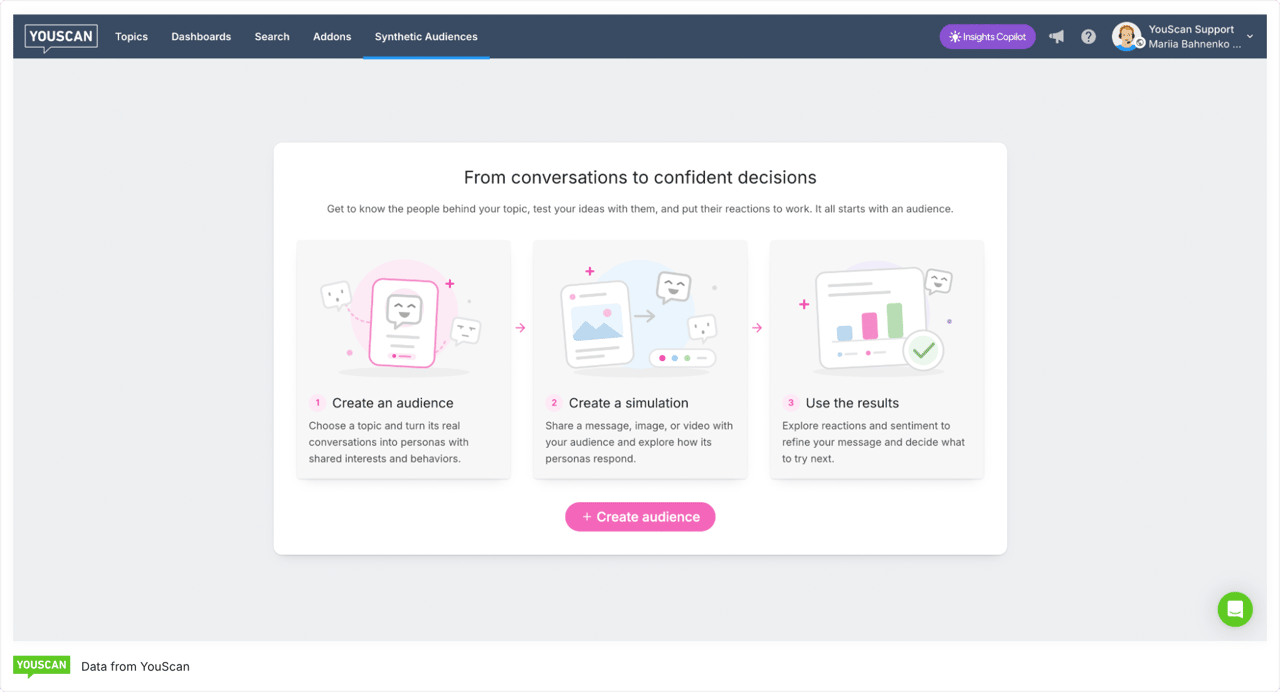
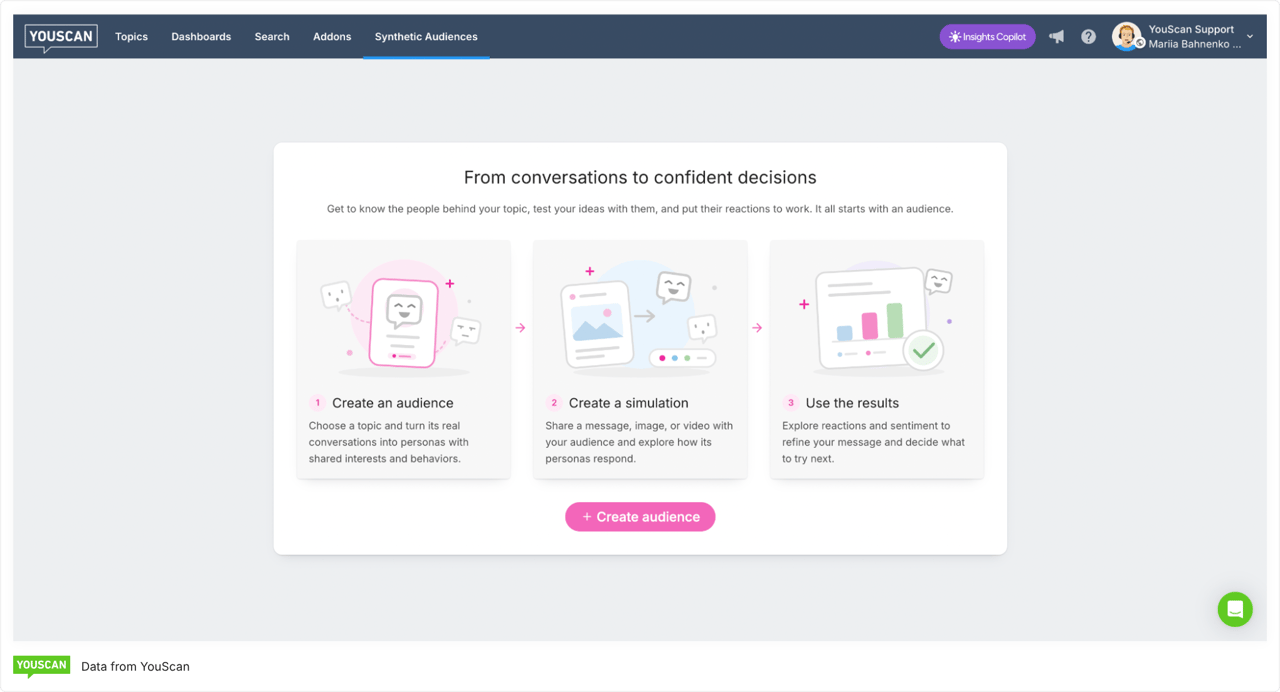
That gives you two things in one place: a complete picture of how the people behind the conversations are likely to react to whatever you want to launch, and it buys you more time to fine-tune your creatives so that they resonate with the audience to the best extent.
Backed by real social data, not prompts
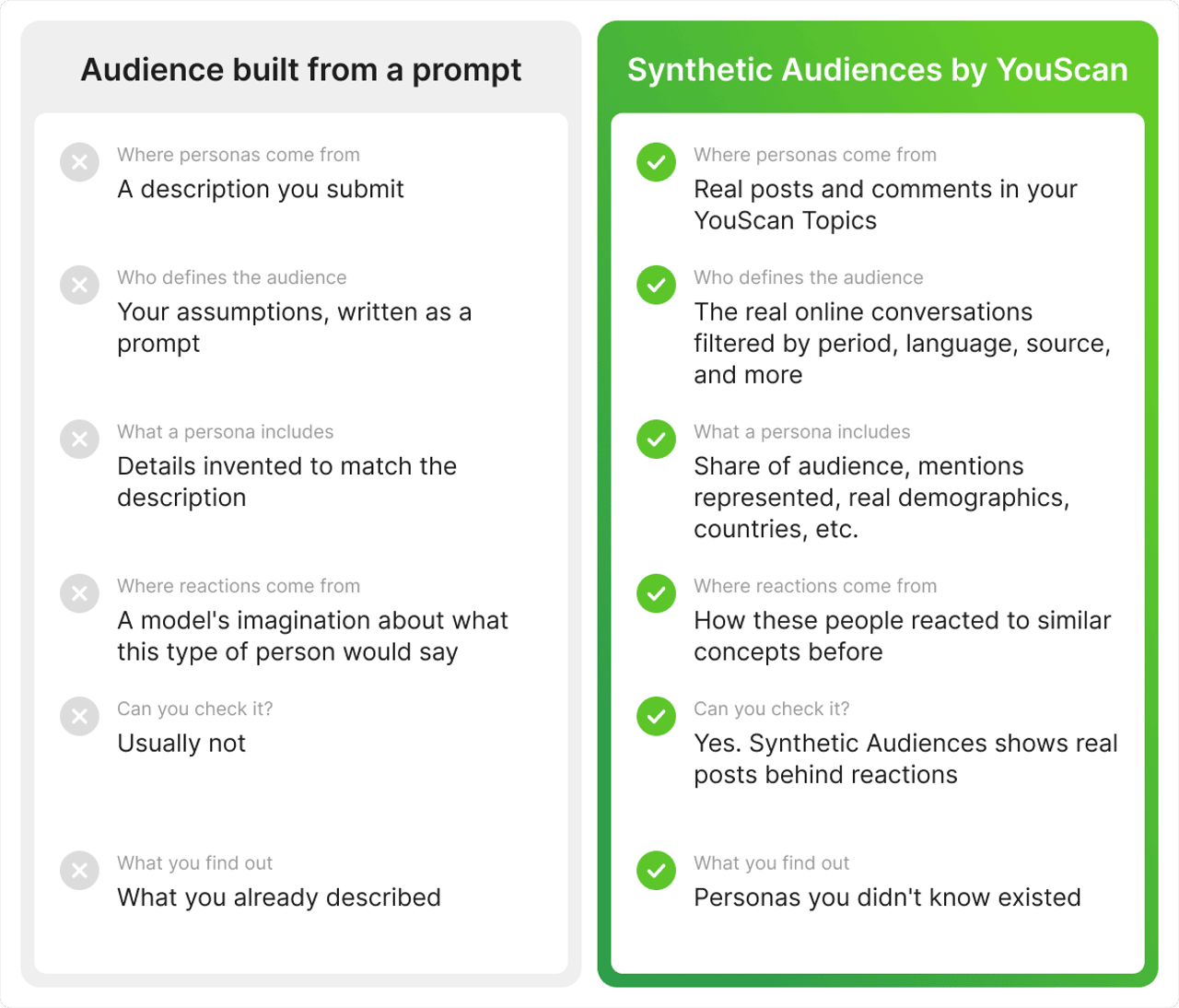
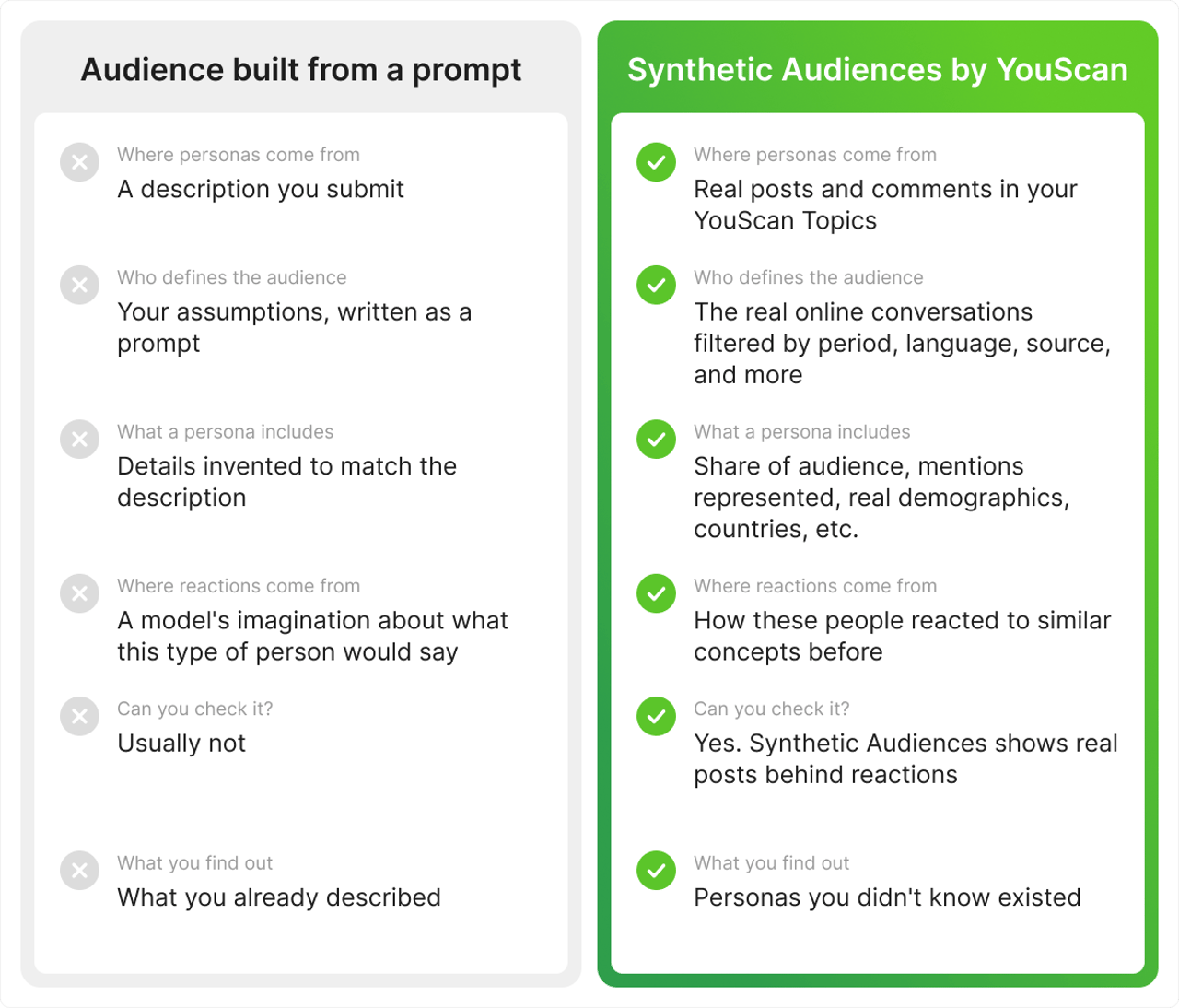
The market is brimming with synthetic audiences generated from a prompt and a model's imagination. It all starts with a description, such as “a 30-year-old mom who cares about healthy snacks and yoga”, and the model plays its part.
The result may sound plausible, but it reflects the model's assumptions, not the market you work with. Could you defend findings like that in a strategy meeting?
Synthetic Audiences by YouScan takes the opposite approach: it starts from the conversation and builds personas from the people in it.
“There has never been a time when attention was as scarce and fragmented as it is today. And so getting to understand your customers, hear them, understand their opinions is even more important now.
With Synthetic Audiences we now add a whole new layer to how you understand your audience. At YouScan, we’ve been helping to understand real conversations about brands for over a decade.
Now, those conversations are the foundation for Synthetic Audiences. You can model how people react before you decide on your next move. That’s valuable because it can help you step out of your own worldview and see things through the eyes of your customers. Give it a try, and let us know what you think!”
Leonid Lytvynenko, CEO of YouScan
Synthetic Audiences in action: concept testing a marketing launch
It takes a village to come up with, prepare, and run a marketing campaign, especially on a tight deadline. Speed up at least one stage in this process with Synthetic Audiences and understand how your audience might take your launch in advance.
The logic is two-part: first, you create an audience based on your existing YouScan Topic. Second, you create a simulation with it to receive synthetic reactions to your content.
Let’s see how Synthetic Audiences helps with creative concept testing. So here’s the marketing brief:
💡A pizza brand is about to announce a "Hot Honey" pizza, available for three weeks only. A social media manager has already drafted an Instagram post and an image to publish:
🍯 Hot honey is back, and this time it comes with a deal. Sweet pepper, a honey drizzle, and the crispy edge you’ve been asking about. For three weeks only, you can pair it with our app deal: use the promo code for 20% off your order.
Order in the app or at your nearest store. ⏰ Hot honey is here for three weeks. #HotHoney #PizzaDeals #LimitedEdition #PizzaNight
Step 1. Shape an Audience
To walk you through the process, we’ve set up a Topic from real online conversations around hot honey pizzas using our AI query assistant. Its query covers:
Deal language (promo code, coupon, buy one get one, half off)
Hot honey concept (hot honey, spicy honey, honey drizzle, chili honey)
Relevant hashtags (#hothoneypizza, #spicyhoneypizza, #pizzadeals)
Then, we created an audience from it, choosing the Topic, date range, and a filter (this is optional):
Once the audience is set up, you get a full profile of who they are, which sentiment dominates, most-used sources, and their share of audience. The audience we’ve just created involves 20 personas. Here are the TOP 5 of them
Pizza Deal Reviewers – 20.3%, 2,169 mentions
Burned Pizza Delivery Complainers – 13.1%, 1,399 mentions
Hot Honey Pizza Regulars – 9.6%, 1,023 mentions
Spend-the-Day Lifestyle Vloggers – 8%, 853 mentions
Domino’s Deal Hunters – 5.8%, 622 mentions
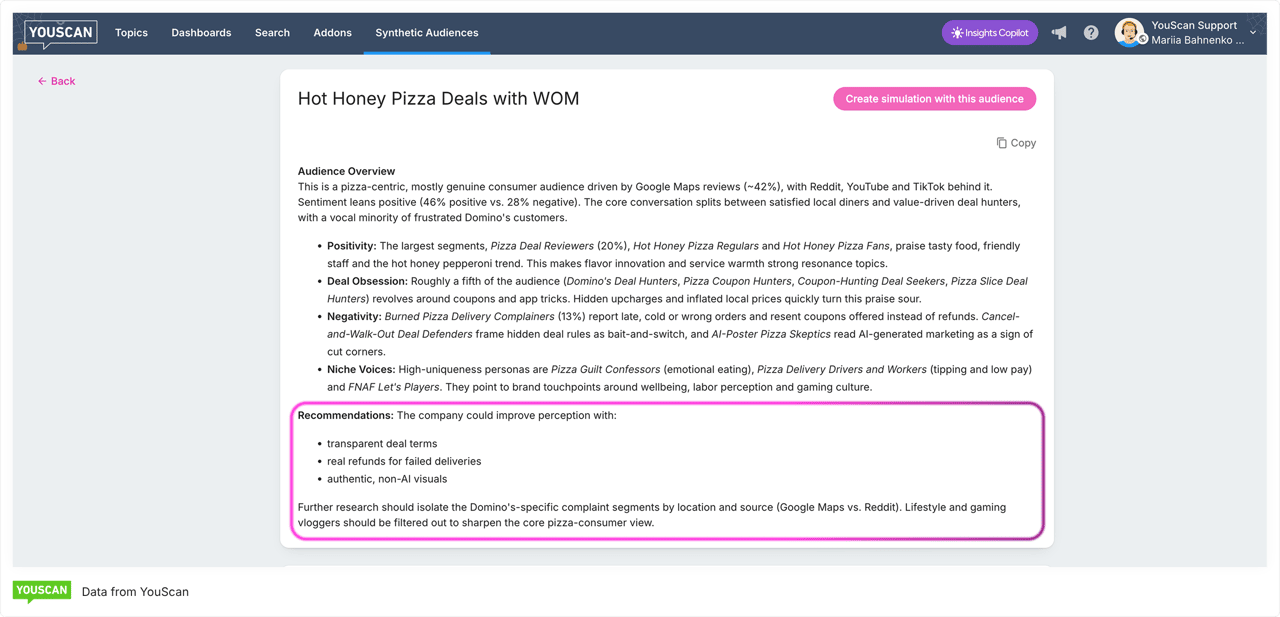
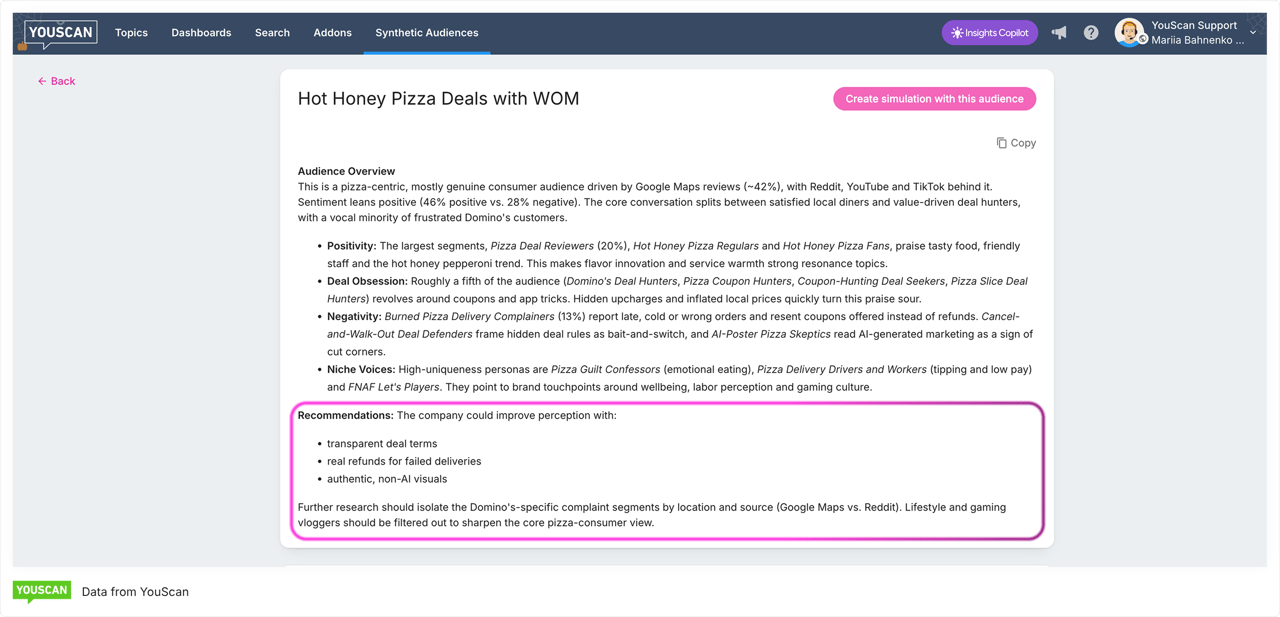
Our audience is pizza-centric, mostly driven by Google Maps reviews (~42%), with Reddit, YouTube, and TikTok behind it. Their sentiment is mainly positive – 46% positive vs. 28% negative. The core conversation splits between satisfied local diners and value-driven deal hunters, with a vocal minority of frustrated Domino's customers.
Another crucial thing for us as marketers is that Synthetic Audiences also suggests recommendations on how we should shape our messaging, which areas to focus on, and how to explore this audience further.
Let’s look at one of the consumer personas: the Pizza Deal Reviewers:
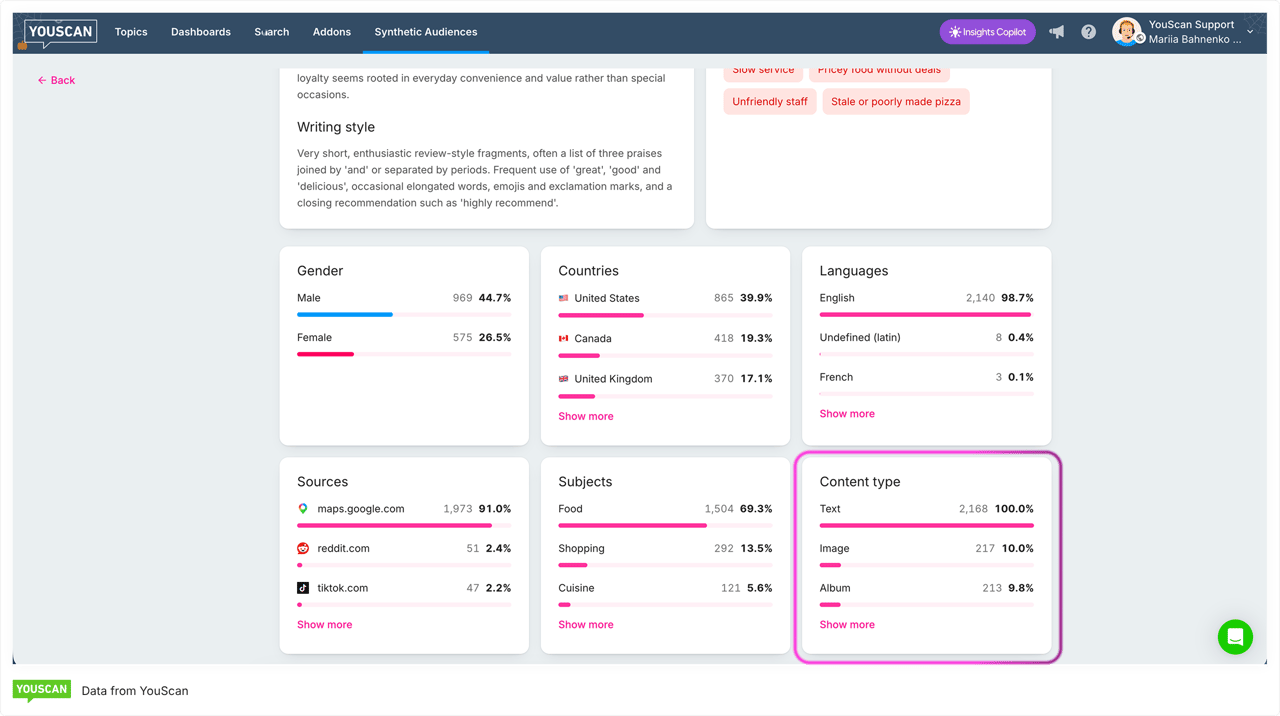
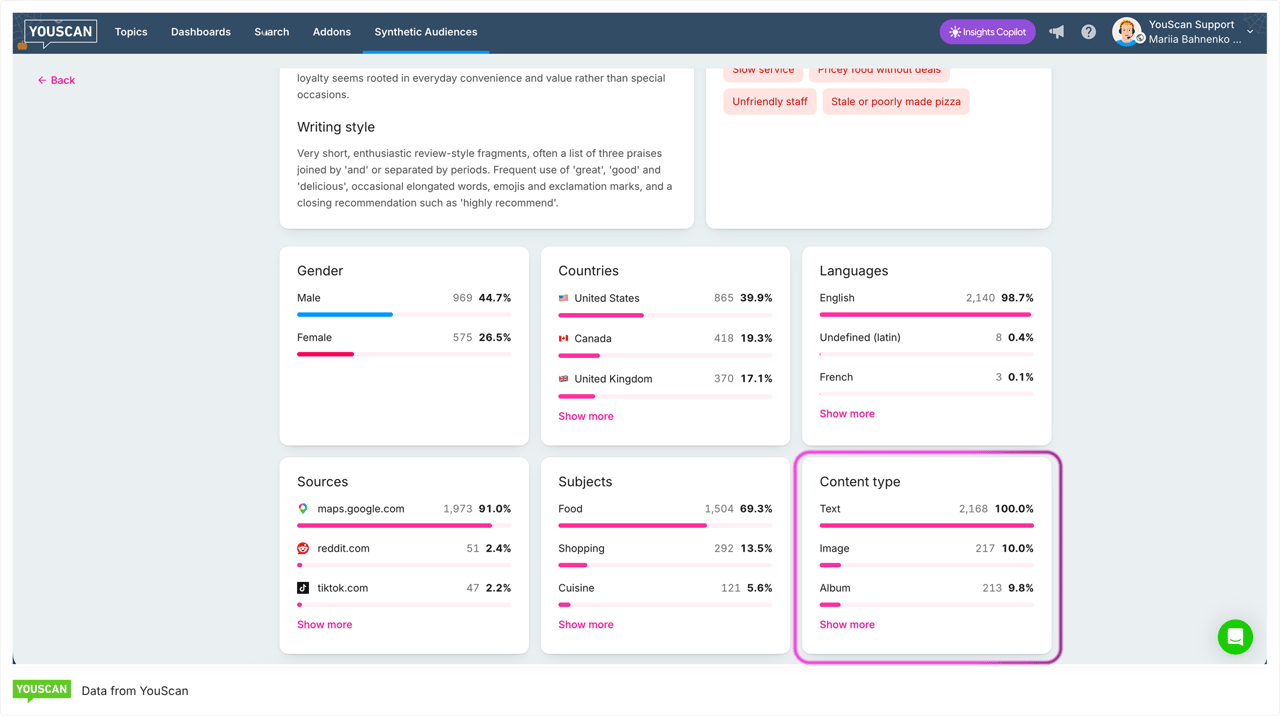
This persona is rated as a genuine consumer, with Medium uniqueness. They love great meals, delicious pizza, and fast service. They dislike pricey food without deals, slow service, and unfriendly staff. To get a clearer picture and evidence behind those preferences, we can jump to the Mentions represented; they are the basis.
Content types are rated, too, so you can see which formats this persona responds to best.
Step 2. Create a simulation
So we’ve received a full picture of who our audience is and how they talk about hot honey pizza. It’s high time we saw synthetic reactions to the upcoming marketing launch!
Let's add a draft Instagram post and a visual we’d like to run.
The simulation returns an overall reception summary and creative recommendations. Besides, Synthetic Audiences even suggests a plan to improve the image and the social post based on the personas:
Add the promo code in the caption
Soften or reframe the three-week scarcity
Double down on the crispy edge claim with real proof
Answer the deal mechanics up front
Validate the honey itself
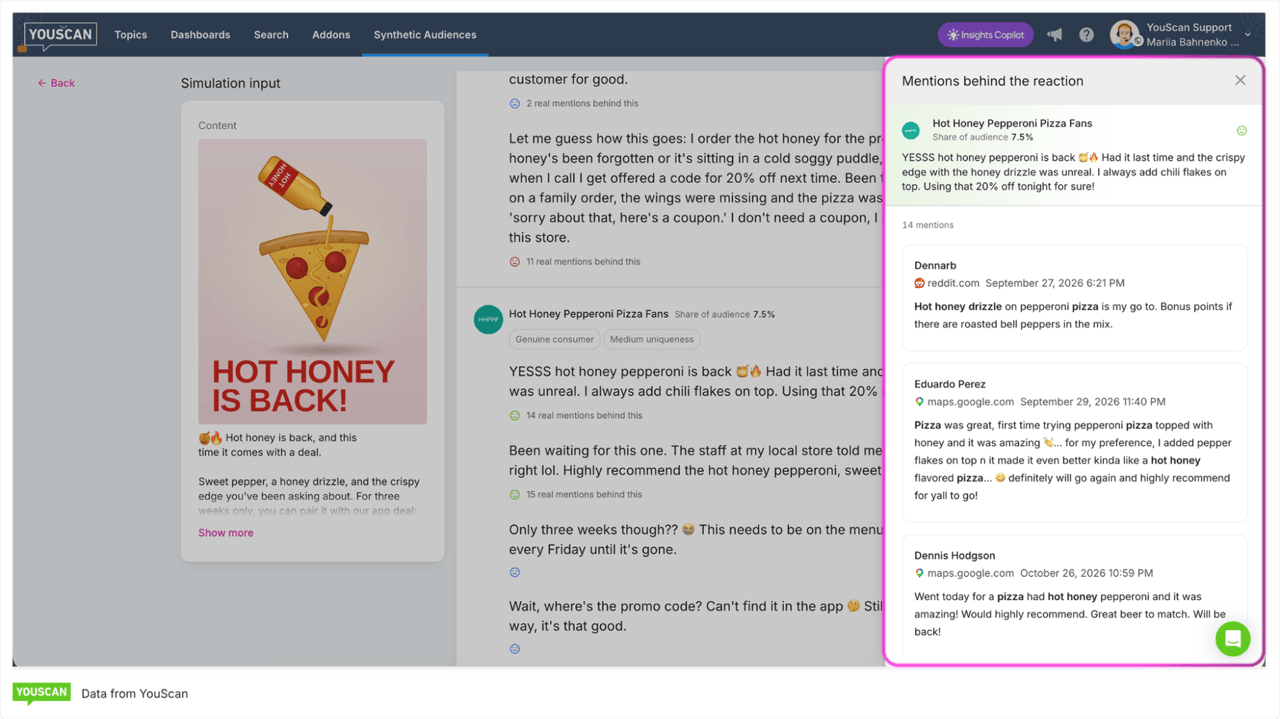
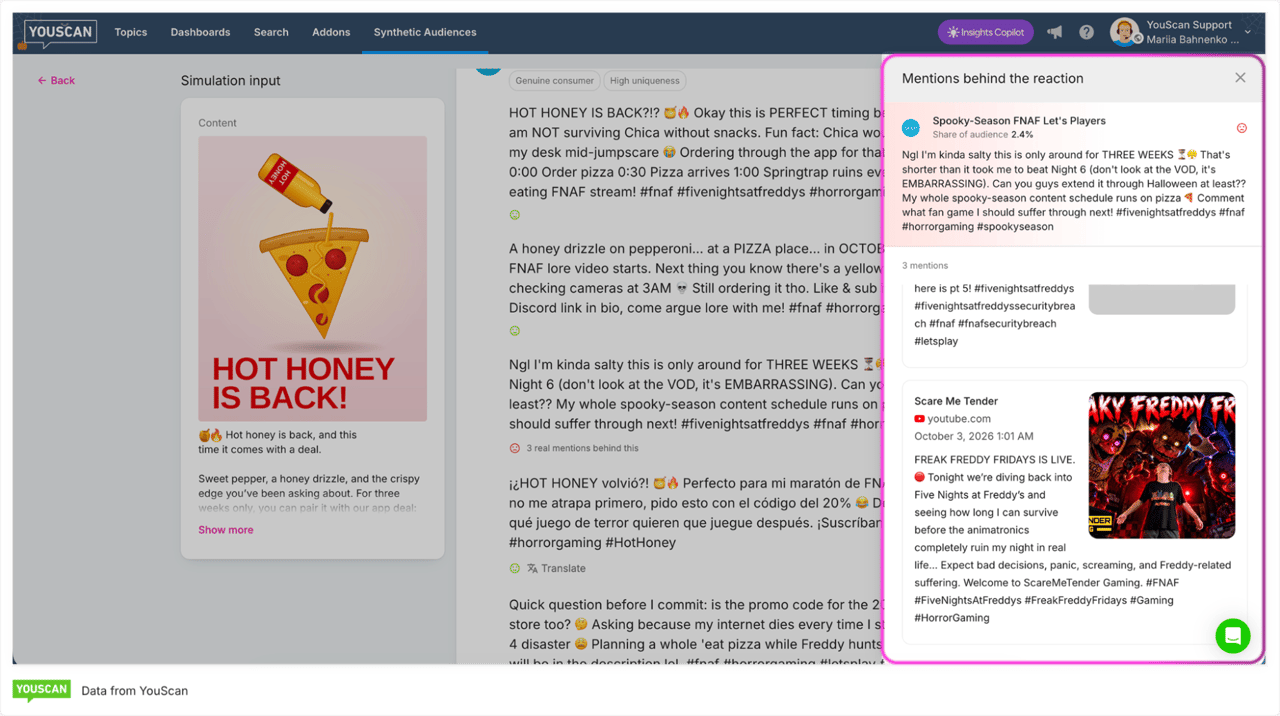
The best part of the deal is that you can clearly see the mentions behind synthetic reactions — so you can check where reactions came from.
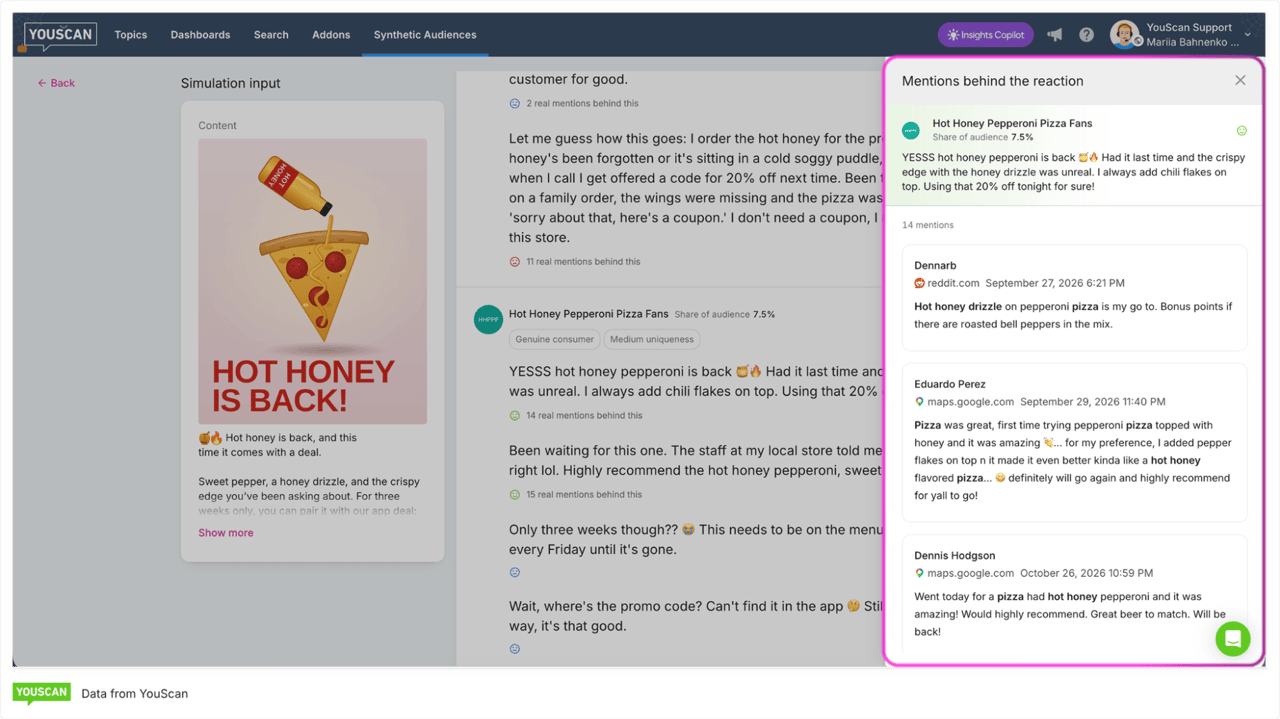
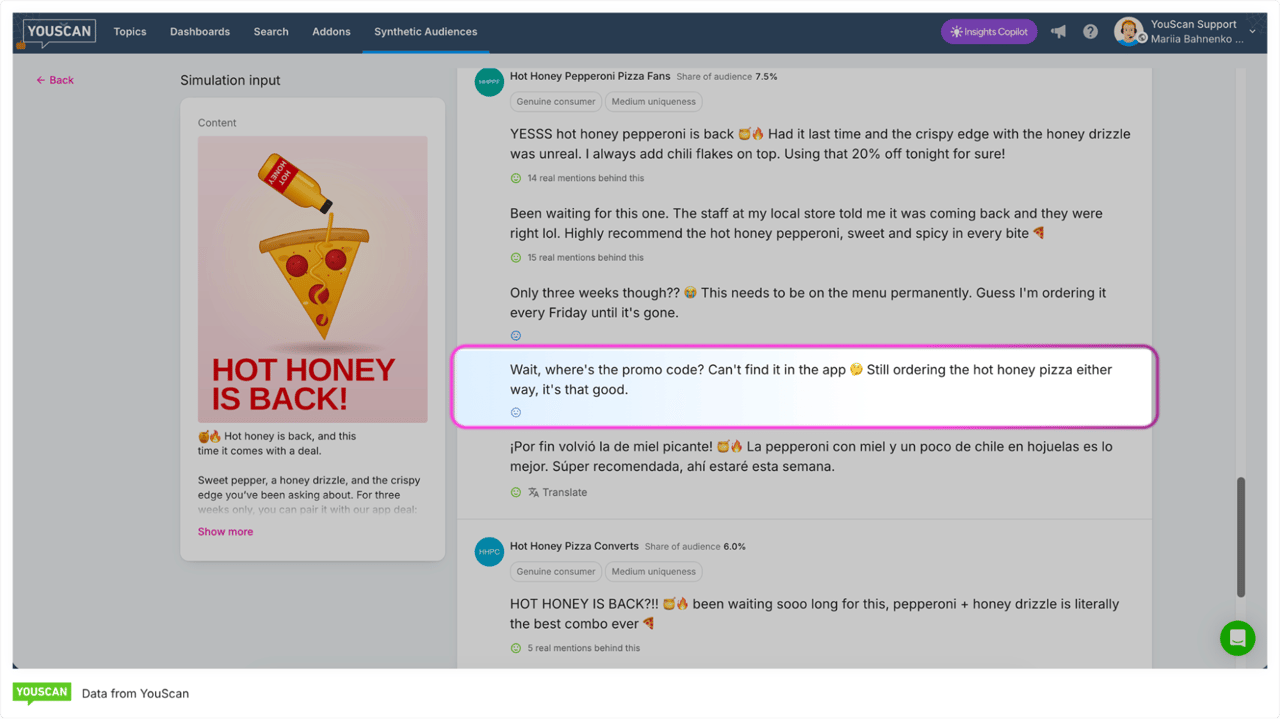
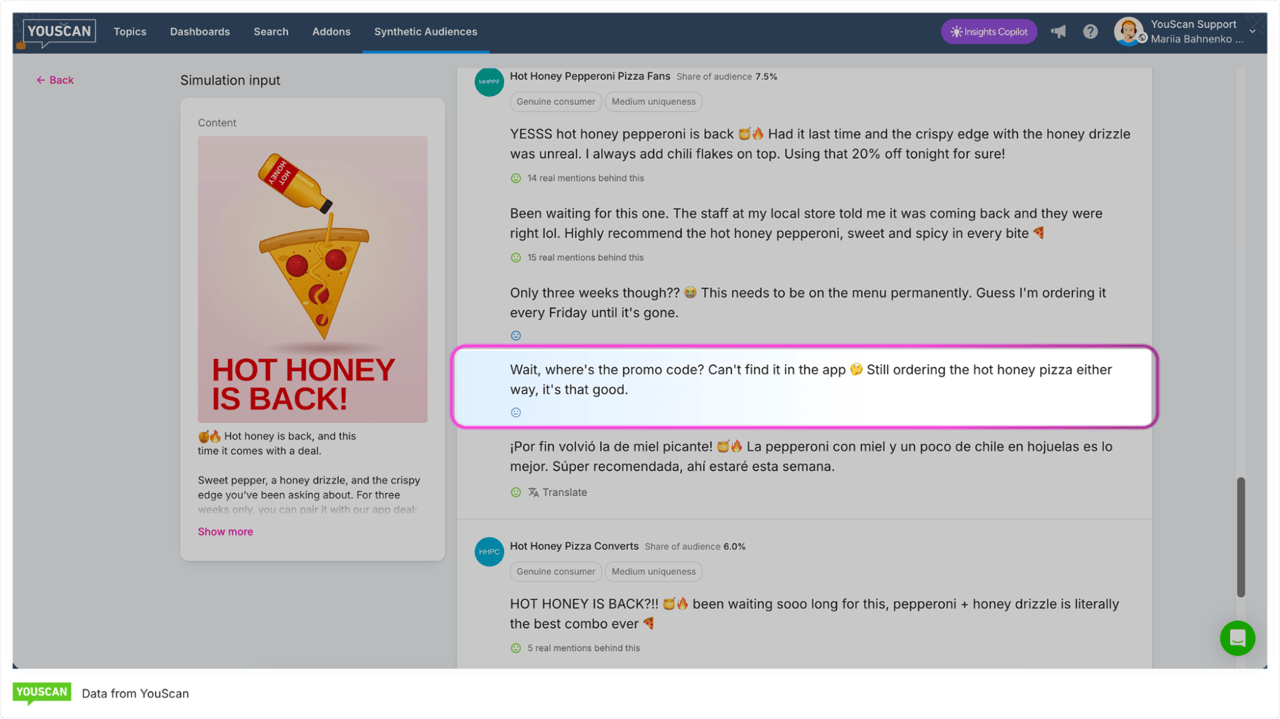
Here is a trick: we left the code out of both the message and image on purpose. The personas caught it immediately:
When to use Synthetic Audiences?
With Synthetic Audiences, you can expand your social intelligence efforts and learn more about the people who'll see your next campaign:
👋 Get to know your audience
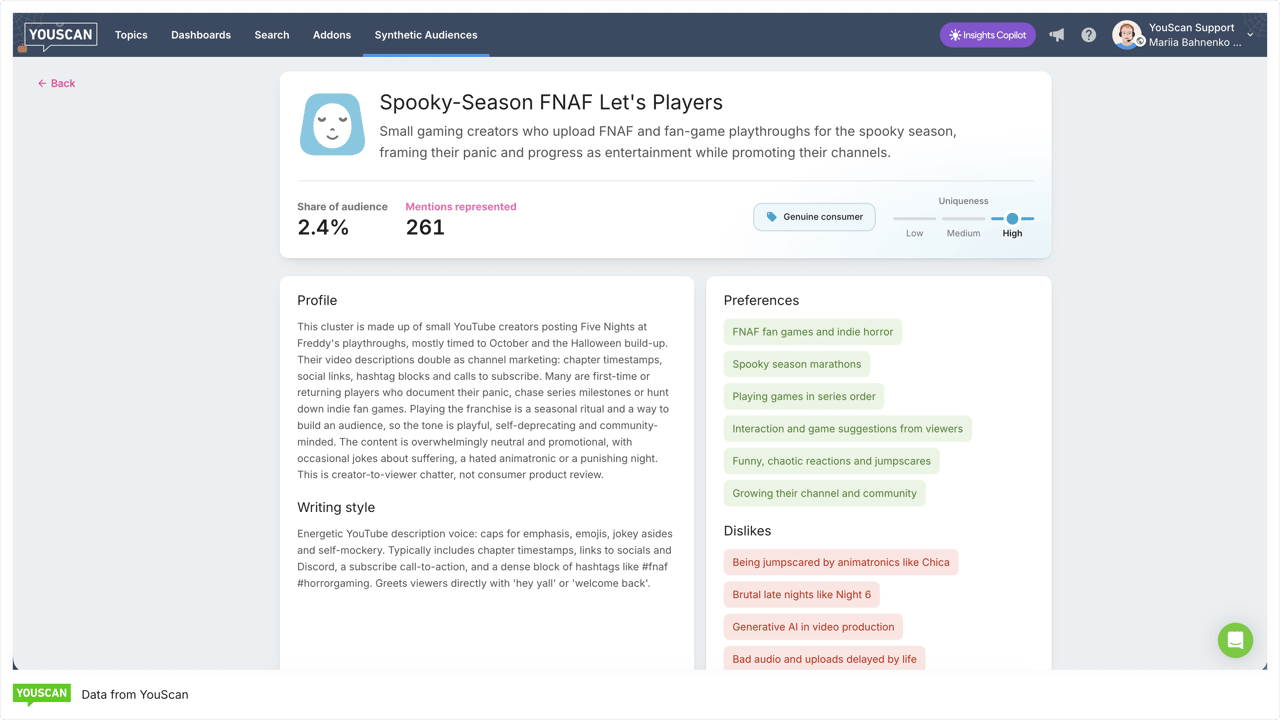
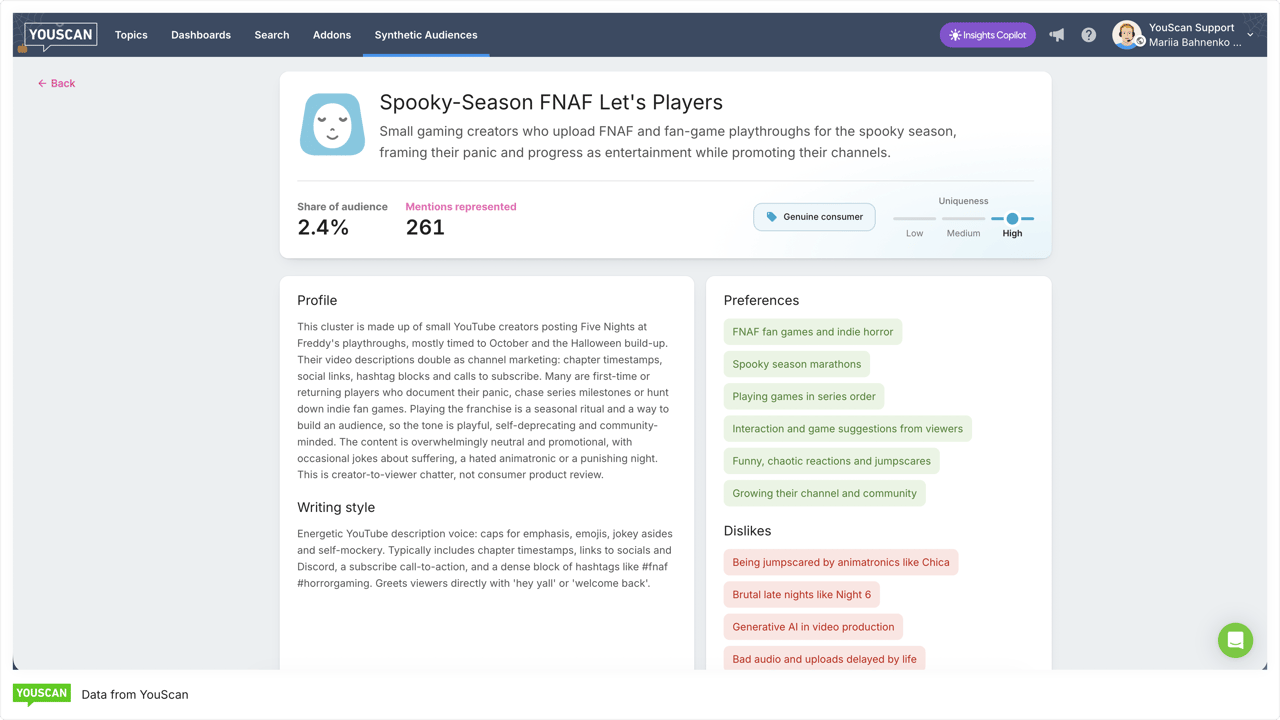
See who's really behind the conversation before you have any creative to test. Pick a Topic and filter it by period, language, source, category, and more. YouScan then reads the matching mentions and groups the folks behind them into a handful of consumer personas, each with its share of audience.
👉 Why you might find it useful: Instead of scrolling through thousands of mentions on social media, the team gets a readable picture: who these people are, what they care about, what they dislike, and how they write. Every persona traces back to real mentions you can open.
💡The questions you can ask:
Who are the people talking about us this quarter, and how is that different from last quarter?
Before we enter a new market, what kinds of consumers are already in the conversation?
Who talked about our last campaign message, and how did different groups take it?
🖼 Test marketing creative concepts before publishing them
Synthetic Audiences shows how your audience is likely to react before you launch. Say you want to test your next message, idea, or creative, or all three. Add where it will be published (optional) and run it against one or more audiences.
Each persona reacts in its own voice, and you get a summary per audience plus an overall comparison.
👉 Why you might find it useful: You can catch weak spots in your messaging while changes are still cheap and adjust whatever you think is necessary: a confusing offer, a joke that lands badly, or a visual that distracts from the main message. Compare how different audiences take the same creative (coming in an upcoming release).
💡 The questions you can ask:
Which of these two captions lands better with our core buyers?
Does this video read as funny or as cringe to Gen Z?
What will people complain about first when they see this launch post?
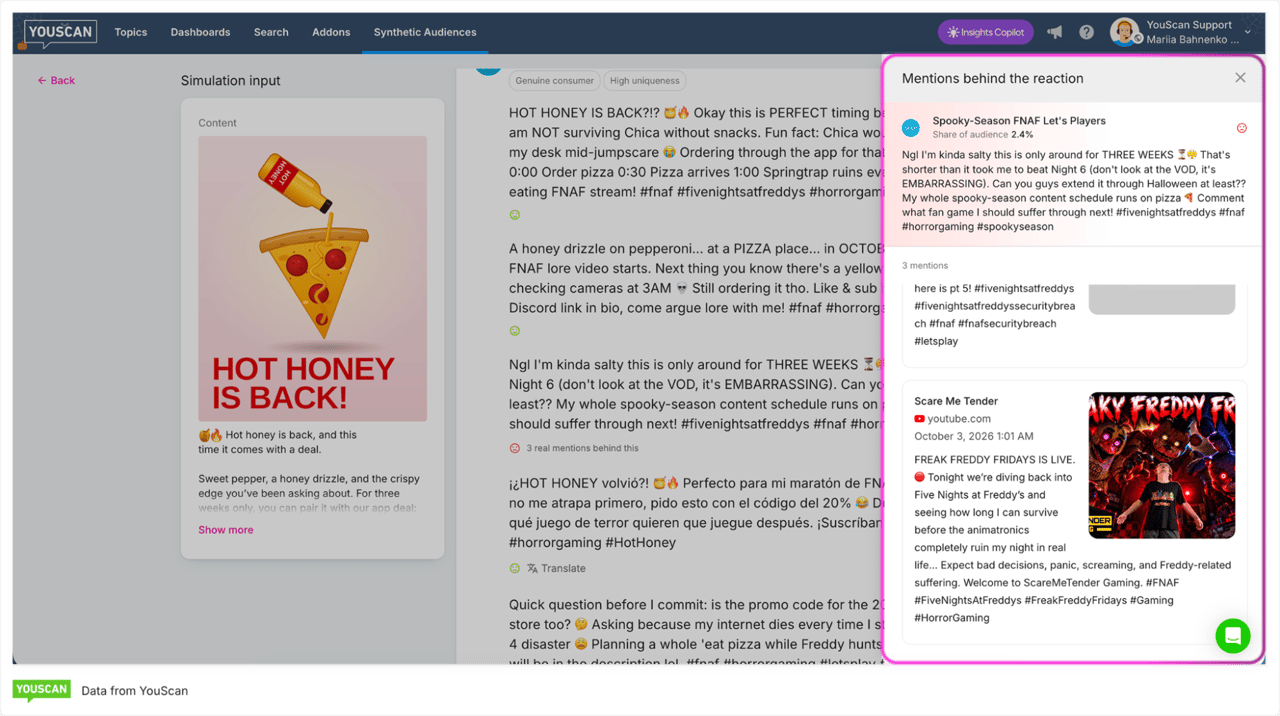
Here we can clearly see where the negative reaction is stemming from: apparently, a person wants the promo to run through the Halloween season, not only for 3 weeks (I can relate!).
📊 Analyze competitors and segment opportunity
Decide whether a segment is big enough to invest in, using social data that first-party numbers can't give you.
👉 Why you might find it useful: This is a chance to see beyond your own customers. Build a Topic around your competitor and see who is talking in the market, including people you don’t reach.
💡 The questions you can ask:
Which segments make up the conversation around a competitor, and which of them are missing from ours?
Is this segment big enough to be worth a dedicated campaign?
Who is talking about the niche but not us?
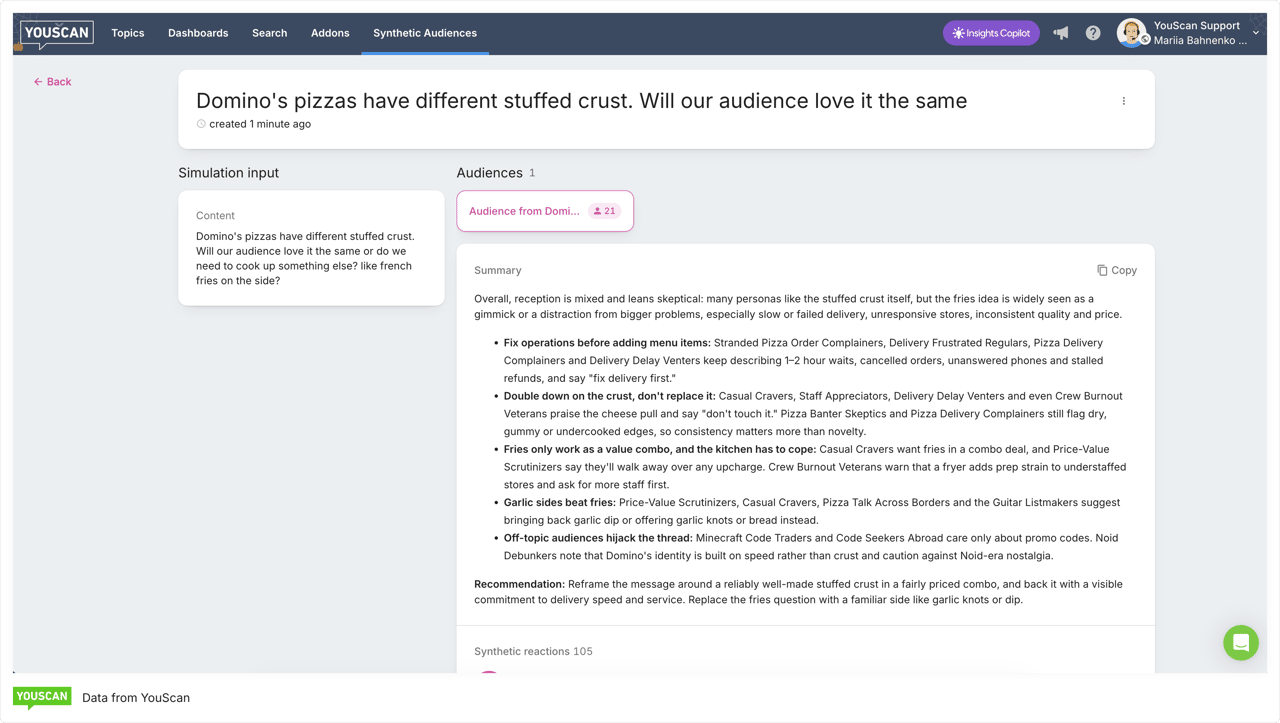
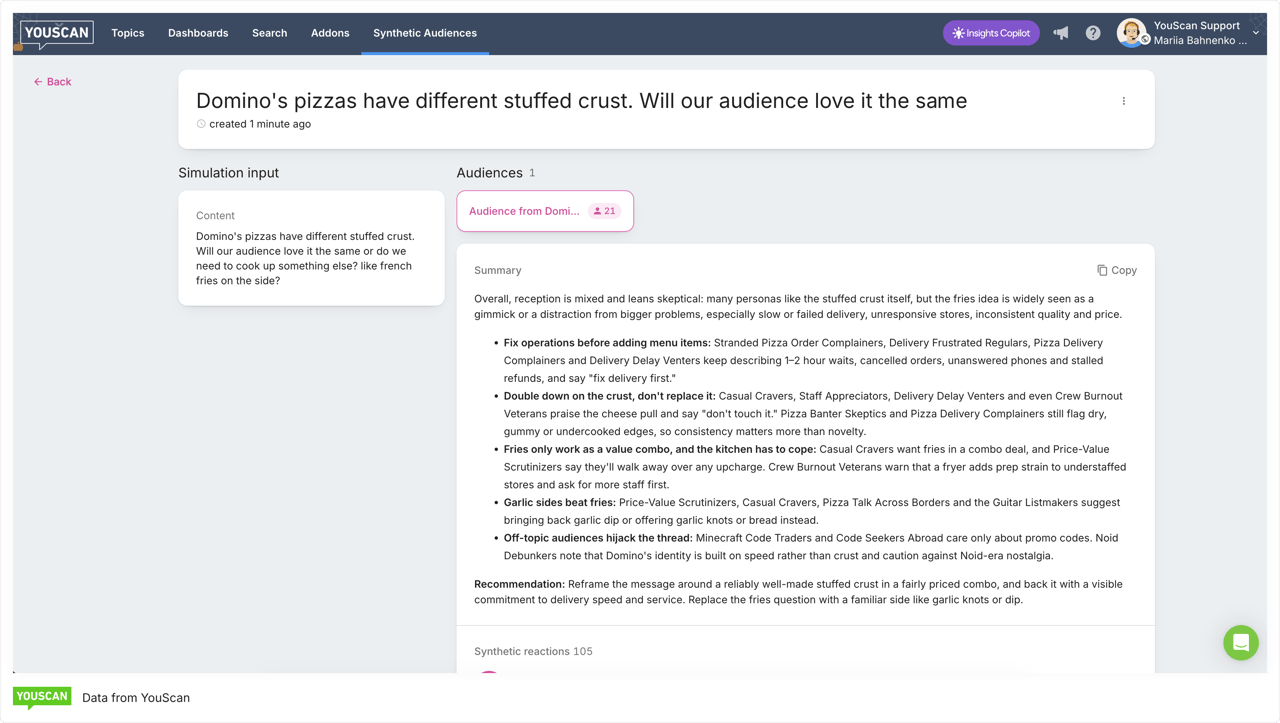
In the following case, we asked if our audience would love stuffed crust in a pizza, like the one Domino’s has, or they might prefer something on the side, like French fries. The recommendation was to the point: we might consider adding garlic knots or dips. Pretty smart!
👍 Validate or reject a hypothesis
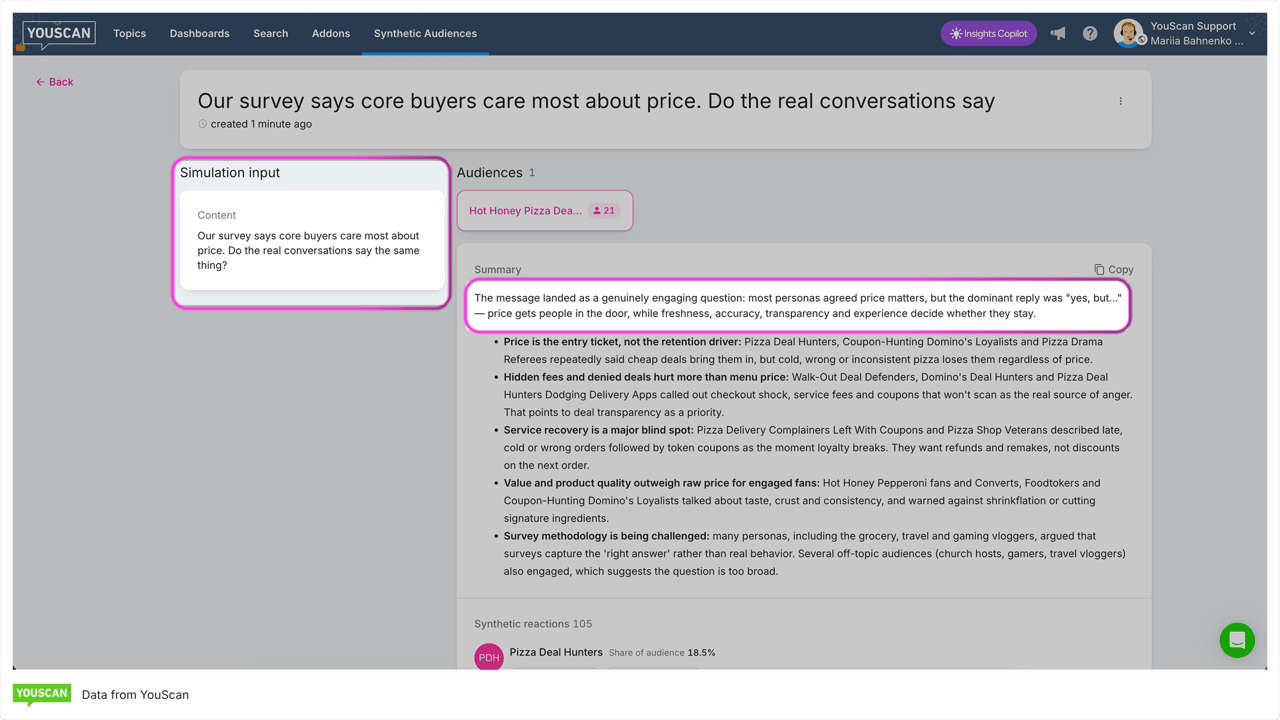
Synthetic Audiences helps you support or challenge an assumption from other research tools, all backed by social data that you can check.
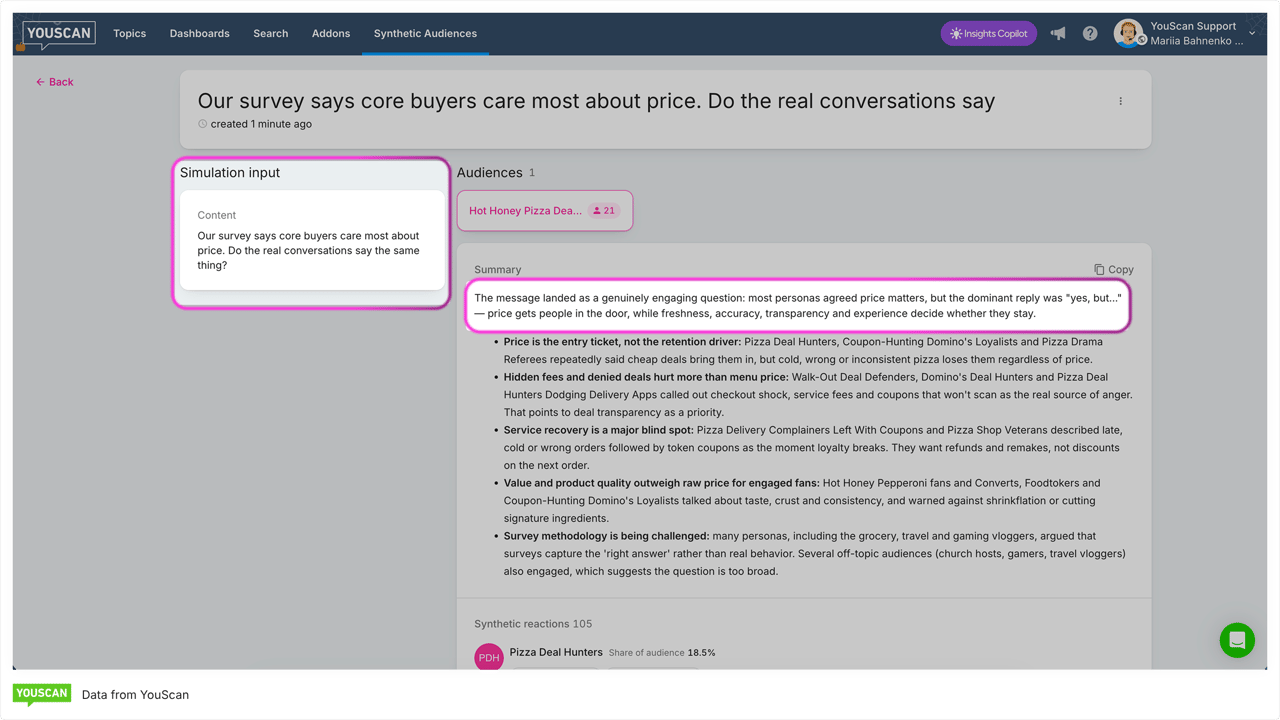
👉 Why you might find it useful: When you run a survey, the information you receive is only one side of the story. Real conversations in your Topics show the other side: whether people say the same thing when nobody is asking them. Besides, you may discover personas you never wrote into a brief. If one of them contradicts your assumptions, you find out before acting on it.
💡 The questions you can ask:
Our survey says core buyers care most about price. Do real conversations say the same thing?
Which group in our audience pushes back on the message, and what exactly do they object to?
Is the complaint we keep receiving from sales widespread, or limited to one segment?
Who benefits from Synthetic Audiences?
If you are in the marketing, research, and consumer insights space, this feature is built for you:
Brand strategists and brand managers can understand who talks about the brand and why. Shape positioning and messaging with evidence.
Consumer insights and research teams can get a quick read before jumping into formal research.
Marketing, social, and content teams can test creative concepts to see how the audience might take new images and ideas before they show them to the world.
Agencies can validate creatives for clients and back up a project direction with real data.
Our first launch of Synthetic Audiences — your feedback matters
YouScan has just shipped the add-on, and we're just getting started. Chat, comparison (comparative analysis), and exporting with your audience are on the way. Your feedback decides what we shape next.
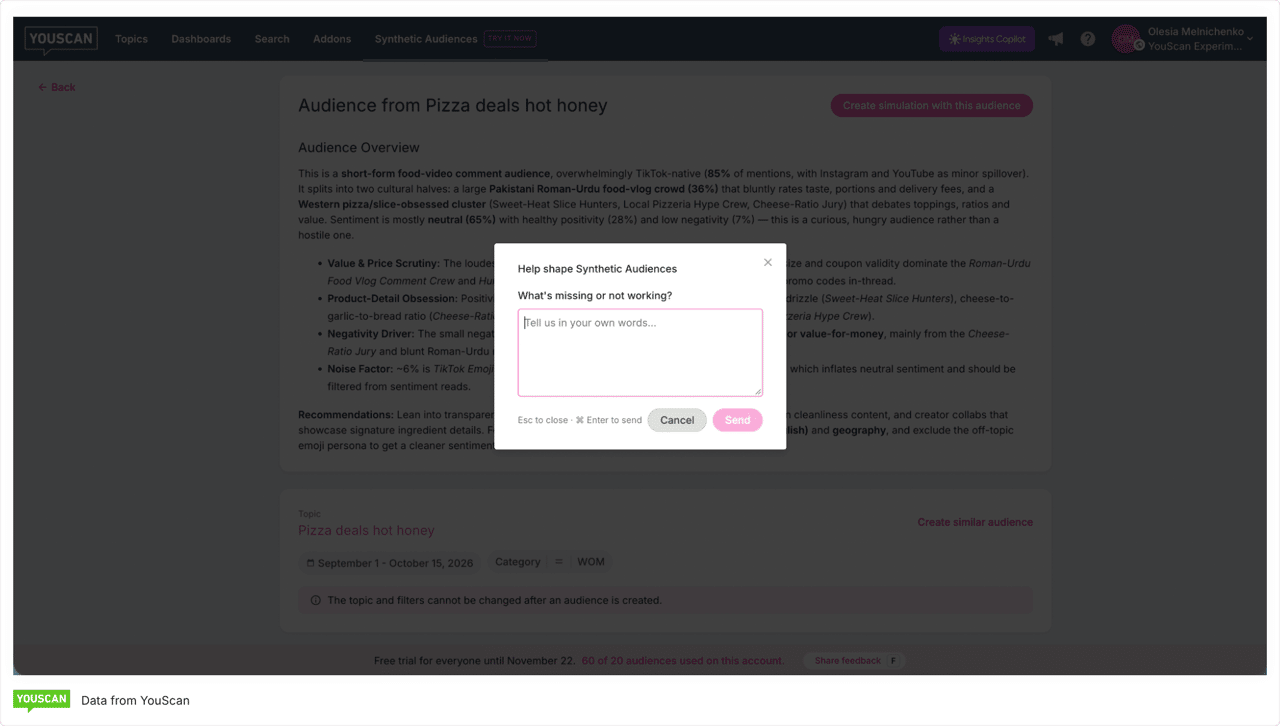
Take Synthetic Audiences for a spin, try it on a real brief, and tell us what you think. Just press F or click “Share feedback” at the bottom of the screen while playing around with the feature to share your thoughts.
If you’ve never used YouScan and would like to try Synthetic Audiences, book a demo: we’ll walk you through the details.