How Do AI Detectors Work in 2026? The Tech Behind AI-Generated Content (2026)


A content manager opens their email on a Tuesday morning. There’s a message from a panicked freelancer: an AI detector flagged his draft at 87%. They swear they wrote every word. The manager believes them, mostly. Still spends two hours figuring out what to do.
That’s the messy reality of AI detection in 2026. The tools are everywhere — baked into fancy brands, sold as standalone products, free on a hundred random websites — yet almost nobody using them understands what’s happening when they paste in a paragraph and get a number back.
So how do AI detectors work? Short answer: they run text through a machine learning model trained on human writing and AI-generated text, and produce a probability score. They don’t read for meaning. They don’t compare against a database. They’re statistical pattern-matchers, and they’re wrong more often than the marketing suggests.
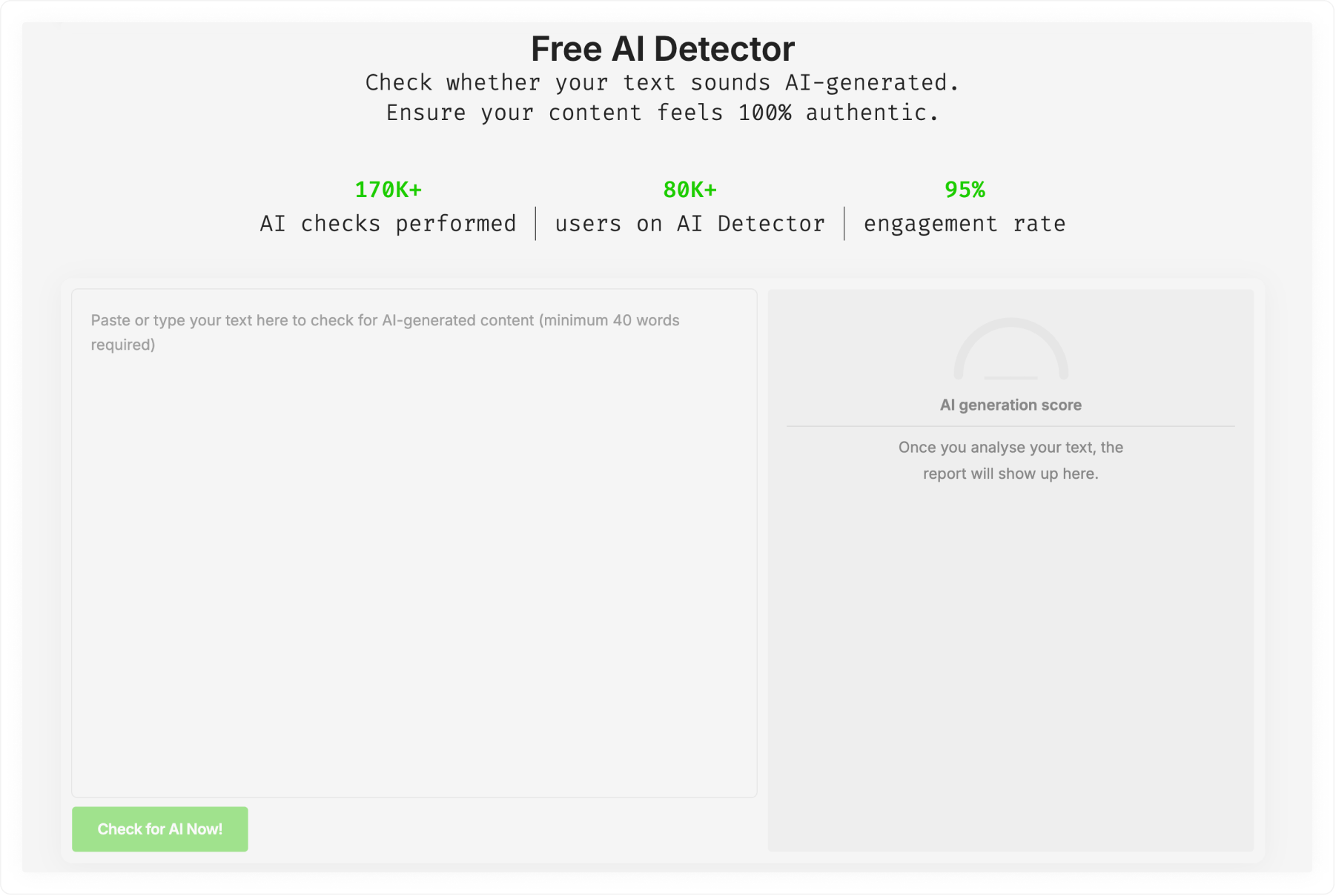
This article walks through the mechanics — perplexity, burstiness, classifiers, watermarking — then gets honest about how unreliable these things really are. (For testing along the way, YouScan offers a free AI Detector with no signup required.)
So what is an AI detector, anyway?
An AI detector is a software tool that takes text (or images, or video) and estimates the probability that the content was generated by AI rather than written by a person. AI detectors don’t prove authorship. They give a probability score based on statistical and stylistic patterns the model learned during training.
A few things they’re emphatically not. Not plagiarism checkers. Not fact-checkers. Not magic. Output is a guess with confidence attached.
Most AI content detectors handle text, but image and video detectors, audio detectors, and code detectors exist, too. Different detection technology under the hood, same idea: pattern recognition trained on labeled examples of AI-generated and human-written content.
Who actually uses these things? Marketers auditing their campaigns. Teachers worried about academic integrity. Editors. Recruiters reviewing cover letters that suddenly read suspiciously well. Trust-and-safety teams at most large platforms.
How do AI detectors work? The core techniques
AI detectors run text through a machine learning model trained on huge datasets of human-written and AI-generated content. The model checks linguistic patterns — word predictability, sentence variation, stylistic signals, sometimes hidden watermarks — and produces a probability score showing how closely the text matches AI writing.
Machine learning and natural language processing foundations
AI detectors use the same building blocks as the AI models being caught — machine learning and natural language processing. The detector trains on examples of human-written text and AI-generated text, then learns to tell them apart.
What surprises people: the detector isn’t looking for a fingerprint. It’s a statistical judgment call. Every new language model release (GPT-5, Claude, Gemini, Llama) shifts patterns, and detectors scramble to retrain. An arms race — with detectors usually losing.
Perplexity (how predictable the words are)
Perplexity measures how surprising each word is, given what came before it. AI-generated text scores low on perplexity because the model picks the most statistically likely next word every time. Humans? Moody, distracted, occasionally drunk. They pick weirder words.
Quick example. “The hiker went out into the…” Low perplexity ending: “woods.” Higher perplexity: “drainage ditch behind a strip mall.” An AI picks the woods every time.
Low perplexity doesn’t prove AI authorship, though, and this is where things get uncomfortable. Non-native English writers, students using simple vocabulary, anyone in a formal register — all produce low-perplexity text. The pattern is documented in the GPT detectors are biased against non-native English writers study, the dirty secret of perplexity-based detection.
Burstiness (how much sentence structure varies)
Burstiness measures variation in sentence length and structure across a document. Humans write in fits and starts. Short sentences mixed with long ones, broken rhythm, tangents. Fragments here and there. Like that. Older AI models produced text that read as suspiciously uniform — every sentence around 18 words, evenly balanced, lulling you to sleep.
GPTZero co-founder Edward Tian puts it well: language models tend to write with a “consistent level of AI-likeness.” Modern AI writing tools have gotten better at varying rhythm — especially the post-2024 models — so honestly, burstiness alone isn’t the gotcha it used to be.
Classifier models (where the heavy lifting happens)
This matters most in modern detectors. A classifier is a neural network trained on labeled examples of human and AI text, learning which combinations of features predict which class. The best AI detectors use deep learning classifiers, usually fine-tuned transformer models like RoBERTa or DeBERTa, rather than perplexity scoring.


Watermarking (markers embedded at generation time)
Some advanced AI models embed an invisible, statistically detectable pattern in their word choices when generating text. A matching detector can identify the watermark with high confidence — in theory.
In practice, watermarking is a mess. Adoption isn’t universal. Even when enabled, light editing or a paraphrasing tool blurs or erases the signal. Google and OpenAI have demoed watermarking research. Actual deployment is patchy.
Embedding and semantic similarity
Modern AI tools convert text into numerical vectors called embeddings that capture meaning rather than surface words. Some advanced AI detection tools compare a document’s embeddings to known AI outputs and flag close matches in semantic shape, even when wording has changed. This catches AI text that’s been paraphrased to look human but still has the structure of a language model output.
The step-by-step process most AI detectors use
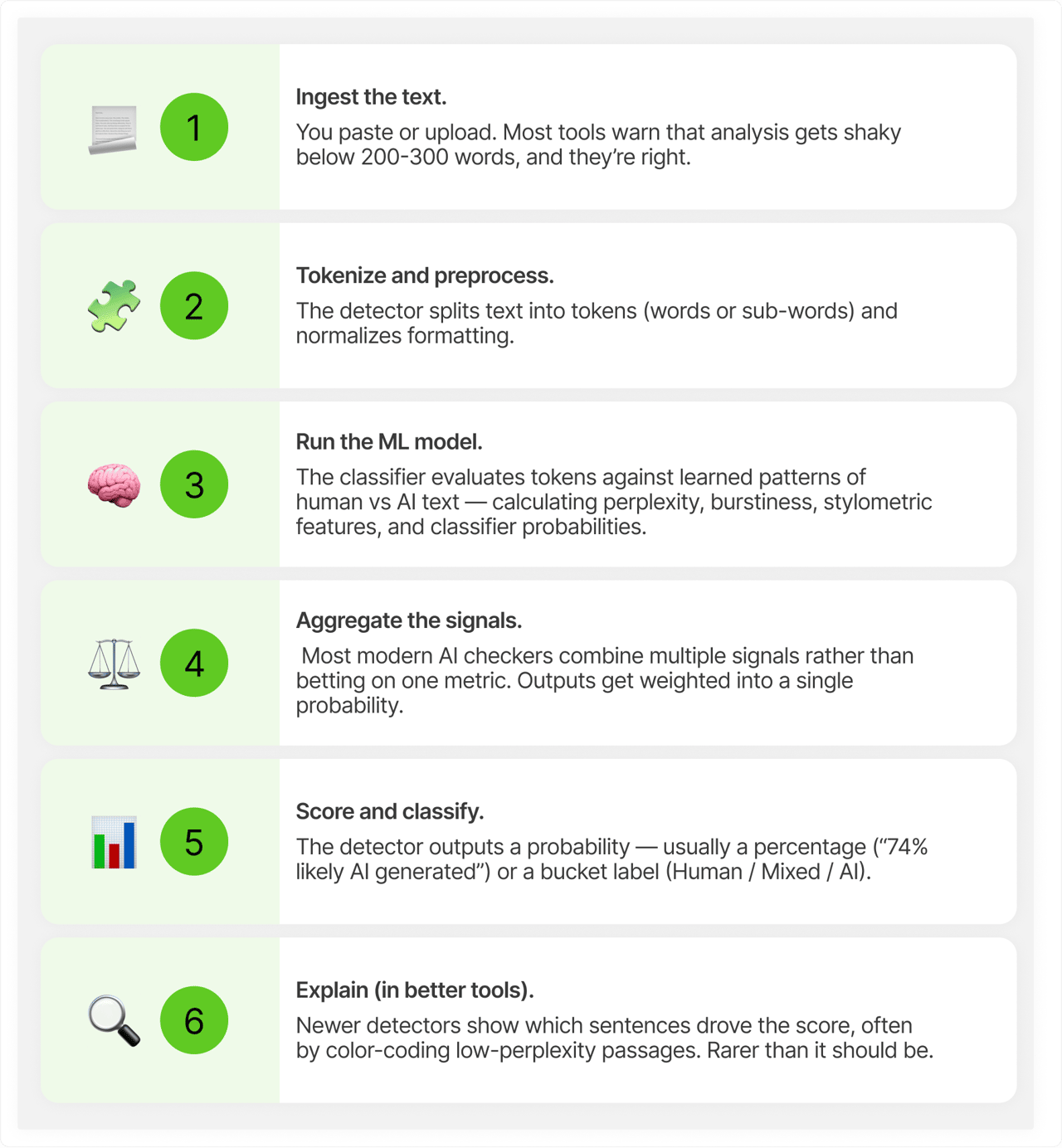
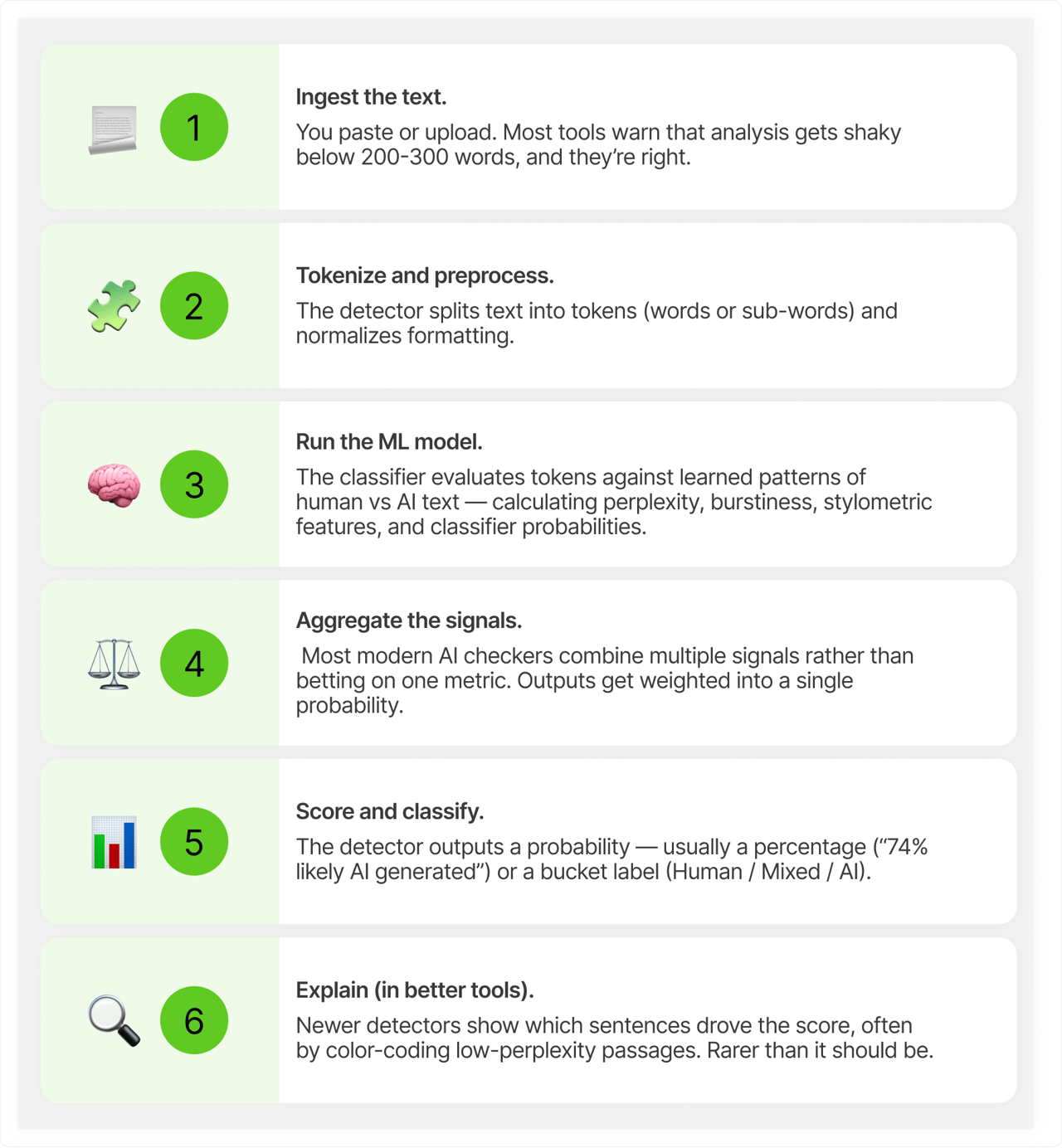
Peek behind the curtain on any modern AI detector and you’ll see roughly the same six-step flow. Not glamorous:
Ingest the text. You paste or upload. Most tools warn that analysis gets shaky below 200-300 words, and they’re right.
Tokenize and preprocess. The detector splits text into tokens (words or sub-words) and normalizes formatting.
Run the ML model. The classifier evaluates tokens against learned patterns of human vs AI text — calculating perplexity, burstiness, stylometric features, and classifier probabilities.
Aggregate the signals. Most modern AI checkers combine multiple signals rather than betting on one metric. Outputs get weighted into a single probability.
Score and classify. The detector outputs a probability — usually a percentage (“74% likely AI generated”) or a bucket label (Human / Mixed / AI).
Explain (in better tools). Newer detectors show which sentences drove the score, often by color-coding low-perplexity passages. Rarer than it should be.
That last point matters. A single number telling you “82% AI” is hard to argue with. A breakdown showing which sentences were flagged and why? Something usable.
How do AI image and video detectors work?
Image and video detectors are catching up to text. Same idea — find statistical patterns the human eye misses.
For images, the toolkit usually includes visual artifact analysis (distorted hands, mangled background text, oddly smooth skin, lighting that’s off), metadata inspection (some AI image generators embed C2PA content credentials — easily stripped by editing or screenshotting), neural classifiers trained on real photos and AI-generated images, and frequency-domain analysis that picks up the pixel-level patterns AI generators leave behind.
Video detection layers image-frame analysis with audio analysis and face-consistency checks. Deepfake detection watches for blinking, facial edges, and lip-sync timing.
Image and video detection lags text by years. Frontier image models from 2025 onward fool most current detectors most of the time. Treat any image or video result as preliminary.
How reliable are AI detectors, really?
Here’s the section everyone skips to, so the short version first: AI detectors are probabilistic, not definitive. Accuracy depends on text length, the AI model that generated it, whether a human edited it, and the detector’s training data.
Independent benchmarks land in the same range — top detection tools (like YouScan’s) score 80-90% accuracy on clean, unedited AI output, drop on lightly edited content, and fall further on heavily paraphrased text.
Per The Markup’s coverage of the Stanford study, seven AI detectors flagged writing by non-native English speakers as AI generated 61% of the time. Nineteen percent of those papers were unanimously misclassified by every detector tested. Not a margin of error — the tool actively penalizing one group for how they write.
Classic human writing trips them up, too. The 1776 Declaration of Independence was misclassified as 98.51% AI-generated by one popular detector. Formal language and clean structure throw these tools off.
AI detectors vs plagiarism checkers — the key differences
These two tools get conflated constantly. Different jobs.
A plagiarism checker scans text against a database of existing published content — academic papers, web pages, news — looking for verbatim or near-verbatim matches. Output: “This matches that source.” A search problem.
AI content detectors don’t search for anything. They look at the text itself and analyze statistical patterns to estimate whether a language model produced it. Output: a probability. A classification problem.
Some tools (Turnitin, Originality, Copyleaks) bundle both into one scan. AI-generated text can pass a plagiarism check perfectly because no human wrote it first — the questions answered are different. For academic integrity or originality concerns, run both.
Limitations every user should know
Where AI detection falls apart:
Length. Texts under ~200-300 words are unreliable.
Bias against simple or non-native writing. Low-perplexity human text — ESL writers, scientific abstracts, legal writing — gets flagged disproportionately.
Human editing. A light pass through AI-generated text adds burstiness and perplexity, slipping past detection.
Paraphrasing tools. Built specifically to defeat AI checkers. They work.
Model drift. Each new LLM release shifts patterns. Detectors lag, typically by weeks to months.
No definitive proof. Even high-accuracy detectors return probabilities, not verdicts. Vanderbilt University publicly disabled Turnitin’s AI detector in 2023, citing accuracy and bias concerns.
A high AI likelihood score is a signal worth investigating, not evidence on its own. In academic, HR, or legal contexts, treating a single score as proof can hurt real people.
Detecting AI writing manually — what to look for
Sometimes the fastest tell is your own eyes.
Word choice. AI loves certain words — “delve,” “tapestry,” “in conclusion.” Three or four in a 500-word piece, suspicion meter ticks up.
Sentence patterns. Medium-length sentences with similar structure and clean transitions read suspiciously. The rhythm of “topic sentence, three supporting sentences, transition” repeated over and over? Classic AI tells.
Hedging. AI text loads up on phrases like “it’s worth noting” because the model is hedging probabilities.
Writing history is the strongest signal. Sudden stylistic shifts in a writer’s output beat any detector score.
Human judgment beats most AI detectors when context is available. The detector is a useful second opinion, not a primary one.
Why AI detection matters for marketing and social listening teams
For brand monitoring, PR, or community work, AI detection is basic hygiene:
Fake reviews. AI can produce convincing 5-star and 1-star reviews at scale. Brands using sentiment analysis tools to read product sentiment need to filter machine-written reviews out, or the sentiment data gets poisoned.
Coordinated bot spikes. A burst of AI-written posts can manufacture a fake “trend” and pull a brand team into responding to nothing. Running suspect posts through a detector is a fast sanity check.
Influencer authenticity. Brands pay influencers for their voice. Influencer discovery should reward engagement and originality, not generic AI prose with a face attached.
Internal content QC. Marketing teams using AI drafts need the final copy to sound human. (For more, AI social listening covers detection in a broader monitoring stack, and AI in social media digs into how AI changes day-to-day brand work.)
YouScan built its free AI Detector for these use cases. No stored text, multi-language support, no account.
How to cite AI and use detectors responsibly
Most style guides (MLA, Chicago) now have specific guidance for citing AI as a source — typically the tool, version, date, and prompt.
For detection workflows: use AI detectors as one signal, not the only one. Combine with writing history, context, and direct conversation. Avoid making consequential decisions (grades, hiring, terminations) based on a single score. Per Microsoft’s 2024 Work Trend Index, 75% of knowledge workers now use AI at work, so AI use itself is no longer evidence of misconduct.
The bottom line
AI detectors analyze statistical patterns — word predictability, sentence variation, stylometric signals, sometimes embedded watermarks — and produce a probability score. The technology is real. The methodology is sound. Better tools are useful.
They’re probabilistic instruments, not lie detectors. False positives hit certain writers harder. New AI models routinely outpace detection. Human editing slips past most checks. Use the score as a signal, not a verdict.
To put it into practice, try YouScan’s free AI Detector on a piece of text — no signup required — or, for monitoring AI-generated content at scale across social media, book a YouScan demo to see how social listening and AI detection work together.
FAQ
What is an AI detector?
An AI detector is a software tool that analyzes text, images, or other content and estimates the probability that it was generated by AI rather than a human. AI detectors return probability scores — not definitive verdicts — based on statistical and stylistic patterns the model learned from training. Common users include educators, publishers, recruiters, marketers, and content moderators.
How do AI detectors work?
AI detectors run text through a machine learning model trained on datasets of both human-written and AI-generated content. The model analyzes linguistic patterns — word predictability (perplexity), sentence-length variation (burstiness), stylometric signals, and sometimes hidden watermarks — and outputs a probability score showing how closely the text matches AI writing. Modern detectors combine multiple signals rather than relying on any single metric.
What are perplexity and burstiness?
Perplexity measures how predictable each word is given what came before — AI tends to produce low-perplexity text (predictable word choices), while humans use more surprising language. Burstiness measures variation in sentence length and structure — humans mix short and long sentences, while older AI models produced suspiciously uniform rhythm. Together they form a classic (though increasingly outdated) heuristic for distinguishing AI from human writing.
Can AI detectors be wrong?
Yes. AI detectors produce both false positives (flagging human writing as AI) and false negatives (missing AI-generated content). False positives are especially common for non-native English writers, formal academic writing, and short texts. False negatives are common when AI content has been lightly edited or paraphrased. No current detector is reliable enough to be used as the sole basis for high-stakes decisions about authorship.