TikTok Social Listening: Turning Platform Chatter Into Actionable Insights
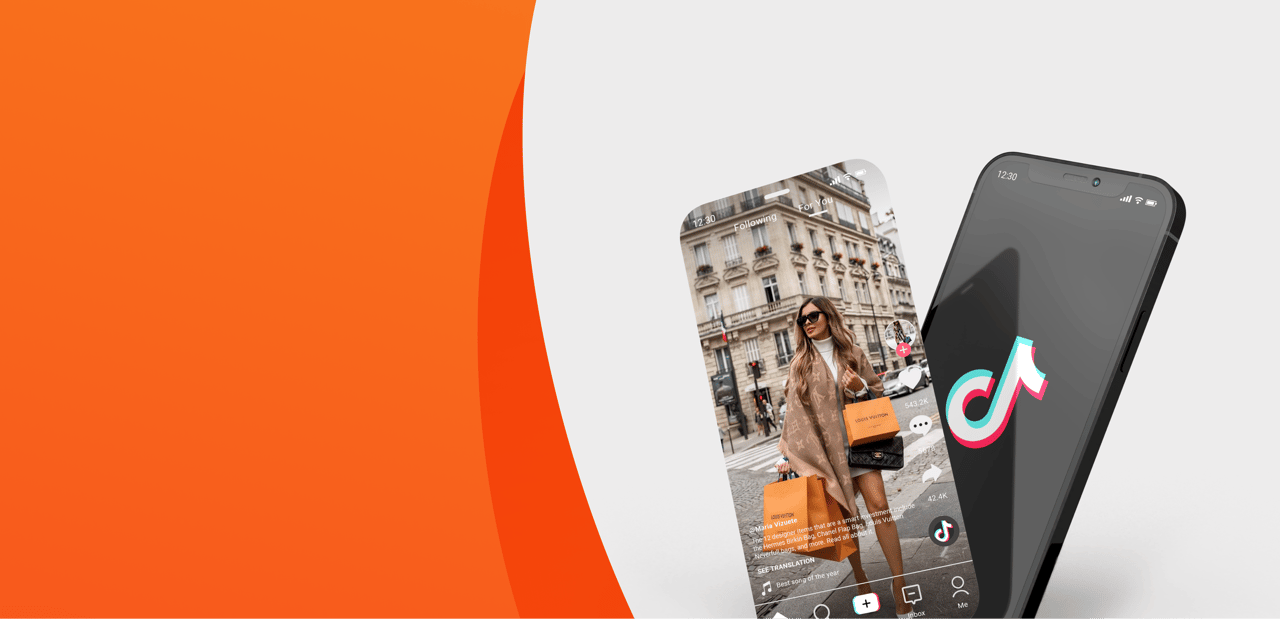

TikTok is approaching 1.9 billion monthly active users, and its engagement rates sit multiples above what brands see on Instagram or Facebook. TikTok users also spend more time in the app — around 95 minutes a day — than on any other platform.
That's not a "you should consider building a TikTok strategy" number. That's a "you already have a TikTok presence, and you don't know what it looks like" number.
Which is a problem.
Posting on TikTok is easy. Understanding TikTok — what people actually think about your brand, which TikTok trends are worth chasing, and where the next viral moment is about to come from — is the hard part. That's what TikTok social listening is for. It's how you stop guessing and start making smarter decisions based on real social listening data, instead of whatever the brand manager happened to scroll past last week.
Below you'll find what listening on this platform actually involves, what the valuable insights look like once you've got them, and where most tools fall apart. If a term feels unfamiliar along the way, our social listening glossary covers the basics.
What makes TikTok different from other social media platforms
Social listening on TikTok is not Instagram listening with extra steps. Anyone who tells you it is hasn't actually tried doing it.
Text platforms are comparatively simple. Pull captions, pull comments, analyze sentiment, done. TikTok is video-first. The conversations happening on the platform live inside voice-over, on-screen text, visual cues, audio, and occasionally all four at once. A brand can be the subject of a wildly viral video and never appear in a single caption.
Trends also move faster. A sound can go from nothing to everywhere in 48 hours and feel stale by the weekend. If your tool refreshes once a day, you're a week late to anything that matters. Real time monitoring isn't optional here. It's the whole game.
And then there's the audience. TikTok users skew younger, trust creators more than brands, and make purchase decisions in ways that don't carry over from other platforms. A 90-second video of a moisturizer bottle can move more product than a six-month media plan on Meta. Add TikTok Shop to the mix — discovery, conversation, and checkout all in the same feed — and what you should be listening for changes completely.
What TikTok social listening actually covers
The shortest useful definition: tracking and analyzing conversations about your brand, your competitors, your category, and the cultural moments shaping the platform.
In practice, that means brand mentions your team would already see (tagged, @-handled, hashtag-flagged) and the ones they wouldn't — the logo in a haul video, the name in a voice-over, the branded filter in someone's transition. Hashtag tracking across branded, product, and category hashtags, plus whatever relevant hashtags your target audience is currently using. Trending sounds, which text-only tools genuinely cannot hear. Comment threads, where honest feedback lives. And sentiment analysis, which is where most tools fall over.
Volume is the easy metric. Turning raw TikTok content into actionable TikTok insights is the part that actually takes work.
Why brand health and brand perception change faster on TikTok than anywhere else
A wave of criticism that would take a week to build on X takes an afternoon on TikTok. I'm not being dramatic. Brand reputation can flip between a creator's Tuesday post and their Wednesday follow-up. Listening helps you see it coming.
Brand perception, in real time
Proper brand sentiment analysis is how you catch perception shifts while they're still small. Not in a quarterly survey. Not in a post-mortem three months later. Now.
When negative sentiment starts clustering around a specific product feature, you spot it. When there's positive buzz you didn't know existed, you amplify it before it fades. When a mid-size creator posts a video that accidentally starts a debate about your brand, you find out before your CEO's LinkedIn feed does.
Spotting emerging trends before everyone else does
The brands that actually win on TikTok noticed a specific sound, a specific format, a specific phrasing, while it still felt like nothing.
Ryanair built an account persona around being early to format-level trends. Duolingo did the same with the owl. Both would be dead in the water if they'd waited for a "TikTok trends 2026" recap post to tell them what was hot — by the time those posts exist, it's over. A decent trend analysis tool picks up on these signals by watching which sounds, formats, and hashtags are gaining traction inside niche communities. That's how you stay ahead: build TikTok campaigns that feel native instead of bolted-on, and stay up to date with cultural moments and industry trends without doomscrolling the FYP for six hours a day.
The other thing you get out of early detection is content permission. If your audience is already in on the joke, you're not the awkward brand forcing it. You're the brand that noticed.
Audience sentiment is not the same as mention volume
Mention volume is a vanity metric. Ignore anyone who tells you otherwise.
Audience sentiment is what you actually care about — the breakdown of positive, neutral, and negative, segmented by product, region, and campaign. Good sentiment analysis tools catch tone, not just keywords. They know when "this is sick" means "amazing" and when it means the opposite, which is harder than it sounds. Tools that analyze sentiment across comments, captions, and audio give you a picture of how different parts of your target audience feel about you that no quarterly brand tracker can match. That's where you start pulling real audience insights.
The customer journey isn't what it used to be
TikTok used to be pure top-of-funnel. Not anymore. Thanks to TikTok Shop — which drove roughly $15.8 billion in US sales in 2025 — discovery, review-reading, and purchase happen in the same scroll.
So your listening has to cover the full customer journey. A user sees a creator review. Drops into the comment threads to check if the reviews are real. Buys. Posts their own unboxing (with, inevitably, some gripe about shipping). Connecting those dots gets you a much better understanding of where friction actually lives, and where customer satisfaction actually comes from.
Influencer discovery, done the boring but correct way
Every brand wants the right creators. Most go about finding them backwards.
The obvious path — scroll through follower counts, cross-reference audience demographics, build a shortlist, pitch — produces lists of creators who've never heard of your brand and who'll generate flat, forgettable content. Mention-based
influencer discovery flips it. You start by finding other users already talking about you, or other brands in your space, organically. Those creators are warm. Their audience is already primed. The content lands because it isn't actually an ad.
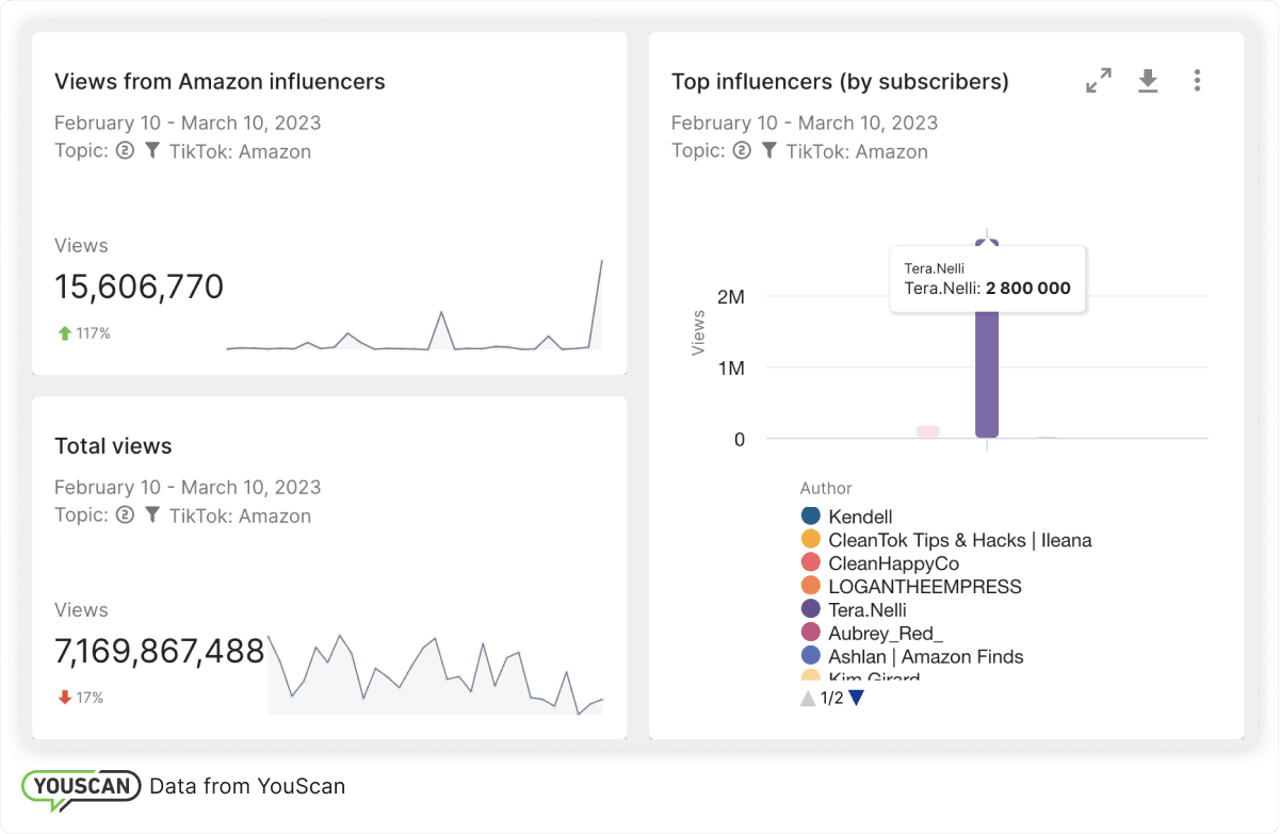
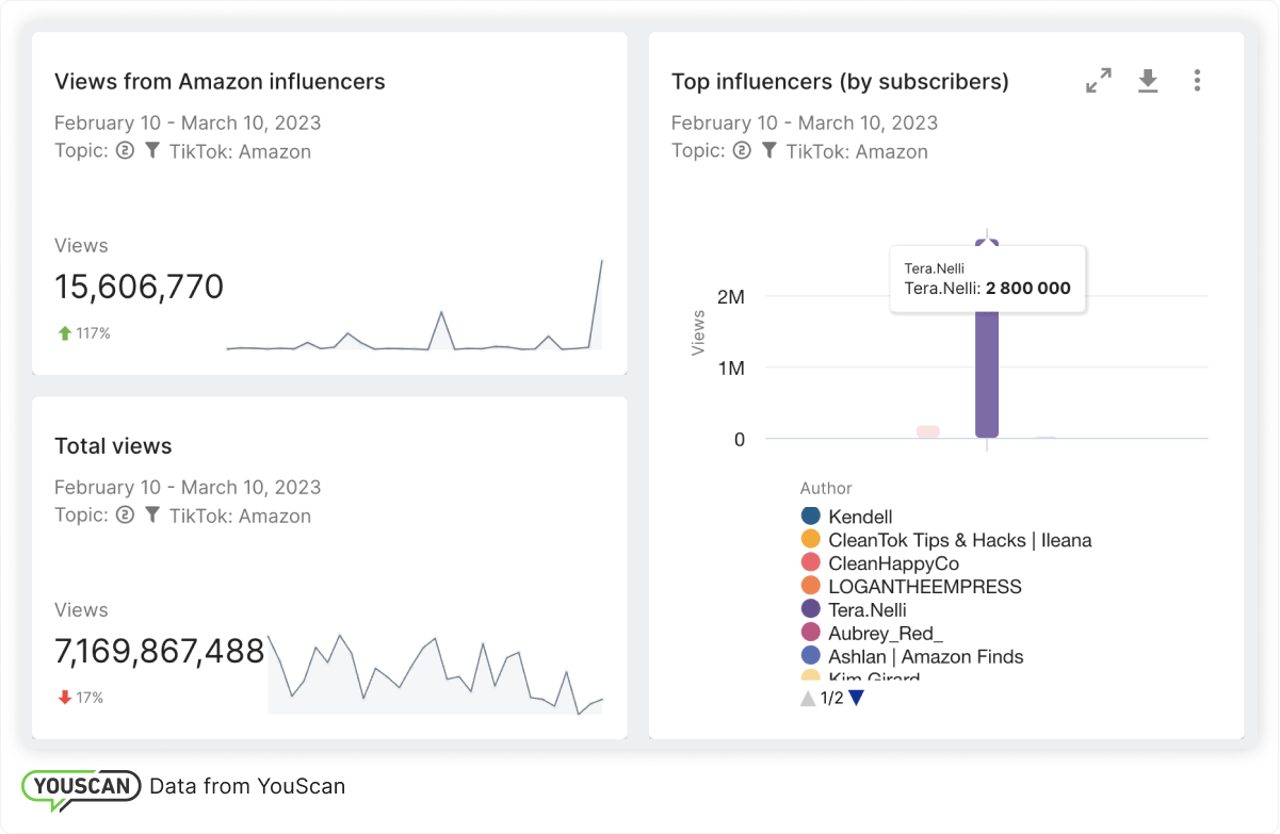
This feature also helps to find new influencers for collaborations. Users can mention the brand when they simply like it and potentially it can be a great match for adverts since their audience is already prepared for content about the particular brand.
💡 Pro tip: For a more proactive approach to influencer discovery on TikTok, Tiger Finder lets you describe the type of creator you need in plain language — and its AI analyzes actual visual content to surface the right profiles in about 45 seconds, no manual filtering required.


Core listening capabilities a real TikTok tool has (and what most pretend to have)
Walking into the social listening tools market in 2026 is a bit like buying a used car. Everyone's TikTok coverage is "great" until you ask specifically what they pull and how often.
The capabilities worth paying for:
Logo recognition, non-negotiable. The best tools spot your brand in a video frame even when nobody types your name. YouScan's own data suggests this can surface up to 80% more mentions than text-only monitoring — an absurd gap if you're not doing it.
Audio and on-screen text analysis, because captions are a fraction of what's actually said in the video.
Sticker, effect, and branded filter tracking. Branded effects are a big chunk of tiktok campaigns and most tools don't look at them at all.
Real time alerts, because "the dashboard will update tomorrow" is not useful when a viral moment is happening tonight.
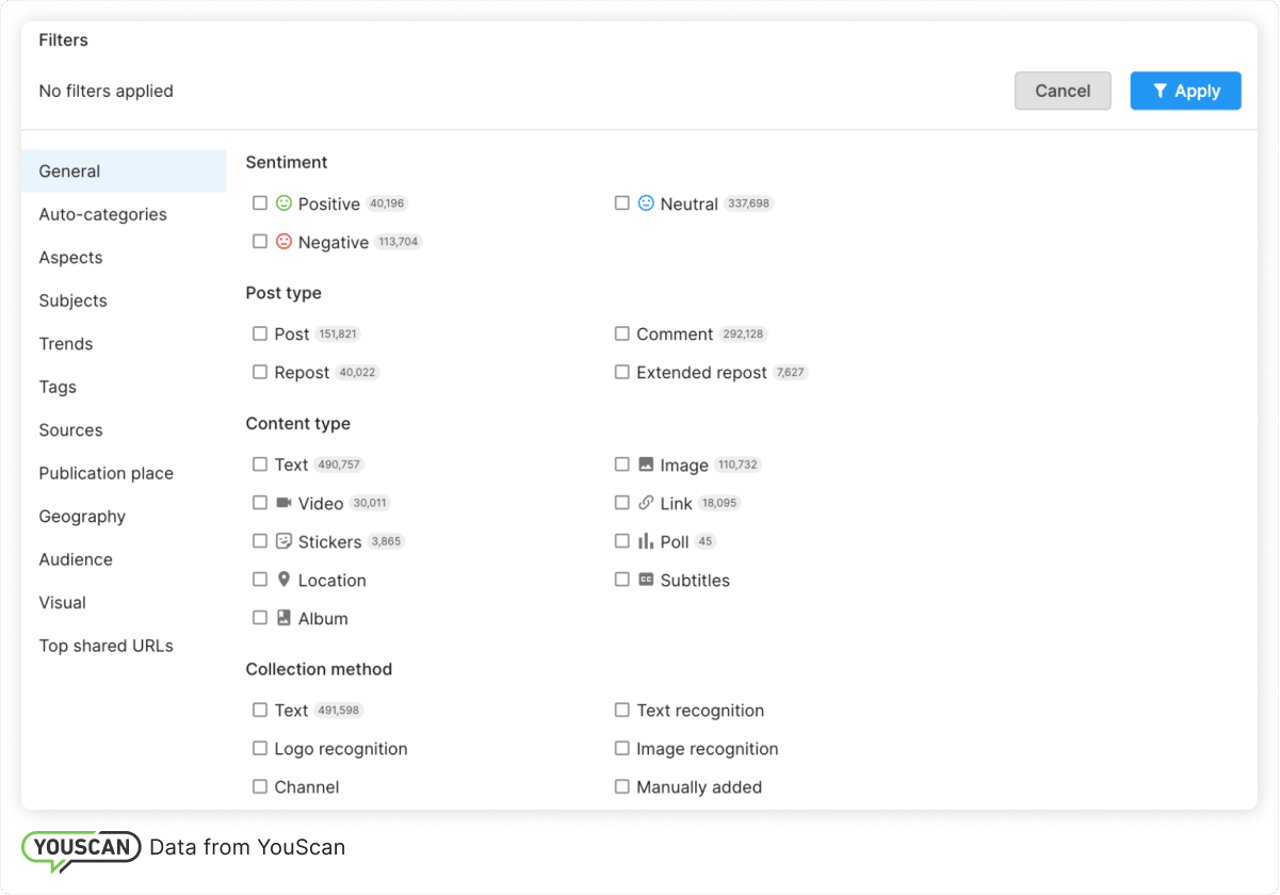
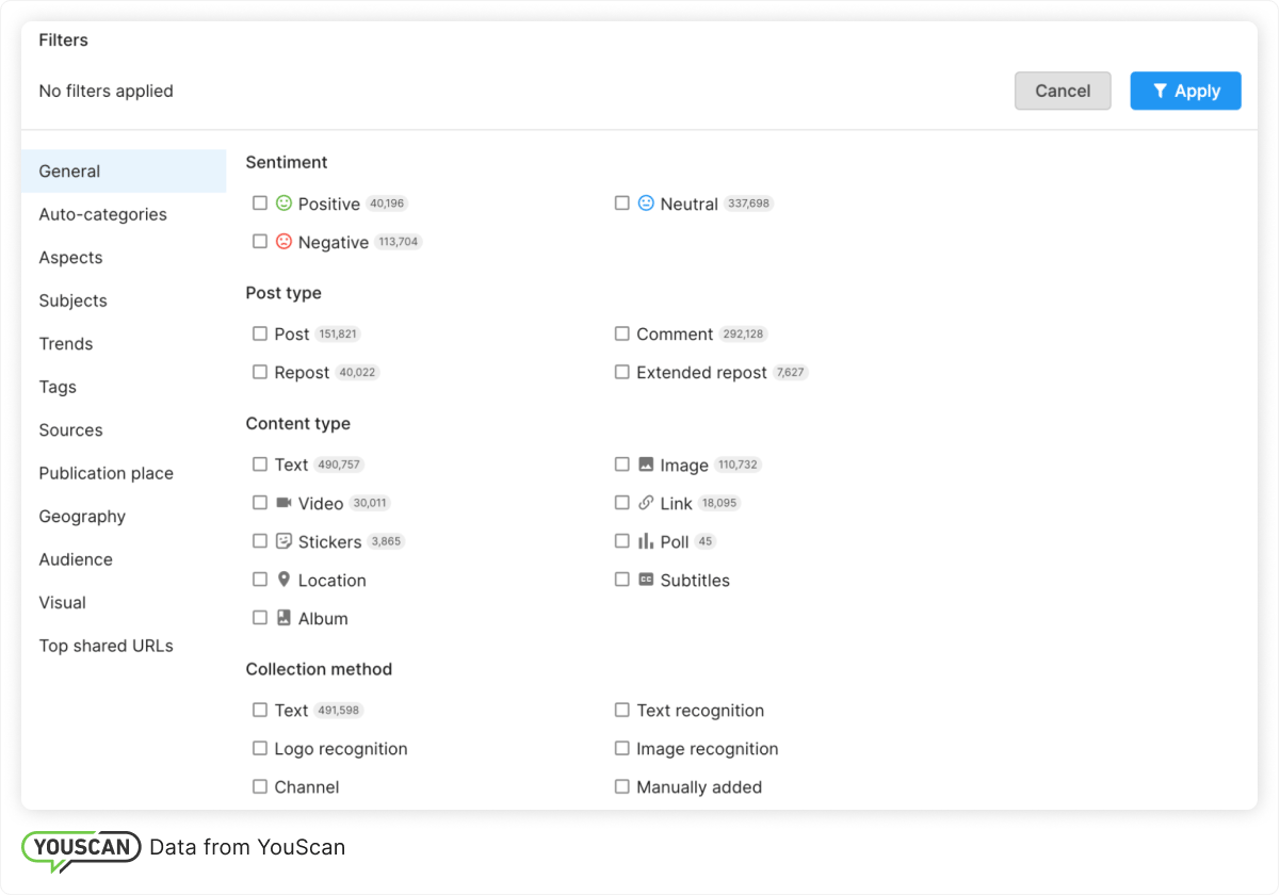
Filters that actually do something — sentiment, geography, audience interests, auto-categories, trends, subjects. The more ways you can slice your social listening data, the faster you find the signal underneath.
And dashboards your team will actually open. YouScan's social listening dashboards pull all of this into one view, which matters more than it sounds. A report nobody reads is a report that doesn't exist. Get that right, and the rest of the team starts getting a better idea of what's moving before anyone else notices.
One more thing on data coverage: TikTok's API is restrictive, and not every vendor respects the fences. Ask specifically what they pull, how often, and from where. If they dodge, move on.
The data sources worth tracking
You can't listen to everything on TikTok, and you shouldn't try. A handful of data sources punch well above their weight.
Direct mentions come first — tagged posts, @handles, videos that name your brand in the caption or voice-over. Obvious, but non-negotiable.
Hashtags next. Branded ones like #nikefits or #amazonfinds are gold because users self-identify as fans. Product hashtags tell you what's getting traction at the SKU level. The top trending hashtags tied to your category tell you what other brands and users are actually saying inside your niche.
Then, trending audio. This is the data source people miss most. Sounds are how ideas actually propagate on TikTok, and tracking which your target audience is using — and which your competitors have jumped on — is its own category of insight. Trending sounds are where the next content strategy lives.
Comment threads are where the real feedback hides. Top comments on a viral video will tell you more about customer journey pain points than any focus group ever run.
And AI generated content, which gets its own category now because it has to. A growing share of TikTok content is AI-assisted or outright synthetic. Sometimes harmless, sometimes a deepfake using your product. Either way, your setup should flag it, which is part of why AI social listening has moved from nice-to-have to baseline.
How to conduct social listening on TikTok without wasting everyone's time
Most good social listening strategies don't just track the brand. They track the brand's category, its competitors, and the conversations happening around both. On TikTok implementing social listening adds complications that other platforms don't have — video content, trending sounds, trend velocity — so the workflow has to adapt.
Define what you're actually trying to learn. This is where most programs die. "Let's monitor TikTok" isn't a goal. Are you running brand monitoring after a launch? Doing market research on a new segment? Tracking a specific campaign? Each answer produces different keywords, different hashtags, and different filters. Skip this step, and everything downstream is noise.
Build the keyword list. Brand name, common misspellings, product names, campaign names, competitors, industry terms. Include what TikTok calls its cultural touchpoints — dance challenges, format names, sound titles — if they touch your category. Start broad, tighten later.
Configure sentiment and auto-categorization. The tool should do the first pass of sorting automatically, splitting mentions into positive, neutral, and negative and flagging commercial posts versus organic ones. Without this, you'll drown in data.
Pick a review rhythm and stick to it. Daily scan for urgent alerts. Weekly review for trend shifts and creator discovery. Monthly deep dive for anything that will inform planning. Lock it in the calendar. Programs without cadence get abandoned.
Close the loop — the step most teams skip. Reports aren't the point. If what you gain insights from doesn't change something downstream — the content you make, the creators you book, the issues you address, the TikTok strategy you actually run — you're running a hobby, not a listening program.
Tracking conversations at this depth is where in-house teams usually hit a wall. YouScan handles it, and also covers adjacent networks like Moltbook monitoring for brands that need coverage beyond the big four platforms.
Turning raw chatter into audience insights
This is where most teams lose the plot. They set up tracking, pull pretty audience insights dashboards, and then nothing actually changes. Data sits. Reports get emailed. Decisions get made the way they've always been made.
Listening insights are supposed to feed real marketing strategies and sales strategies, not a monthly PDF nobody opens. Teams that turn data around in hours — not days — catch a viral moment in time to do something with it. The rest run nostalgia tours.
A few real-world examples of what "doing something with it" looks like.
A mid-size skincare brand notices negative comments about slow shipping clustering in one region. Treat it as a supply chain signal, not a marketing problem to spin. Send it to ops, address issues at the source, then — and only then — write follow-up content.
A 40k-follower creator is quietly outperforming a 2M-follower creator on engagement metrics for your brand. Reallocate the budget accordingly. Yes, really. (Most brands won't. That's the opportunity.)
Sometimes you get the weird one. A specific use case for your product keeps showing up in dance challenges and niche communities — a use case your content brief didn't mention, because whoever wrote the brief didn't know about it yet. That's the angle you build the next campaign around. Not the one the agency pitched.
The brands getting actual value out of TikTok social treat it as an input to every team, not a dashboard the social manager opens once a week. That's the difference between real listening insights and reporting theatre.
Why most social listening tools collapse when you point them at TikTok
TikTok is a major challenge for most social media monitoring tools. Buying one without asking the awkward questions is how you end up with "coverage" that turns out to be a public caption search.
The API is restrictive. Video analysis is expensive. Trending audio is hard to license. Most vendors cut corners somewhere, and the corner they cut is almost always the part you actually need.
Before you sign, ask what the tool pulls. Ask how often. Ask from which data sources. Ask to see a live demo against your brand. Compare their mention count to what you can find manually. If the numbers are way off, their coverage is weak, and your audience sentiment data will be wrong in the same direction.
It's worth being annoying about this. Vendors who can't answer clearly are vendors you don't want. Listening helps brands that trust the data. If you can't trust the data, you're better off not pretending to listen at all.
Conclusion
TikTok keeps pulling more of the cultural conversation, more purchase decisions, and more viral trends under its own roof every quarter. More of the latest trends in every category now start there, regardless of whether your brand has a presence.
Ignoring it is a decision. Listening to it properly — with a tool that actually covers the platform, connected to teams that will act on what it finds — is also a decision. The second one is the right one.
If you want to see what real TikTok social listening looks like in practice, YouScan's free demo is a reasonable place to start.
FAQ
What is TikTok social listening?
TikTok social listening is the practice of tracking and analyzing conversations, brand mentions, hashtags, sounds, and video content about your brand or industry on TikTok. It goes past counting views — the goal is to understand sentiment, spot emerging trends, and pull out insights that actually change how you market. Think of it as a systematic way to hear what TikTok users are saying, not just what they're tagging.
How is TikTok social listening different from other platforms?
Most platforms are text-first. TikTok is video-first, trend-driven, and moves at a different pace. Effective listening on TikTok has to handle spoken audio, on-screen text, logos in video frames, and trending sounds — not just captions and comments. Trends also peak and fade in days rather than weeks, so real time monitoring matters more here than almost anywhere else.
Can you do TikTok social listening without a paid tool?
You can search hashtags, scroll the For You Page, and manually track direct mentions — but it won't scale past a few hundred videos a week, and you'll miss anything that doesn't tag you. For any brand with real volume, a social listening tool is the only practical way to cover logo detection, audio analysis, and sentiment at scale. Free exploration is fine for discovery; paid tooling is what you need for coverage.
How often should you review your TikTok listening data?
Three cadences work well for most teams. Daily for urgent alerts — spikes, negative sentiment waves, crisis signals. Weekly for trend shifts and early creator discovery. Monthly for the deeper audience insights that feed quarterly planning. If your tool only lets you check in once a week, you'll miss most of what made listening worth doing in the first place.