World Cup 2026 in Mexico: 3.4 Million Mentions, a National Paradox, and the Map Every CMO Needs Before Kickoff

This article is written by Alexis Soubran, CEO of Minimalist Agency and a YouScan Ambassador, with data from YouScan.
Mexico is less than 80 days away from opening its third World Cup. The Estadio Azteca will be the only venue in history to inaugurate three World Cups (1970, 1986, 2026). On paper, that should be a tsunami of unmitigated national pride.
But the digital conversation tells a different story—one that is more interesting, more complex, and, for those who know how to read it, infinitely more useful.
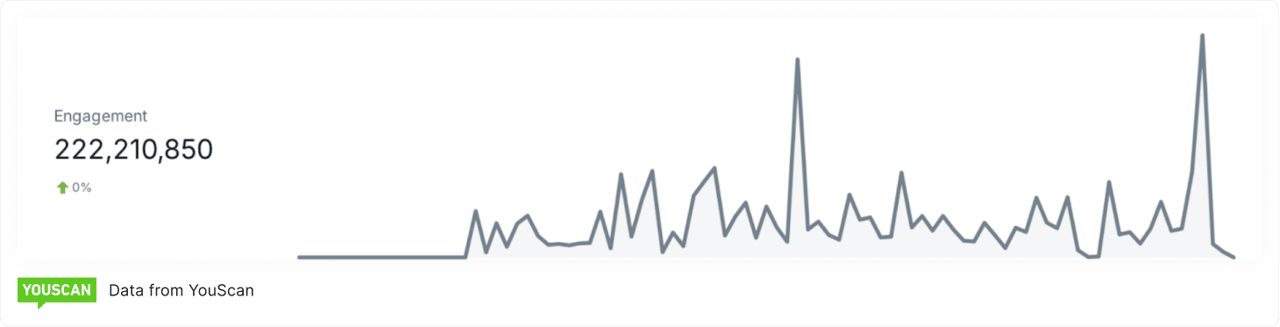
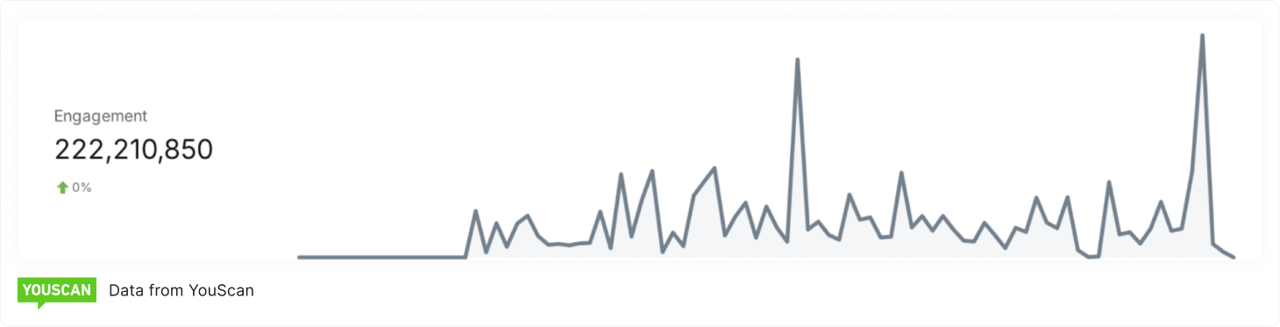
From January to March 24, 2026, YouScan captured 3,430,650 mentions with 222 million interactions regarding the 2026 World Cup in Mexico. What we found was not a uniform conversation of excitement. It was an X-ray of a country divided between the pride of being a host and the anxiety of being one in 2026 Mexico: with cartel blockades in Guadalajara, inaccessible tickets, the shadow of Trump, and a National Team that only 3% believe can be champions.
For CMOs, this is not a problem. It is the most honest brief they will receive all year.
Listening to the Real Mexico: The Methodology
Monitoring was carried out through YouScan with the topic "Mundial 2026 MX," covering conversations in Spanish and English on Twitter/X, YouTube, TikTok, Bluesky, Threads, Reddit, Quora, blogs, and media. We analyzed from January to March 24, 2026, a period that included the aftermath of the security crisis in Guadalajara, the arrival of the Coca-Cola Trophy Tour, and the first waves of brand campaigns.
The goal was not to count mentions. It was to understand what emotions sustain the conversation, what territories are available for brands, and where the mines are that no one should step on.
The Numbers: An Event Already Happening
Metric | Data |
Total mentions (30 days) | 3,430,650 |
Total engagement | 222,210,850 |
Unique authors | 222,075 |
Dominant platform | Twitter/X (~1.5M menciones) |
Second plataform | YouTube (~500K+) |
Third plataforma | TikTok |
To put this in perspective: the analysis we did of the Stranger Things phenomenon in Mexico generated 437K mentions in two months. The World Cup is generating nearly 8 times that volume, and there are still 80 days left until the first match.
The conversation is not a pre-tournament murmur. It is a roar. And brands that are not listening now are going to be late to a party that has already started.
Sentiment: The Paradox That Defines Everything
This is where the analysis gets interesting, and where YouScan shows its real value.
The general distribution of sentiment was:
Sentiment | % | Mentions |
Neutral | 82.5% | 2,831,350 |
Negative | 10.6% | 364,600 |
Positive | 6.8% | 234,700 |
At first glance, a CMO might read this data and conclude: "Negative doubles positive; this is risky." That would be a mistake.
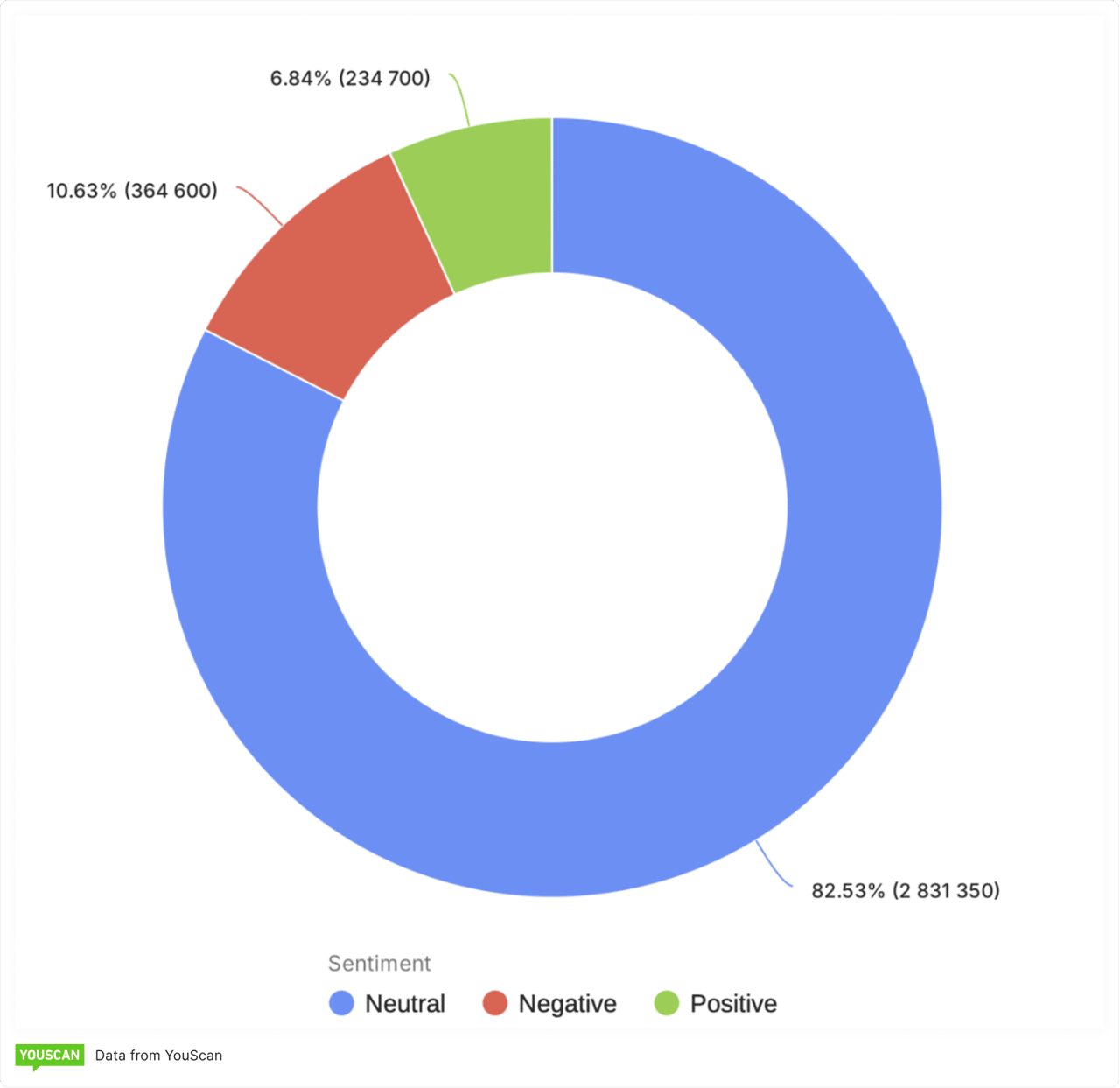
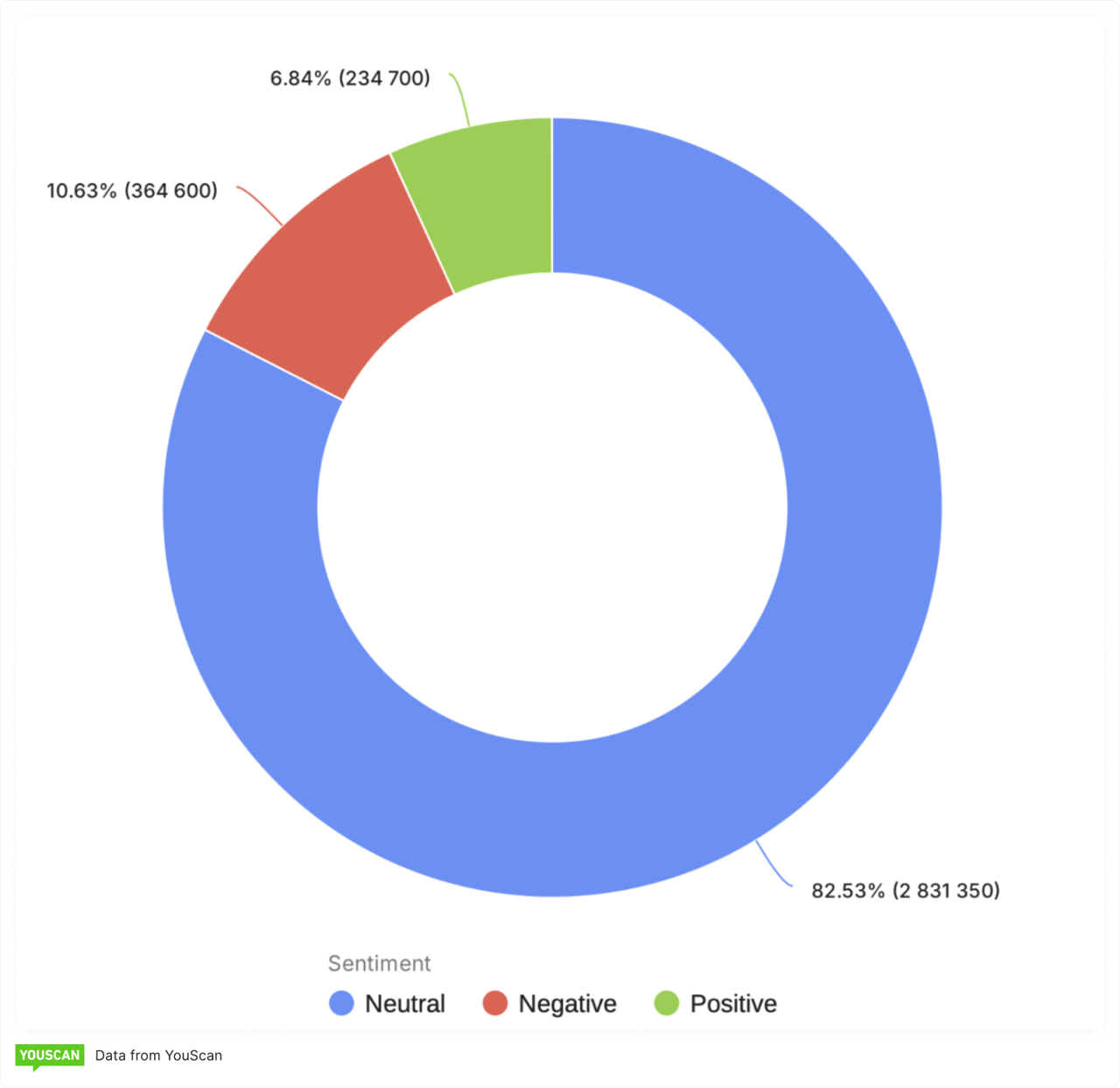
What the data really says is that the conversation is massively informative and news-oriented (hence 82% neutral), with a layer of active controversy (10.63%) that generates disproportionate volume due to its political nature, and a layer of positive emotion (6.84%) that, although smaller in percentage, represents 234,700 mentions from people genuinely excited about the event.
But the most revealing data comes from the analysis of promoters vs. detractors in YouScan:
Typo | % of authors |
Detractors | 67.74% (150,425 authors) |
Promoters | 32.26% (71,650 authors) |
Two out of every three authors with a defined stance are negative. Should this scare a brand? No. It should inform it.
"Negative" sentiment is not always rejection. Sometimes it is emotional investment, frustrated expectation, or, in this case, the legitimate concern of a citizen who wants their country to look good. The Mexican who tweets about the traffic chaos on Calzada de Tlalpan with the hashtag #Mundial2026 does not hate the World Cup; they are worried it won't be ready. These are very different things.
💡Insights for brands: The dominant negativity is political and situational, not anti-soccer. The love for the game, the party, and the ritual remains intact.
The brand that speaks to the fan (not the frustrated citizen) has 234,700+ positive voices ready to amplify its message.
Where Does the Conversation Live? Platform by Platform
YouScan's Brand Health Pulse revealed a multi-platform distribution with clear peaks:
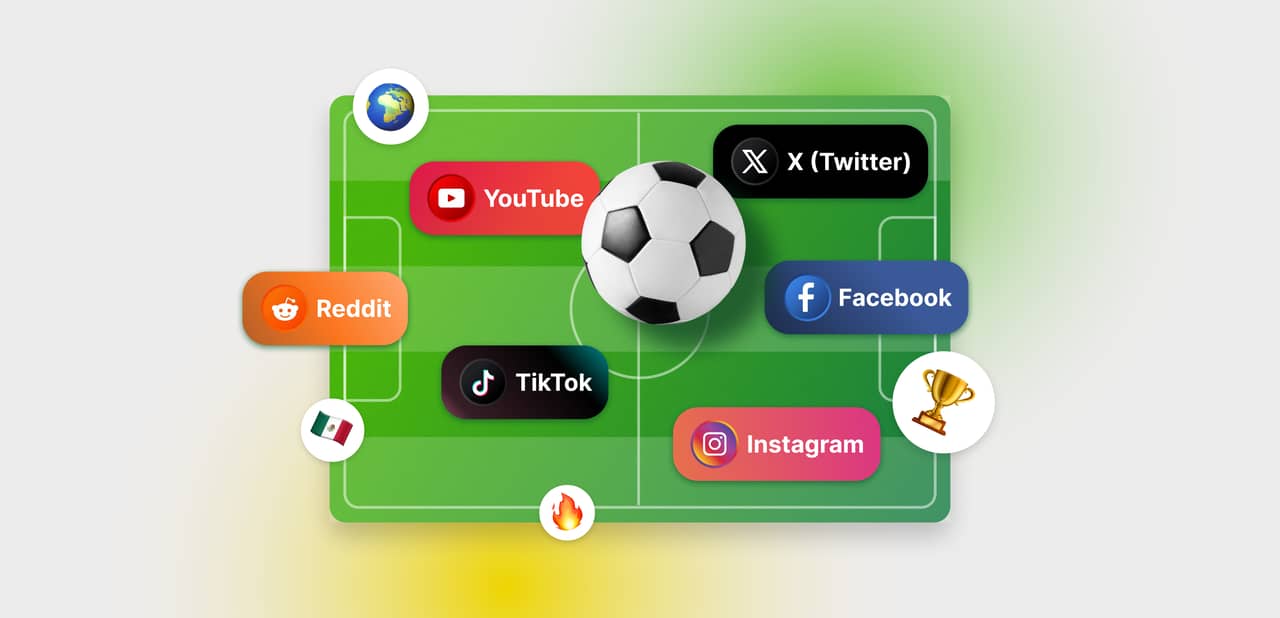
Twitter/X dominates with ~1.5 million mentions. It is the real-time debate ring: this is where reactions to security news, criticisms of FIFA, draw memes, and discussions about Mexico's group live. Sentiment here tends toward negative because X rewards controversy.
YouTube takes second place with ~500K+ mentions. It is the space for long-form analysis: National Team tactics, predictions, and sports creator content. Sentiment is more balanced because the long format allows for nuance.
TikTok is the third force and the most important for brands. This is where spontaneous UGC (User-Generated Content) lives: jersey edits, draw reactions, humor about "superstitions," and creative countdowns. Positive sentiment is proportionally higher on TikTok than on any other platform. It is where the Mexican fan expresses themselves with joy, not with complaints.
Bluesky and Threads appear as emerging platforms with surprising volume, a sign that post-Twitter fragmentation is redistributing the sports conversation.
Reddit and Quora concentrate international conversations: global fans discussing security, tickets, and predictions. Reddit dominates forums with ~40K mentions, showing high engagement per post.
💡Takeaway for CMOs: If your campaign lives only on Meta and Instagram, you are losing 70% of the conversation. Twitter is volume, TikTok is emotion, YouTube is depth.
The distribution strategy must be triple-platform or it doesn't exist.
The Word Cloud: What Mexico is Really Saying
YouScan generated a map of words and objects that functions as a real-time cultural thermometer. The most mentioned words tell a layered story:
Layer 1, The expected: "World Cup," "Mundial," "FIFA," "Mexico," "2026," "soccer," "national team," "cup"—the base vocabulary of the event.
Layer 2, The political: "Trump," "government," "United States," "boycott," "#BoycottWorldCup," "#NoVenganAlMundial"—the conversation that brands should monitor but not touch.
Layer 3, The emotional: "host," "moment," "best," "day," "final," "match"—the words that reveal pride, expectation, and personal connection to the event.
Layer 4, The unexpected: "Gianni Infantino," "Jalisco New Generation Cartel," "emergency meeting," "cancelled," "massive evacuations"—disruptive narratives that can hijack the conversation at any time.
Layer 5, The cultural: "Carín León," emojis like 🇲🇽🏆🔥😂, "#CDMX," "Estadio Azteca"—Mexican identity expressing itself on its own terms.
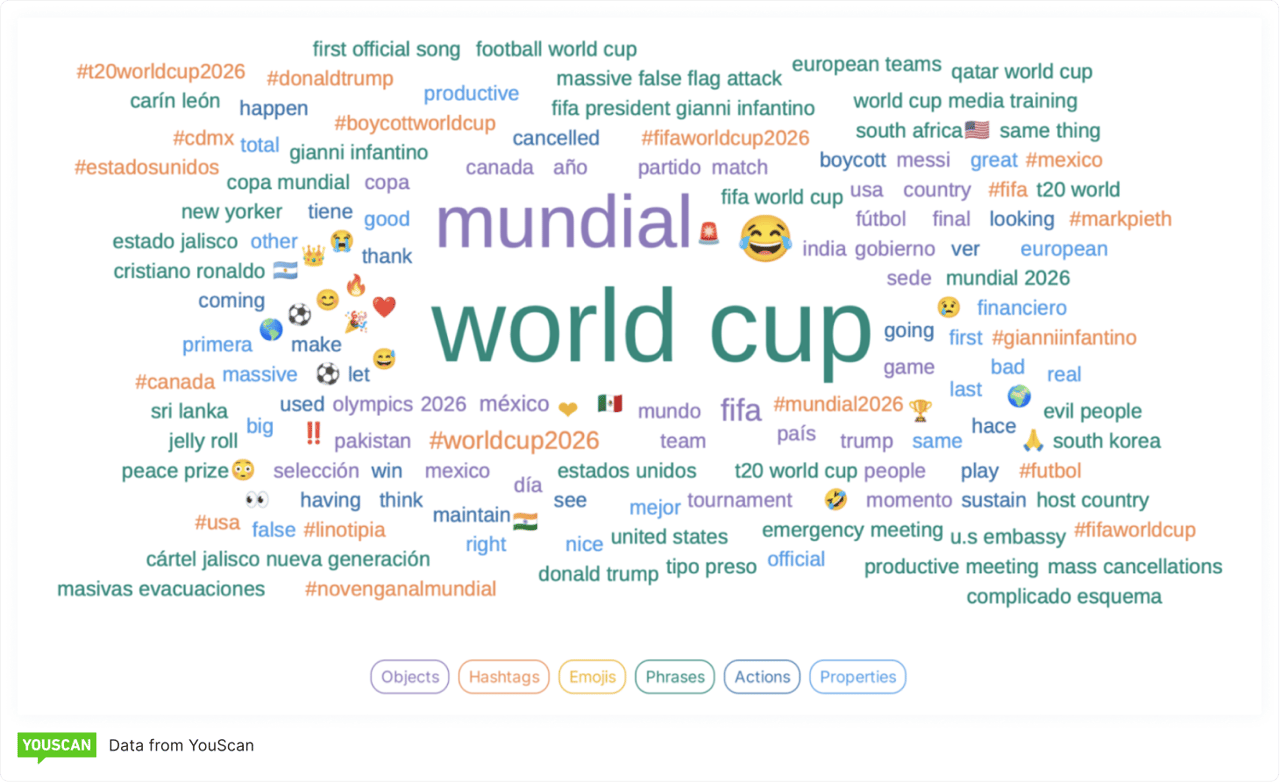
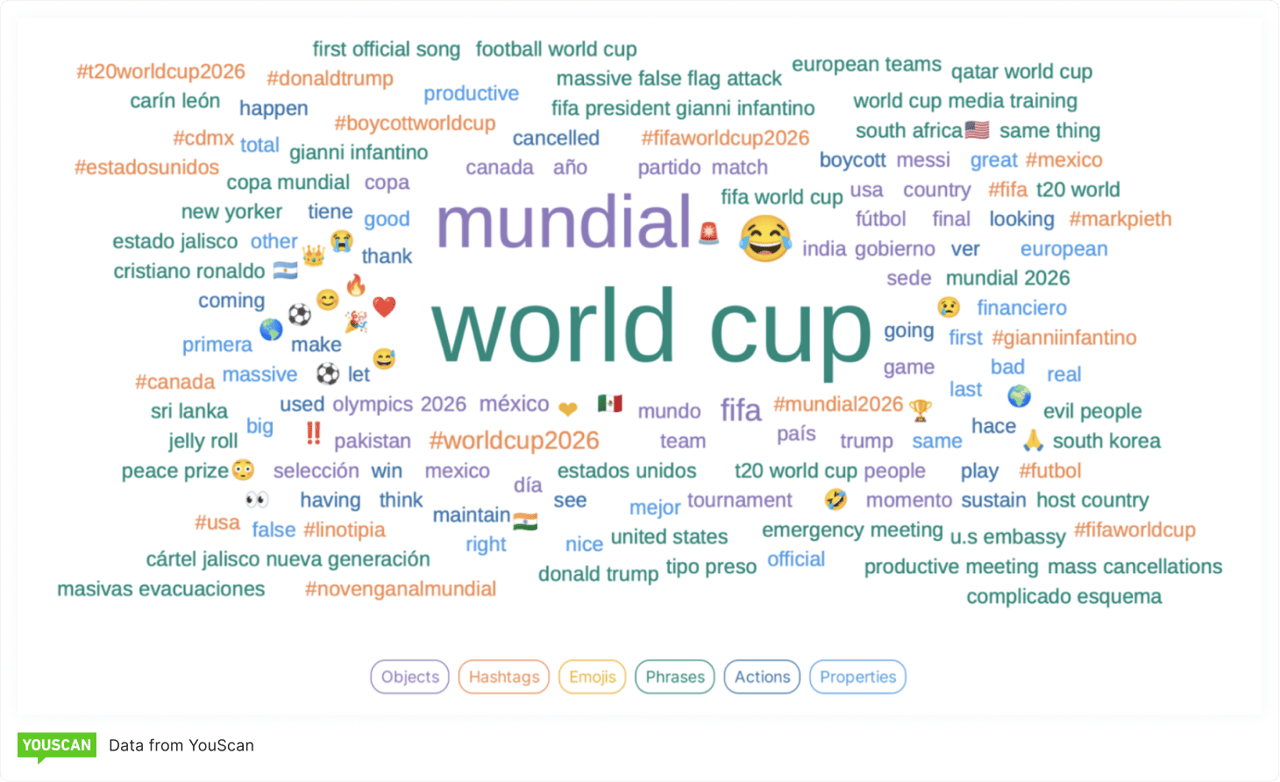
The hashtags tell their own story. #Mundial2026 leads in Spanish, #WorldCup2026 in English, but the most interesting are the emerging ones: #NoVenganAlMundial (activism), #Linotipia (memes), #FIFAWorldCup2026 (official content). For brands, fan culture hashtags like #ElTriEnCasa, #TercerMundialEnCasa, and #ModoMundial are the territories where conversation is positive, authentic, and ready for co-creation.
Hot Topics: The Thematic Map of the Conversation
YouScan automatically identified the dominant themes in the conversation:
Topic | Relative volume | Dominant sentiment |
Sports | Very high (~100) | Neutral/positive |
Gambling | High (~40) | Neutral |
Events | Medium (~25) | Positive |
Fashion | Medium-low (~15) | Positive |
Economics | Low (~10) | Negative |
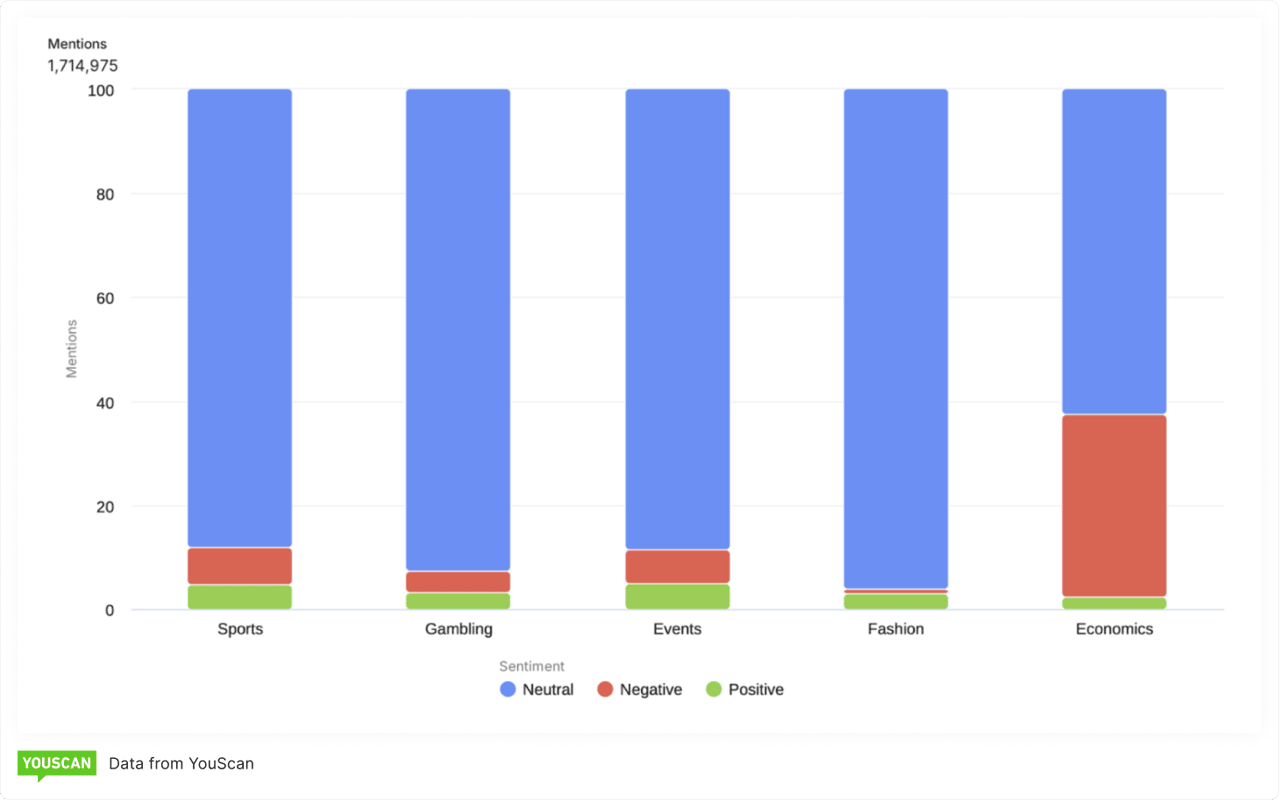
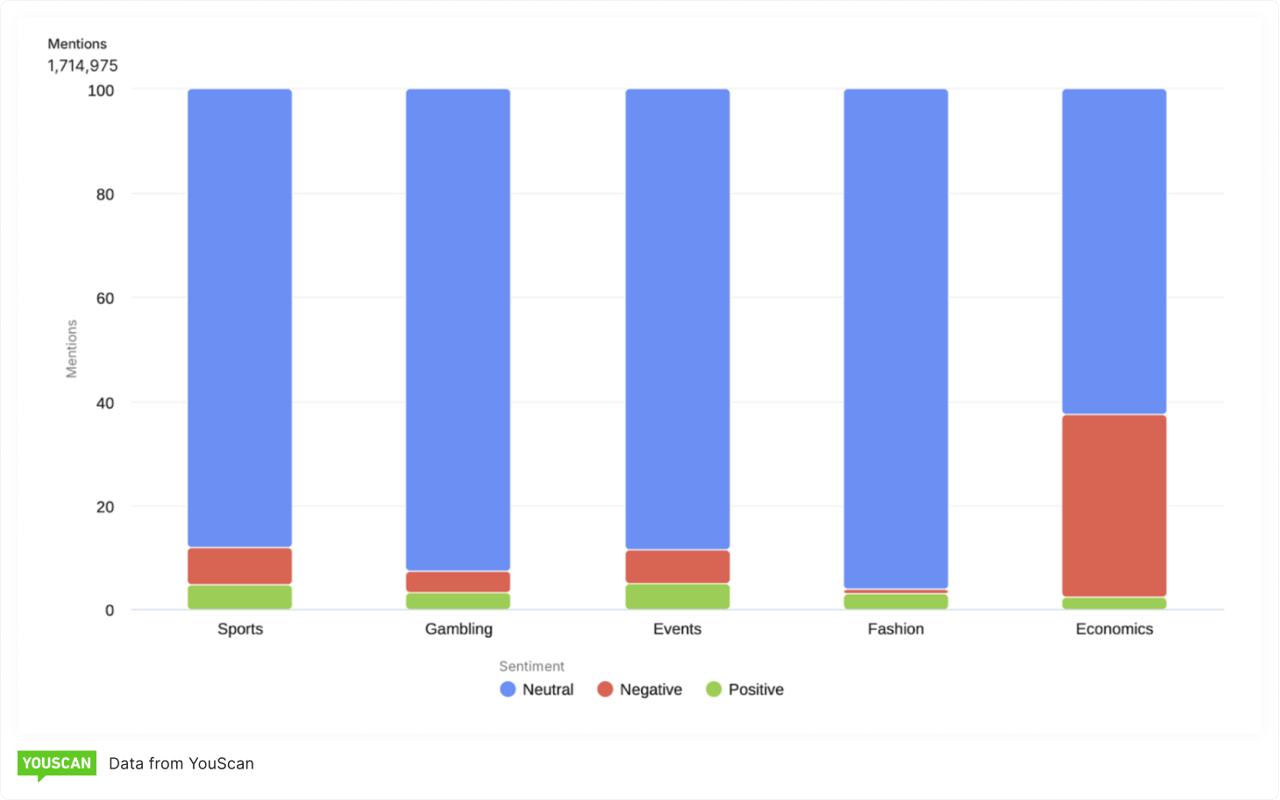
The important finding here is Fashion. Why does fashion appear as a relevant topic in a soccer conversation? Because the jersey launches by Adidas, Nike, and Puma for the 2026 World Cup have triggered a massive conversation about design, national identity, and sports aesthetics. The jersey is not just a uniform: it is a cultural statement. PUMA Paraguay was harshly criticized for an "effortless" design, while Adidas launched 22 federations with a viral campaign ("The American Preparation") that dominated the conversation - a textbook case worth adding to any roundup of social media campaign examples.
Gambling as the second dominant theme is a red flag: betting houses are occupying conversational space that traditional brands could be filling. For CMOs, this means that if you are not in the conversation, the betting houses are taking your place.
Brand Health Pulse: The Peaks That Tell the Story
YouScan's temporal analysis shows very clear conversation peaks between December 2025 and March 2026:
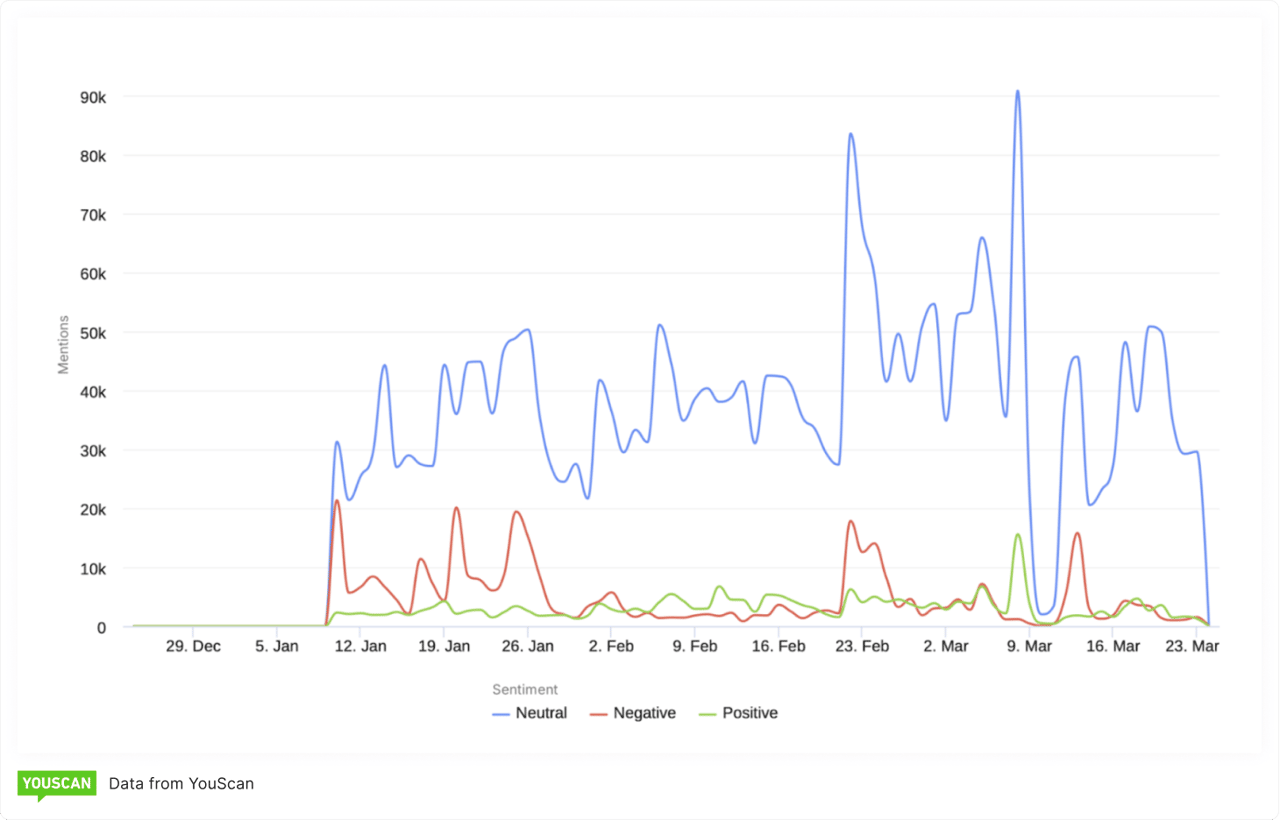
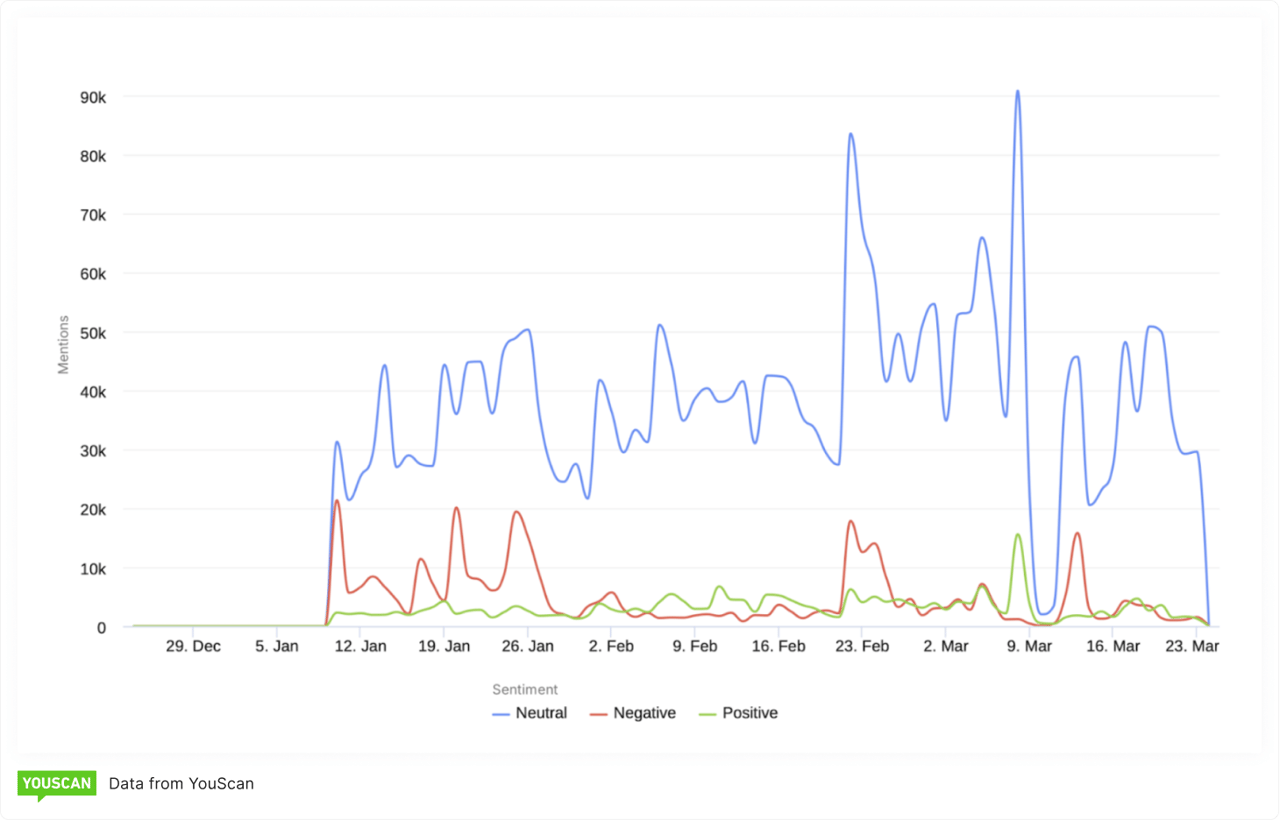
December 5, 2025: The World Cup draw in Washington. Volume explosion when Mexico was placed in Group A with South Africa (opening match), South Korea, and a UEFA playoff winner. Massive memes, general relief ("We made it out alive!"), and instant nostalgia for the 2010 Mexico-South Africa match.
February 2026: The CJNG crisis in Guadalajara. The highest negative peak of the period: cartel blockades in 20 states, suspension of Liga MX matches, international headlines. Negative sentiment spiked and has not fully returned to pre-crisis levels.
February 28, 2026: The Coca-Cola Trophy Tour arrives in Guadalajara, literally one week after the violence. Powerful contrasting images: fans lining up to take selfies with the trophy in the same city that burned days before. This moment summarizes the emotional paradox of Mexico as a host.
March 2026: Launch of Adidas jerseys and Bimbo/Corona campaigns. Volume rises with a positive-commercial tone.
💡The lesson: Negative peaks are episodic and linked to crisis events. Positive peaks are sustained and linked to brand activations and fan culture moments.
Brands that activate consistently are building equity; those waiting for "the perfect moment" have already lost it.
From Data to the CMO's Desk: 7 Actionable Insights
This is where conversation stops being a metrics dashboard and becomes a campaign brief. Each insight is backed by YouScan data and contrasted with market intelligence.
Insight 1: The Mexican Fan Has Already Decoupled the Party from the Result
Only 3% believe Mexico will be champion. Only 27% show active enthusiasm for the tournament (Mitofsky, January 2026). But 7 out of 10 Mexicans say they are more excited than in Qatar 2022. How is this contradiction explained?
The Mexican fan has already learned. They don't need the Tri to win to enjoy the World Cup. What they need is the ritual: the gathering, the jersey, the taco party, the shout, the goal meme. YouScan data confirms it: positive mentions are concentrated around shared experiences, not sports predictions.
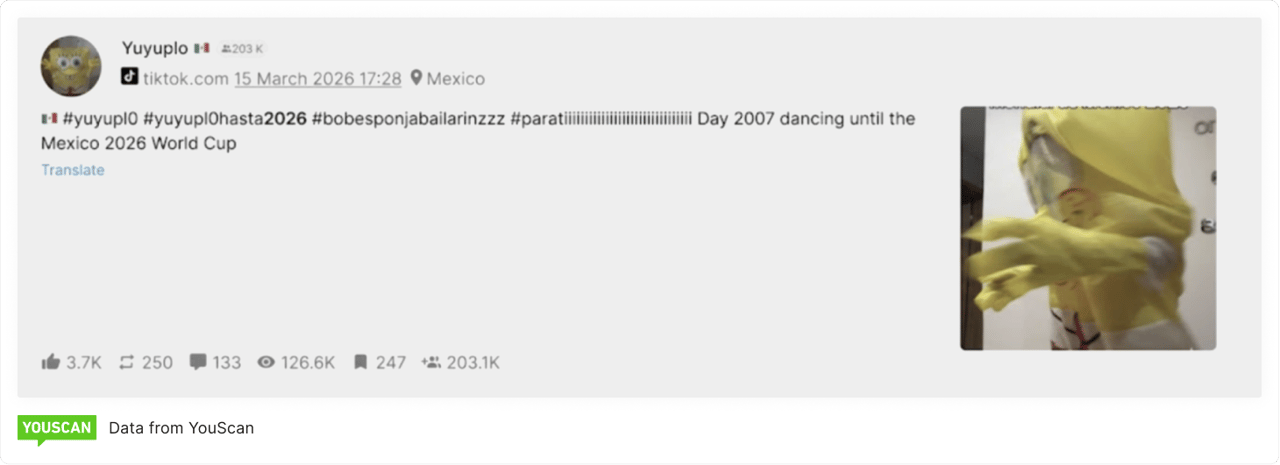
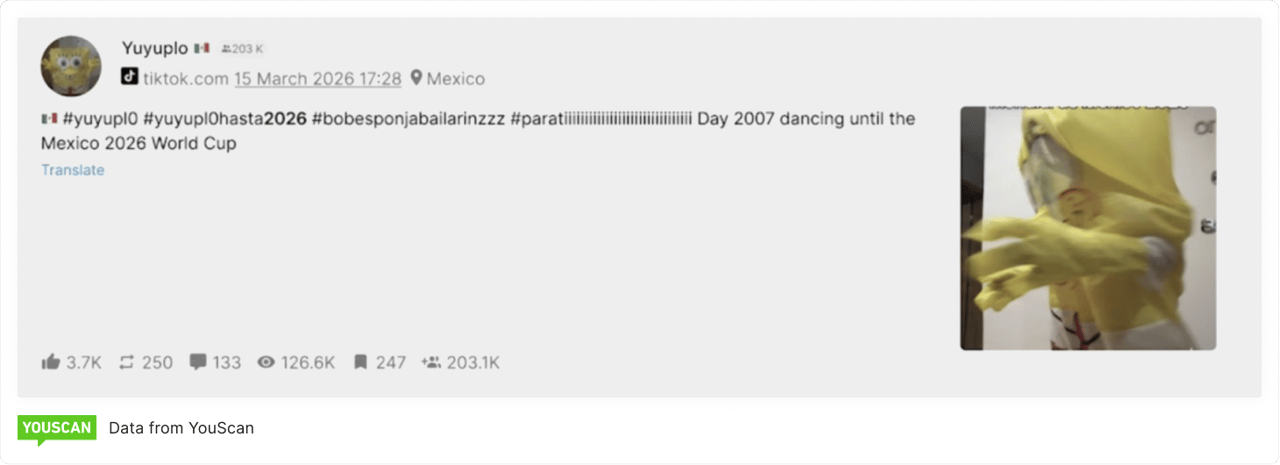
💡For the brand: Anchor your campaign on the fan as the protagonist, not the National Team as the hero. "You are the extra in this World Cup" > "Let's go for the sixth match."
The first is immune to elimination; the second dies in the group stage.
Insight 2: The Negativity is Civic, Not Anti-Soccer
67.74% of authors with a defined stance are detractors. But when you use YouScan to analyze the themes of that negativity, you discover that 80%+ is about infrastructure, government, security, and ticket prices. Not about soccer. Not about brands. Not about the fan experience. This means there is an enormous conversational space where positivity dominates—fan culture, jerseys, memes, nostalgia—that is being ignored by brands that see the "67% negative" number and get scared.
💡For the brand: Use social listening not to measure "is it safe to enter?" but to identify exactly where the positive conversations are and plant your flag there.
YouScan allows you to filter by sentiment and topic simultaneously; that granularity is what separates an informed decision from panic.
Insight 3: TikTok is the Emotional Pitch, X is the Political Ring
The platform distribution in YouScan reveals a truth that changes the distribution strategy: positive sentiment lives on TikTok (fan UGC, jersey edits, humor, countdowns), while negative sentiment is concentrated on X/Twitter (political debate, FIFA criticism, security news).
If your brand only measures "general sentiment," it will conclude the conversation is hostile. If it segments by platform, it will discover that TikTok is a party where fans are waiting for brands to arrive.
For the brand: Design native content for TikTok (15-60 sec, humor, UGC, local creators) and use X only for monitoring and quick response, not for awareness campaigns. The emotional ROI per platform is radically different.
💡For the brand: Design native content for TikTok (15-60 sec, humor, UGC, local creators) and use X only for monitoring and quick response, not for awareness campaigns. The emotional ROI per platform is radically different.
Insight 4: Jerseys are the New Storytelling
Fashion as an emerging topic in YouScan data is no coincidence. Jersey launches have generated more positive conversation than any individual brand campaign. PUMA was destroyed for "lack of effort" with Paraguay; Adidas was celebrated for its absurdist "The American Preparation" campaign; and the debate over which country has the best jersey became one of the most active threads on Reddit.
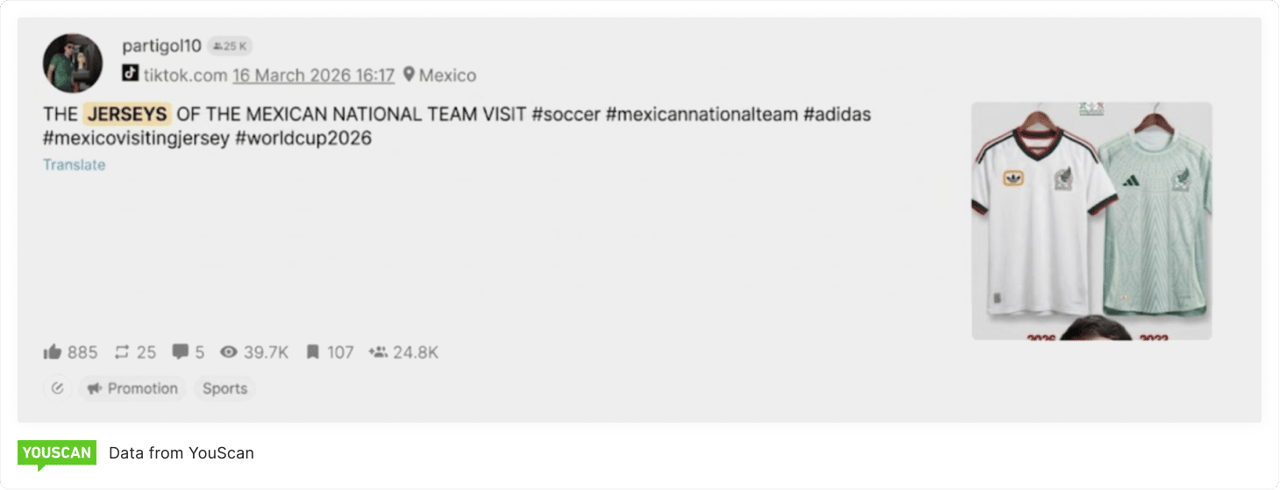
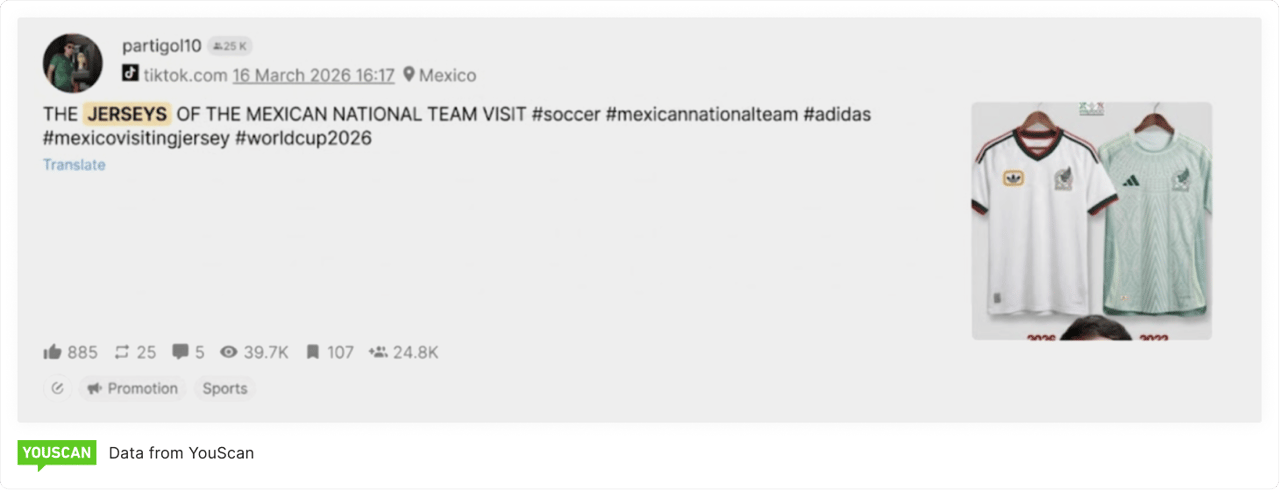
The jersey is portable identity. It is the most democratic product of the World Cup: it costs less than a ticket, it is worn in public, it lends itself to UGC. Retail and fashion brands not activating around the jersey are losing the most shareable cultural object of the tournament.
💡For the brand: If you sell anything that can be worn, used, or shown, the World Cup is your territory. If you don't sell clothing, create your own "jersey"—a cultural object associated with your brand that people can photograph, share, and use as a signal of belonging.
Insight 5: Guadalajara is the City that Will Define the Brand Narrative
The CJNG crisis in February left a mark in the data that won't disappear: Guadalajara appears associated simultaneously with violence AND resilience. Fans lining up for the Trophy Tour a week after the cartel blockades is the most powerful image of the pre-tournament. Brands with activations in Guadalajara have a binary choice: ignore the context (and look foolish) or recognize the resilience (and gain deep cultural credibility).
💡For the brand: If you activate in Guadalajara, do it with content from local voices, residents, merchants, fans of Chivas and Atlas who decided to stay and celebrate. Hyper-local authenticity is the only antidote to the international risk narrative.
Insight 6: The Largest Whitespace is the Fan Who Will Not Go to the Stadium
The cheapest ticket costs $60 USD. The most expensive, $8,680 USD for the final. The vast majority of Mexicans will experience the World Cup from their home, their corner bar, or a free Fan Fest. However, most brand activations are designed for the stadium fan—a minuscule segment.
The living room, the rooftop, the corner taqueria: these are the true venues of the 2026 World Cup for 30+ million Mexican homes. The brand that designs experiences for this fan has a massive market without competition.
💡For the brand: Create an activation that works in a living room with 8 people watching a match on a screen. You don't need the stadium. You need the shared moment.
Insight 7: Spanish Content has 3-5x Value due to the Binational Audience
Mexico is the bridge between LATAM and the 29 million US Hispanic fans. Content created for the Mexican fan, in Spanish, with local slang, and with authentic cultural references, has a natural, organic reach to the Hispanic community in the United States and to all of Latin America.
YouScan data shows it: mentions in Spanish and English coexist in the same conversational ecosystem, with constant crossover. A Mexican meme travels to Los Angeles in minutes. A TikTok from Querétaro (#1220) reaches Buenos Aires effortlessly.
💡For the brand: The ROI of producing high-quality Spanish content for the Mexican fan multiplies 3-5x when distributed on borderless platforms. Prioritize Mexican creators with binational audiences (MX + US Hispanic).
The 3 Decisions Every CMO Must Make Today
👍 DECISION 1: Choose your audience and hold the line. YouScan data shows three clear segments: the Critical Citizen (political, high volume, high risk), the Passionate Fan (emotional, medium volume, high purchase intent), and the Pragmatic Spectator (entertainment, low volume, the largest segment). Speaking to all three is speaking to none. Choose the Passionate Fan; they are the most commercially active and the least politically volatile.
👍 DECISION 2: Activate now; don't wait for the opening whistle. The Brand Health Pulse shows that the conversation is already at its peak. Brands building equity today (Corona, Bimbo, BBVA, Adidas) will arrive on June 11 with a cumulative advantage. Those waiting for the opening will compete with 150+ simultaneous campaigns for the same attention.
👍 DECISION 3: Implement a Social Listening Kill Switch. The Guadalajara crisis proved that a security event can contaminate World Cup conversation in 24 hours. Brands need a real-time monitoring protocol (like YouScan alerts) linked to a content pause workflow. If a crisis intersects your campaign territory, you have 2 hours to pause distribution. It’s not paranoia; it’s operational hygiene.
Closing: Mexico as the Most Complex and Rewarding World Cup Market
What YouScan data reveals about the 2026 World Cup conversation in Mexico is not a simple story of a "country excited about soccer." It is the story of a country that can have cartel blockades on a Tuesday and line up for a trophy selfie the following Friday. That criticizes FIFA with fury and puts on the jersey with devotion. That knows the Tri probably won't win and is still more excited than ever.
That complexity is not an obstacle for brands. It is the richest territory available. 3.4 million mentions. 222 million interactions. 222 thousand voices. The conversation is already happening. The question for every CMO is not whether they should enter, but if they have the intelligence necessary to know exactly where to plant their flag.
With the right social listening tools, the answer is in the data. You just have to know how to read it.
Data: YouScan Social Listening Platform | Period: January, Mar 24, 2026 | Topic: Mundial 2026 MX Analysis and insights: Alexis Soubran, CEO of Minimalist Agency | YouScan Ambassador Supplementary sources: Kantar "Between Goals, Brands & Fans"; Mitofsky/Ovaciones; CONCANACO SERVYTUR; WARC; Deloitte; FIFA Official Media
"This analysis is independent editorial content. It is not affiliated, sponsored, or authorized by FIFA or its official sponsors."