Social Listening ROI: The Formula, the Metrics, and the Business Case


There's a moment most social media leads hit eventually. Renewal is three weeks out, you're in a budget review, and someone from finance asks what the social listening subscription actually returns. You say something about brand awareness and understanding your target audience on social media. They nod politely. Then your line item quietly moves into the "review" column.
The social listening ROI question is fair, by the way. Every other line on that spreadsheet has to produce a number, so yours does too.
The pressure behind that question is measurable:
9.0%: marketing's share of company revenues, the lowest in several years (The CMO Survey, 35th edition)
81% of B2C marketing decision-makers already use social listening tools or a consumer intelligence platform (Forrester)
35.2%: the average share-price drop after a reputational crisis, with recovery taking well over a year (SenateSHJ Crisis Index 300)
Nearly everyone owns the tool, the money to keep it is tighter than it was, and missing something is expensive.
Most guides on this topic stop at benefits. They'll tell you social media listening helps you spot emerging trends and improve customer service, which is true and useless in a room with a CFO.
What's missing is the arithmetic: a formula, real numbers plugged into it, and a short list of metrics that survive a follow-up question. Whether you're defending an existing social listening strategy or funding your first one, the math is the same.
What is social listening ROI?
Social listening ROI is the return a team gets on the time and money spent on social media listening, measured by comparing the value it generates against what it costs to run. Value comes from three places: revenue or leads you attribute to social listening insights, costs you save, and costs you avoid. Cost covers the social listening tool plus staff hours. The result is a percentage that behaves like any other ROI figure on the budget.
The social listening ROI formula
Use this formula:
Social Listening ROI (%) = (Value Generated − Cost of Social Listening) / Cost of Social Listening × 100
It's the same shape as the ROI calculation used for influencer marketing campaigns, with "value generated" standing in for revenue, since the value isn't always a sale.
Value generated covers three buckets:
Revenue or leads attributed to relevant conversations you found
Cost saved through support deflection
Cost avoided by catching negative sentiment early or killing a doomed campaign before it ships
Cost has two parts:
What you pay for social listening tools
The staff time spent on it
That second part is where people cheat. If an analyst spends a day a week on this, that day belongs in the denominator, or finance will dismantle your number in ninety seconds.
A positive percentage means social listening generated more value than it cost. A negative one means it didn't. That figure is your company's ROI on listening, stated the way finance states everything else.
A worked example: calculating social listening ROI
The figures below are illustrative and rounded. They're not a real client's results. The structure is the part worth copying.
Say you're a mid-market brand running social listening across social media platforms, forums, and review sites for a year, with one analyst splitting time between social media management and analysis.
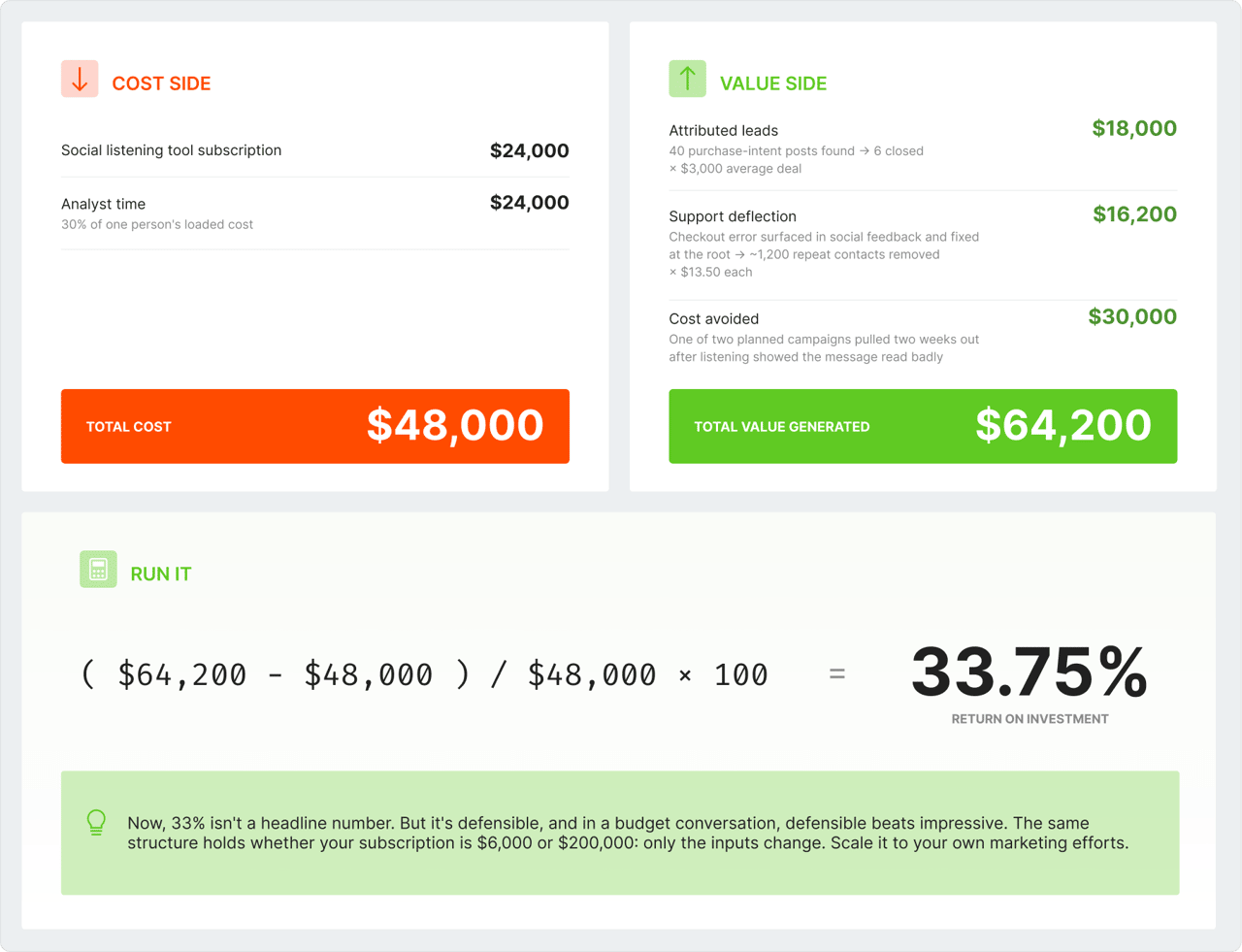
Cost side:
Social listening tool subscription: $24,000
Analyst time (30% of one person's loaded cost): $24,000
Total cost: $48,000
Value side:
Attributed leads: 40 potential customers found through social lead generation on purchase-intent social media posts, 6 closed, $3,000 average deal = $18,000
Support deflection: a checkout error surfaced in social media feedback and fixed at the root, removing roughly 1,200 repeat contacts at $13.50 each = $16,200 (Gartner puts the median cost per assisted contact at $13.50, versus $1.84 for self-service)
Cost avoided: one of two planned marketing campaigns pulled two weeks before launch after listening showed the message read badly with the target market = $30,000
Total value generated: $64,200
Run it: ($64,200 − $48,000) / $48,000 × 100 = 33.75%
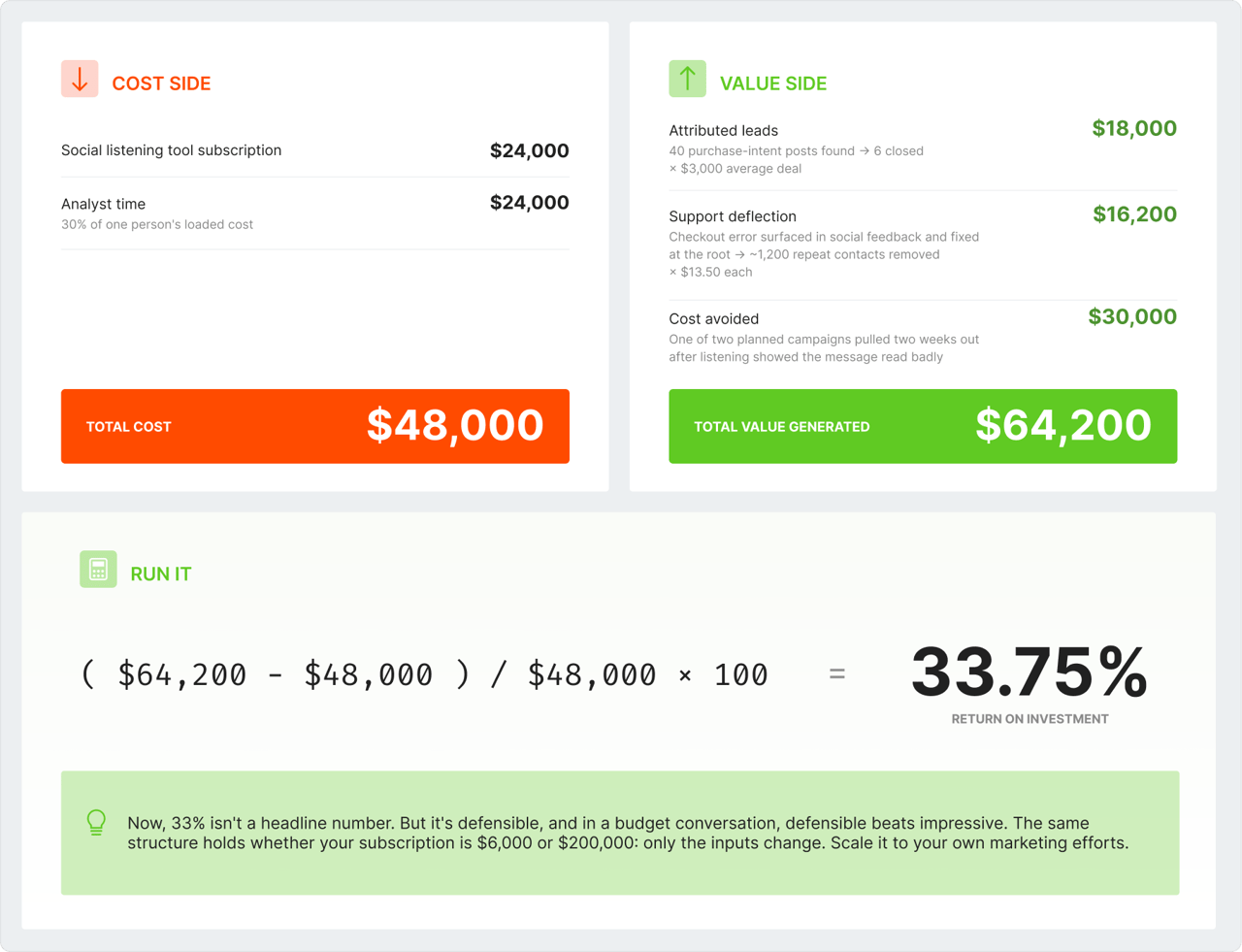
Now, 33% isn't a headline number. But it's defensible, and in a budget conversation, defensible beats impressive. The same structure holds whether your subscription is $6,000 or $200,000: only the inputs change. Scale it to your own marketing efforts.
Metrics that actually tie to ROI
Two kinds of metrics show up in social media listening reports, and confusing them is why so many ROI conversations fall apart.
Leading indicators move first and show direction. Business-outcome indicators carry a dollar figure, and only those belong in the "value generated" side of your formula.
Here's how they pair up:
Leading indicator (shows direction) | Business-outcome indicator should connect to |
Mention volume and brand mentions | Revenue generated or leads attributed to social media conversations |
Sentiment analysis output and brand sentiment | Customer retention or churn change in the affected segment |
Share of voice across social channels | Change in cost per acquired customer versus competitors |
Social media engagement and audience growth | Campaign effectiveness: cost per qualified lead |
Negative feedback clusters and complaint spikes | Support tickets deflected, plus cost avoided from an early catch |
Leading indicators: brand mentions, sentiment, and other data points
Mention volume, sentiment analysis output, and social media engagement are the data points you'll check weekly, and social media moves faster than your CRM does. They're useful during a pilot: they shift before revenue does.
What they can't do is prove value alone. "Our brand sentiment improved 8 points" invites the obvious follow-up: and? Without an answer, you're presenting a dashboard, not a case. Plenty of social listening efforts stall right here.
Business-outcome indicators: the numbers that carry business value
These are slower, harder to gather, and worth it: attributed leads, tickets deflected, retention change, cost avoided. Each connects to a number finance already recognizes. Don't present the two categories as interchangeable, or the leading indicators will discredit the rest.
Turning actionable insights into customer lifetime value
A note on attribution. You won't get clean end-to-end tracking here the way you would from paid media. Tag the conversations that led to an action, match them against conversions in Google Analytics, and be upfront that the link is directional.
Then go a layer deeper. Knowing which segments generate the most meaningful interactions tells you where customer lifetime value sits, and whether your actionable insights are landing on buyers or on people who'd never purchase.
Where social listening ROI shows up
Four places, mostly, and a mature social listening strategy touches all of them. We’d argue the cost-avoidance ones are undervalued precisely because they're invisible when they work.
Campaign and content strategy efficiency
You guess less at messaging when you can read how your audience describes the problem in their own words. A social media strategy anchored to what your target audience already says beats one built in a workshop. Content strategy built on real phrasing needs fewer revision rounds, and rounds cost agency hours. This is where social media marketing stops being instinct and targeted marketing strategies start running on evidence.
Audience segmentation and audience demographics


Not every segment deserves an equal budget. Social media data on audience demographics, occupations, and consumer preferences lets you split spend by who actually converts. Audience segmentation built from unprompted posts also beats survey panels on honesty, and it shows which slice of your target market carries the value.
Crisis cost avoidance and brand perception
Catching a negative social media narrative in week one costs a fraction of managing it in week four. That 35.2% figure is the version that reaches the board.
"A direct hit to the bottom line."
— Craig Badings, SenateSHJ, on the cost of a corporate crisis (Accounting Times)
Early PR crisis management protects brand reputation before brand perception shifts. Repairing it after costs far more.
Customer service deflection and service gaps
When the same complaint appears forty times in a week, you've found one of your service gaps. Fix the root cause or publish the workaround, and repeat volume drops. That's a straight cost saving, and one of the easiest numbers to defend because support already tracks contact volume. It tends to improve customer service and customer experiences at once.
Competitive research and influencer efficiency
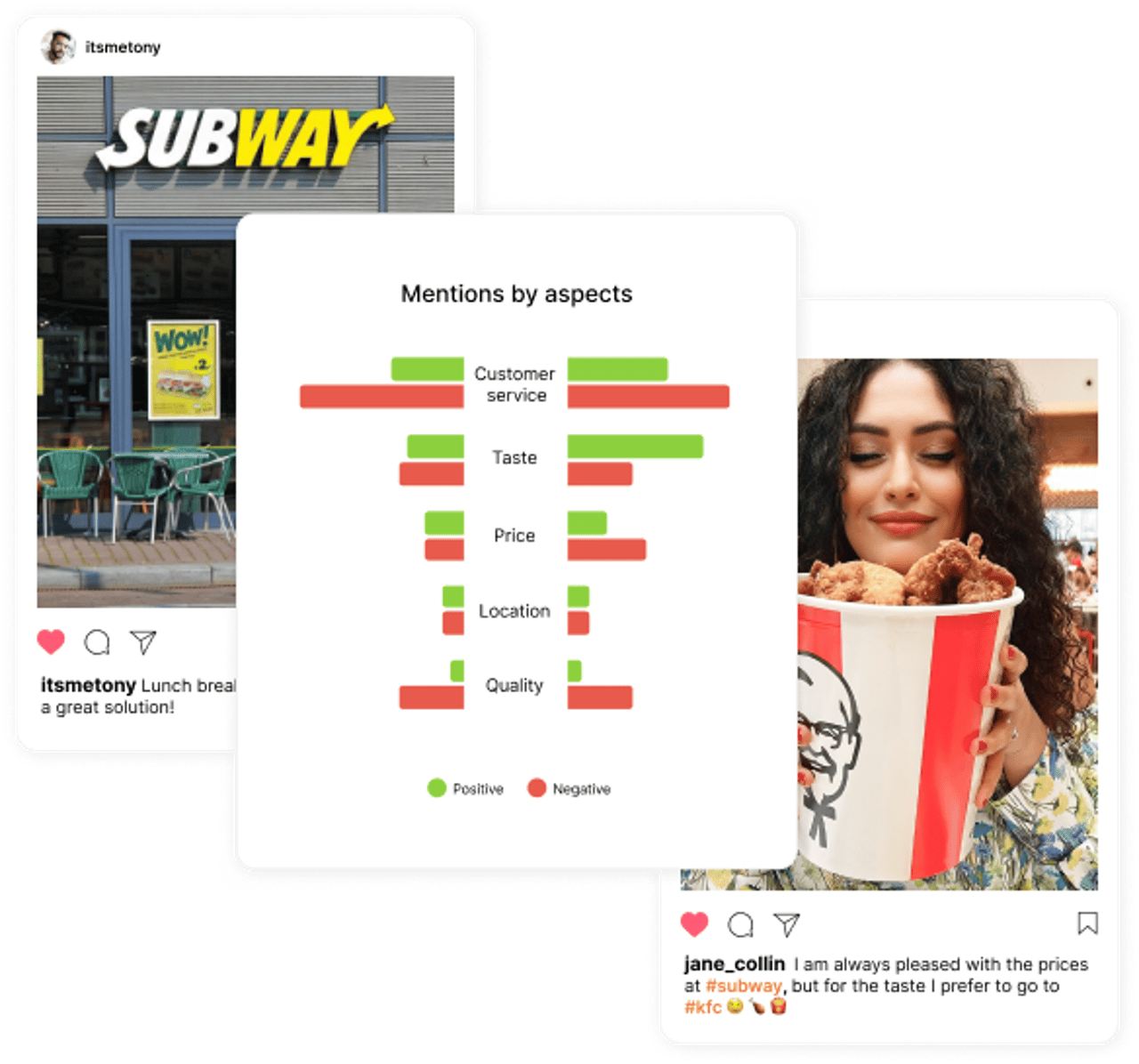
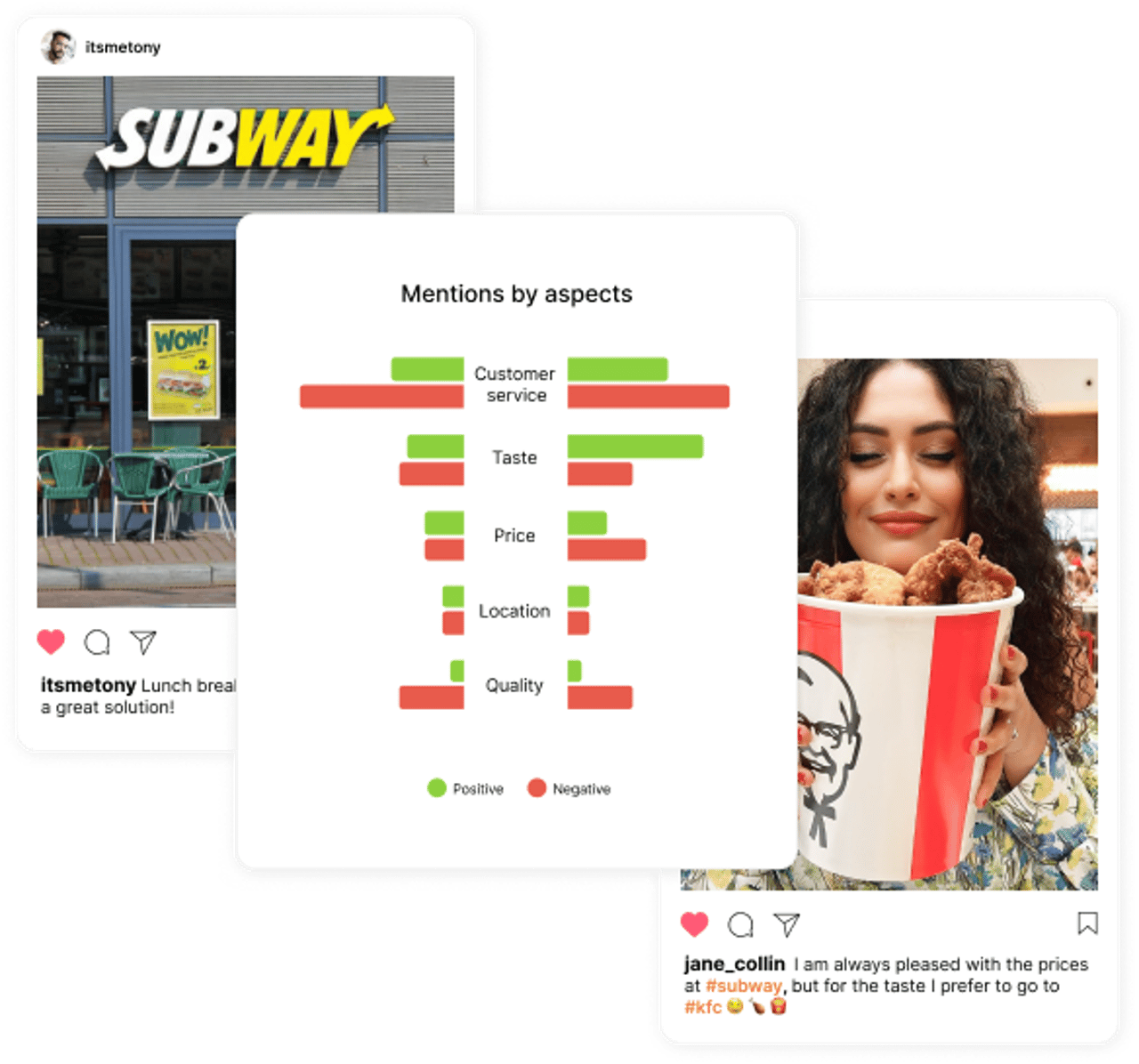
Competitive research through social listening shows you a rival's social media positioning shift or a category-wide move in industry trends before it reaches a report. Use the same data to identify influencers whose audience overlaps yours: influencer marketing gets expensive fast when the fit is wrong, and checking costs nothing.
How to build the business case for leadership
The reader most guides forget is the person who has to stand up and present this.
Five steps that tie social listening to business goals
Anchor to KPIs leadership already tracks. Map social data onto the business goals finance reviews anyway: acquisition cost, retention, support cost per ticket, customer lifetime value. Familiar numbers get less scrutiny than invented ones.
Pick 2 or 3 business-outcome metrics, not ten leading indicators. A dense dashboard looks thorough and defends badly. Two attributed numbers with a stated method hold up better than charts nobody reads.
Run the formula over a defined pilot period. One quarter usually shows direction without waiting a year. State the window so nobody assumes you cherry-picked months for your social listening strategy.
Show both sides: revenue growth and cost avoided. A crisis that didn't happen and a deflected support spike are often easier to defend than attributed revenue. Listening can decrease costs as readily as it lifts sales.
Revisit quarterly. A one-time number ages fast. Incorporating social listening into standing actionable reporting is what turns it into a normal budget line instead of an annual negotiation.
How to track the inputs without manual work
Most of the effort goes into gathering inputs, not analyzing them. Running sentiment analysis by hand and recalculating share of voice before every report eats the hours that should go into the case itself.
Analyzing online conversations across multiple platforms manually is also where accuracy slips, and a number your leadership team can poke a hole in is worse than none. Per the Forrester figure above, the data usually exists already. It's the assembly that hurts.
Most social media management tools report on your own social media accounts and stop there. Social listening covers everything else: the conversations happening about you where nobody tagged you.
Social media monitoring platforms like YouScan track this continuously across social accounts, forums, review sites, and news, including newer sources like Moltbook monitoring.
A few things that remove the manual step:
Insights Copilot answers questions straight from your data: "how has customer sentiment moved since launch?"
Social listening dashboards give other marketing teams performance insights without a manual pull
Continuous collection hands you data-backed insights rather than raw exports
With the right tools, social media monitoring runs in the background. YouScan won't calculate your ROI or do the attribution: that stays with your team. It makes the inputs continuous, which is what makes a social listening strategy survive its second year.
Make the number a habit, not a pitch
The ROI of social listening stops being a hard question the moment it has a formula, honest inputs, and two or three business-outcome metrics behind it. That's the whole trick: less satisfying than a benefits narrative, considerably more durable.
The teams that keep getting budget approved aren't the ones with the most social media data. They're the ones producing the same kind of number every other line item produces, quarter after quarter.
Your content marketing team already reports on lead generation this way, and so does everyone spending your social media marketing budget. Social insights deserve the same treatment.
Social media trends move faster than reporting cycles, so treat listening as a marketing tool you check weekly rather than a quarterly project that produces meaningful insights nobody reads in time. A detailed social listening strategy is really just that habit, repeated.
Two things worth bookmarking: the social listening glossary if you're still building vocabulary for these conversations, and a
social media audit to tell you what you're working with today.
Book a YouScan demo to see how automated mention, sentiment, and share-of-voice tracking feeds straight into your own ROI calculation.


Frequently asked questions (FAQs)
What is social listening ROI?
Social listening ROI is the return a team gets on the time and money spent on social listening across social media, measured by comparing the value it generates against what it costs to run. Value can include attributed revenue or leads, cost savings from deflected support tickets, or costs avoided by catching a reputation issue early. A positive ROI means social listening produced more value than it cost; a negative one means the reverse.
How do you calculate social listening ROI?
Use the formula: Social Listening ROI (%) = (Value Generated − Cost of Social Listening) / Cost of Social Listening × 100. Value generated includes attributed revenue or leads, support deflection savings, and estimated cost avoided from issues caught early. Cost includes what you pay for social listening tools plus staff time spent monitoring social media and acting on the data, not just the software line item. Run it over a defined period, such as a quarter, for a clean comparison.
What metrics prove social listening ROI?
Business-outcome metrics prove ROI directly: attributed revenue or leads, support tickets deflected, retention or churn change, and cost avoided from an issue caught early. Leading indicators like mention volume across social media, social sentiment analysis, and share of voice track the direction of your social listening efforts and build the pilot-period story, but they don't demonstrate dollar value on their own. Each needs connecting to a metric with business impact.
How do I present social listening ROI to leadership?
Anchor the case to KPIs leadership already tracks rather than introducing new metrics, and lead with 2–3 numbers that carry business impact instead of a dense dashboard. Run the ROI formula over a defined pilot period, such as a quarter, and present cost avoidance alongside growth, since a crisis that didn't happen is often easier to defend than attributed revenue. Revisit and re-present the calculation quarterly rather than treating it as a one-time pitch.