Aspect-Based Sentiment Analysis: The Complete Guide for 2026

Standard sentiment analysis tells you how people feel — positive, negative, neutral. But when a customer writes "The camera is incredible but the battery life is terrible," a single sentiment label misses the real story.
Aspect-based sentiment analysis fixes that. It's a natural language processing technique that breaks customer feedback apart, identifies the specific aspects being discussed, and assigns sentiment to each one individually. Instead of one overall sentiment score, you get a detailed map of what people love and what frustrates them.
This guide covers how aspect-based sentiment analysis works, the techniques and models behind it, real-world use cases, and how to get started.
What is aspect-based sentiment analysis?
Aspect-based sentiment analysis (ABSA) is a fine-grained natural language processing technique that identifies specific aspects within text data and determines the sentiment expressed toward each one. Unlike traditional
sentiment analysis — which assigns a single sentiment label to an entire document — ABSA provides a nuanced understanding of opinion. It can detect, for example, that a reviewer loves a restaurant's food but dislikes its service.
ABSA sits within the broader field of artificial intelligence and opinion mining. You'll also see it called aspect-level sentiment analysis, fine-grained sentiment analysis, or simply ABSA across relevant literature.
ABSA vs. traditional sentiment analysis
Here's the core difference in a quick comparative analysis:
Feature | Traditional Sentiment Analysis | Aspect-Based Sentiment Analysis |
Granularity | One overall sentiment per text | Sentiment per specific aspect |
Output | Single sentiment label (positive/negative/neutral) | Multiple aspect sentiment pairs |
Example | "This phone is great" → Positive | "Battery life → Positive, Camera → Negative, Price → Neutral" |
Actionability | Low — you know the vibe, not the details | High — you know exactly what to fix |
Best for | Quick pulse checks, large-scale sorting | Product improvement, CX programs, deeper insights |
Traditional approaches give you the overall sentiment. ABSA tells you why that sentiment exists — which specific aspects drive satisfaction or frustration.
Key subtasks of ABSA
ABSA breaks down into several core subtasks:
Aspect term extraction (ATE): Identifying aspect terms in a sentence. In "The battery life is excellent," the aspect term is "battery life."
Aspect category detection (ACD): Mapping aspects to predefined categories. "Battery life" maps to the aspect category "POWER."
Aspect sentiment classification (ASC): Determining the sentiment polarity toward each extracted aspect — positive, negative, or neutral.
Opinion term extraction (OTE): Identifying the opinion terms that express sentiment. In "The battery life is excellent," the opinion term is "excellent."
Aspect sentiment triplet extraction (ASTE): Extracting complete (aspect, opinion, sentiment) triplets — a newer subtask and active area of future research.
How aspect-based sentiment analysis works
ABSA follows a two-step pipeline: aspect extraction (identifying what people discuss) and sentiment classification (determining how they feel about each aspect).
Take this hotel review: "The room was spacious and clean, but the Wi-Fi was unreliable and the breakfast selection was disappointing."
Step 1 — Aspect extraction: The system identifies three specific aspects: room, Wi-Fi, and breakfast selection.
Step 2 — Sentiment classification: Each aspect gets a sentiment polarity label: room → positive sentiment, Wi-Fi → negative sentiment, breakfast selection → negative sentiment.
Now you have something actionable. The facilities team knows rooms are strong, IT knows the Wi-Fi needs work, and F&B knows breakfast needs attention.
Explicit vs. implicit aspects
Explicit aspects are directly named: "The camera takes great photos."
Implicit aspects are inferred from contextual words: "It fits in my pocket easily" implies size/portability without ever saying it. Implicit aspects are much harder for existing models to handle because they require understanding contextual information beyond surface-level text — which is why deep learning models and transformer-based approaches outperform older rule-based methods here.
Aspect-based sentiment analysis techniques and models
The technical landscape ranges from simple to sophisticated. Here's how the main approaches compare.
Rule-based and lexicon approaches
The simplest approach uses dictionary matching and syntactic structure analysis. You define known aspect terms, then use dependency relations and POS tagging to find connected opinion terms.
Limitations: No context awareness. "Long" is positive for battery life but negative for wait times. These methods also can't handle implicit aspects or complex sentences.
Machine learning models
Feature-engineered ML approaches (SVM, CRF, Random Forests) dominated ABSA research, especially in SemEval (semantic evaluation) competitions. These existing methods use hand-crafted linguistic features and syntactic features for aspect identification and polarity classification.
They established important benchmarks but are being replaced by deep learning in most real-world applications.
Deep learning and transformer models
Transformers changed everything for ABSA. BERT, RoBERTa, and DeBERTa can be fine-tuned on ABSA-specific training datasets to understand aspect-level sentiment within a single sentence. The key innovation is attention — the ABSA model learns which contextual words matter most for each aspect.
Some architectures also incorporate graph data structures to model syntactic information and dependency relations between aspects and their corresponding opinions, achieving significant performance over earlier existing approaches.
Key open-source options:
PyABSA — End-to-end ABSA framework with pre-trained models for aspect term extraction and sentiment classification across diverse datasets.
SetFitABSA (Intel Labs + Hugging Face) — Few-shot ABSA that matches the model's performance of fully fine-tuned systems using minimal labeled data.
DeBERTa v3 fine-tuned for ABSA — Available on the Hugging Face model hub; one of the strongest existing models for aspect sentiment classification.
Using LLMs for ABSA (GPT, Claude)
Large language models can perform ABSA through prompt engineering alone — no training dataset needed. You provide the input text, describe the task, and ask for a structured output of aspect sentiment pairs.
Advantages of such an approach: Zero labeled data required, works across domains, and handles implicit aspects reasonably well.
Limitations: Higher cost at scale, potential inconsistency, latency compared to fine tuned models. Best for prototyping and low-volume analysis where no labeled datasets exist.
Real-world use cases
ABSA has real-world applications across various industries. Here are the most impactful.
Product and customer review analysis
E-commerce and SaaS companies break down textual reviews by specific aspects — battery life, pricing, customer support, UI. Instead of a 3.8-star average, product teams see that users love the core product but are frustrated by onboarding. That deeper insight drives roadmap decisions.
Brand monitoring and competitive intelligence
Marketing teams use aspect-based sentiment to track how people discuss their brand versus competitors across
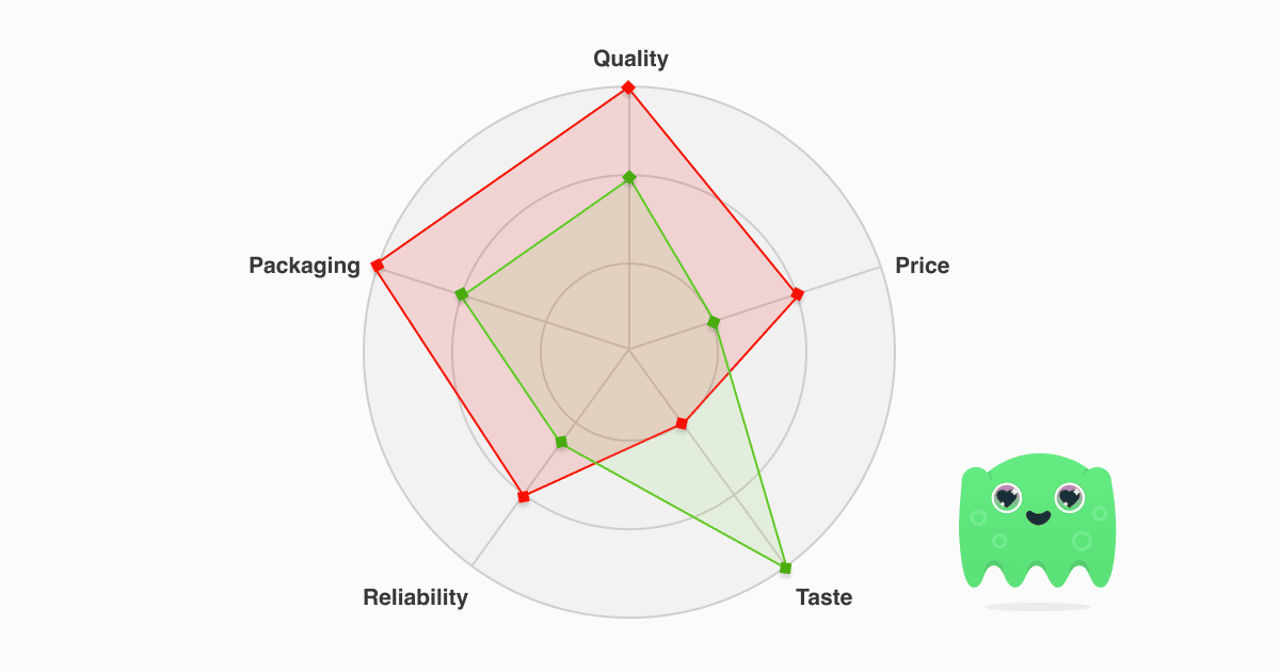
social media. A comparative analysis might reveal your brand wins on quality but loses on price perception — shaping messaging and positioning.
This is where a social listening platform makes a real difference. YouScan's aspect-based sentiment analysis automatically extracts aspects from social mentions, reviews, and forums, then visualizes sentiment trends with filters for geography, demographics, language, and source.


Instead of manually tagging thousands of mentions — which is time-consuming and expensive — YouScan's machine learning models handle the aspect identification and sentiment classification automatically, analyzing millions of mentions per day with 95% accuracy on sentiment detection.
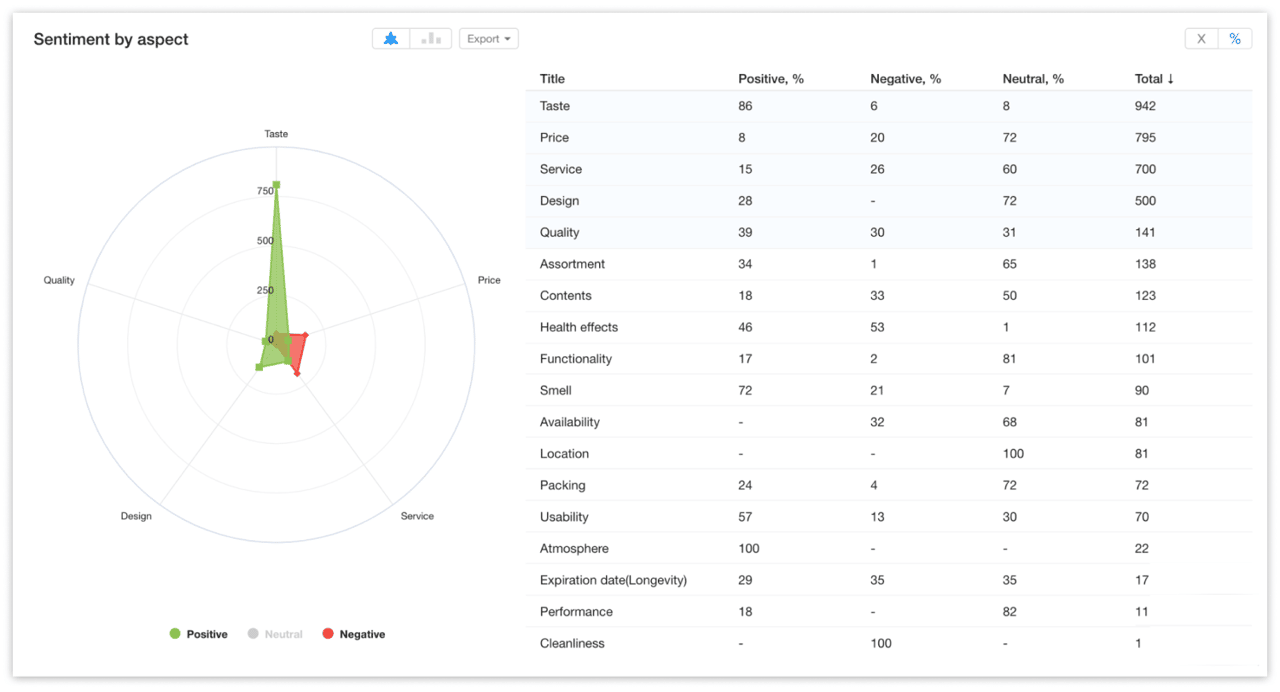
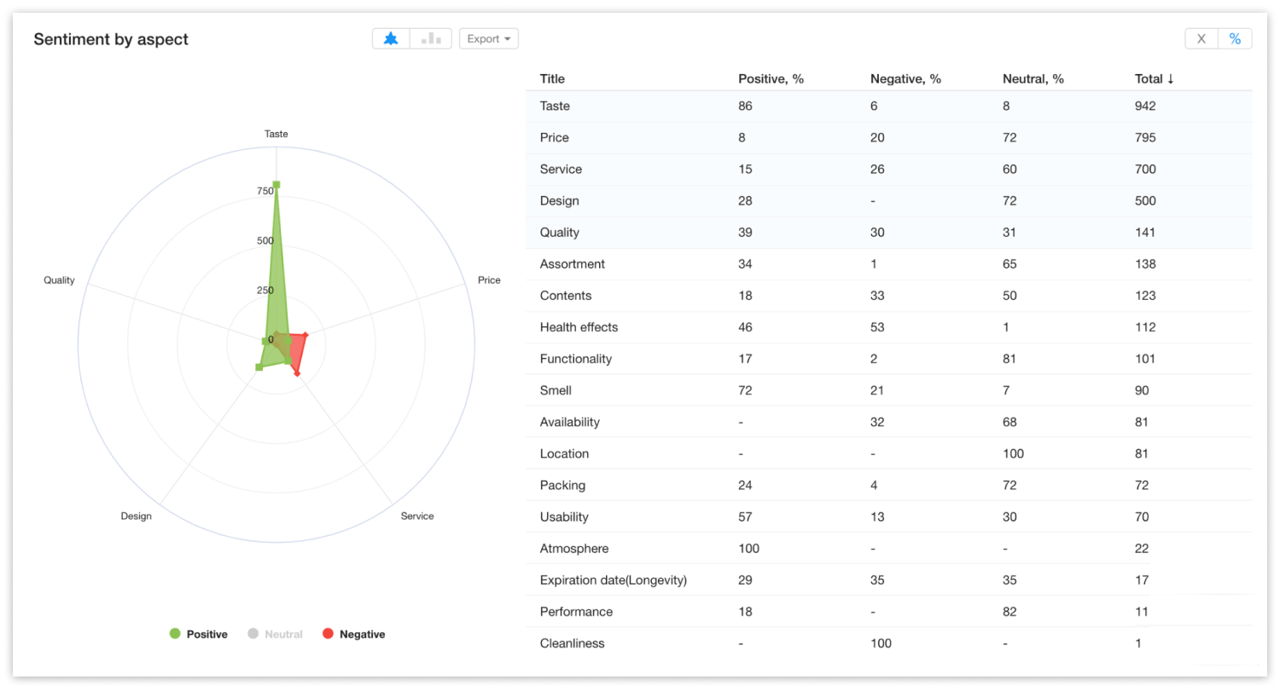
For example, a brand monitoring mentions through YouScan can instantly see that taste, price, service, design, and quality are the most-discussed aspects — and that (hypothetically) 26% of service-related mentions carry negative sentiment while design mentions are overwhelmingly positive. That kind of granularity turns raw social data into actionable business intelligence.
Other industries
Hospitality: Hotels analyze reviews by aspect (cleanliness, location, food, staff) to prioritize improvements.
Healthcare: Researchers analyze patient feedback to identify concerns about treatments or care quality.
Finance: Analysts extract sentiment toward specific entities from earnings calls and financial news.
How to get started with aspect-based sentiment analysis
Step 1 — Define your aspects
Figure out which specific aspects matter for your domain before touching any tool. For SaaS: onboarding, pricing, performance, support, integrations. For restaurants: food, service, ambiance, price, wait time.
YouScan comes with pre-built aspect categories — price, quality, design, taste, service, assortment, contents, smell, and more — that cover common consumer product dimensions out of the box. You can also create custom tags for domain-specific aspects using Smart Tags.
Step 2 — Choose your approach
No-code + social data → YouScan. Handles aspect extraction and sentiment classification automatically across social media, reviews, and forums. No ML expertise required.
Quick prototype → LLM prompting (GPT-4, Claude). No training data needed.
Custom model → Fine-tune a transformer (BERT/DeBERTa) using PyABSA or Hugging Face. Needs a labeled training dataset but delivers strong, consistent experimental results.
Narrow domain → spaCy + lexicon for rule-based prototyping.
Step 3 — Prepare your data
If building a custom ABSA model, the SemEval 2014 Restaurant and Laptop datasets are the gold standard benchmarks — cited in the majority of ABSA research. The MAMS dataset focuses on sentences where the same aspect or multiple aspects carry different sentiments.
If using YouScan, your text data is collected automatically from 500K+ media sources. The platform handles preprocessing, aspect extraction, and sentiment classification in one pipeline — you focus on analysis, not data wrangling.
Step 4 — Analyze and act on insights
Extracting aspect sentiment pairs only matters if you act on them. Track aspect-level sentiment over time, set up alerts for spikes in negative sentiment around a particular aspect, and feed insights into product, CX, and marketing decisions.
YouScan's dashboard templates (brand health tracking, customer experience, crisis management, competitor analysis) make it easy to visualize and share aspect-level data across teams. You can export graphs in PNG, PDF, XLS, or CSV, and set up automated rules — like getting emailed whenever negative mentions about a specific aspect spike.
Conclusion
Aspect-based sentiment analysis turns vague customer feedback into specific, actionable insights. Instead of guessing why your ratings dropped or what's driving positive buzz, ABSA shows you exactly which aspects of your product, service, or brand are resonating — and which ones need attention.
Whether you're a product team prioritizing your roadmap, a CX leader reducing churn, or a marketer sharpening your positioning against competitors, ABSA gives you the granularity to make smarter decisions faster.
If you want to skip the complexity of building custom models and start extracting aspect-level insights from social media, reviews, and forums right away, request a free YouScan demo. You'll see how the platform automatically identifies aspects, classifies sentiment, and surfaces the consumer insights that matter most to your business — no ML expertise required.
Frequently asked questions
What is aspect-based sentiment analysis?
Aspect-based sentiment analysis (ABSA) is a natural language processing technique that identifies specific aspects within text and determines the sentiment polarity toward each one. Instead of assigning a single sentiment label to an entire review, ABSA extracts individual aspect sentiment pairs — detecting, for example, that a customer loves a product's design but dislikes its price. This nuanced understanding makes it far more actionable than traditional sentiment analysis for improving products and customer experience.
How is ABSA different from regular sentiment analysis?
Traditional sentiment analysis assigns one overall sentiment (positive, negative, neutral) to an entire piece of text. ABSA goes further by decomposing text into its individual aspects and analyzing sentiment toward each separately. A review saying "Great camera but terrible battery life" gets a single "mixed" label from traditional tools — but ABSA extracts two distinct insights: camera → positive, battery life → negative. That specificity is what makes ABSA valuable for product teams and CX programs.
What are the best tools for aspect-based sentiment analysis?
For no-code social listening and review analysis, YouScan automatically extracts aspects and classifies sentiment from social media, forums, and reviews across 500K+ sources — with built-in dashboards and AI-powered insights. Other SaaS options include Thematic (VoC), SentiSum (support tickets), and Brandwatch (social listening). For developers, the top open-source libraries are PyABSA (end-to-end framework), SetFitABSA (few-shot learning), and Hugging Face Transformers (pre-trained ABSA models).
What are the biggest challenges of aspect-based sentiment analysis?
The major challenges include sarcasm detection (where surface words contradict actual sentiment), implicit aspect identification, domain dependency (models trained in one domain performing poorly in another), scarcity of labeled datasets, handling negation in complex sentences, computational cost of deep learning models, and limited multilingual support. These remain active areas of future research, though platforms like YouScan address several of these challenges — particularly multilingual analysis and domain adaptation — through their continuously trained machine learning models.